What Your Dog Does at Night While You Sleep, Explained
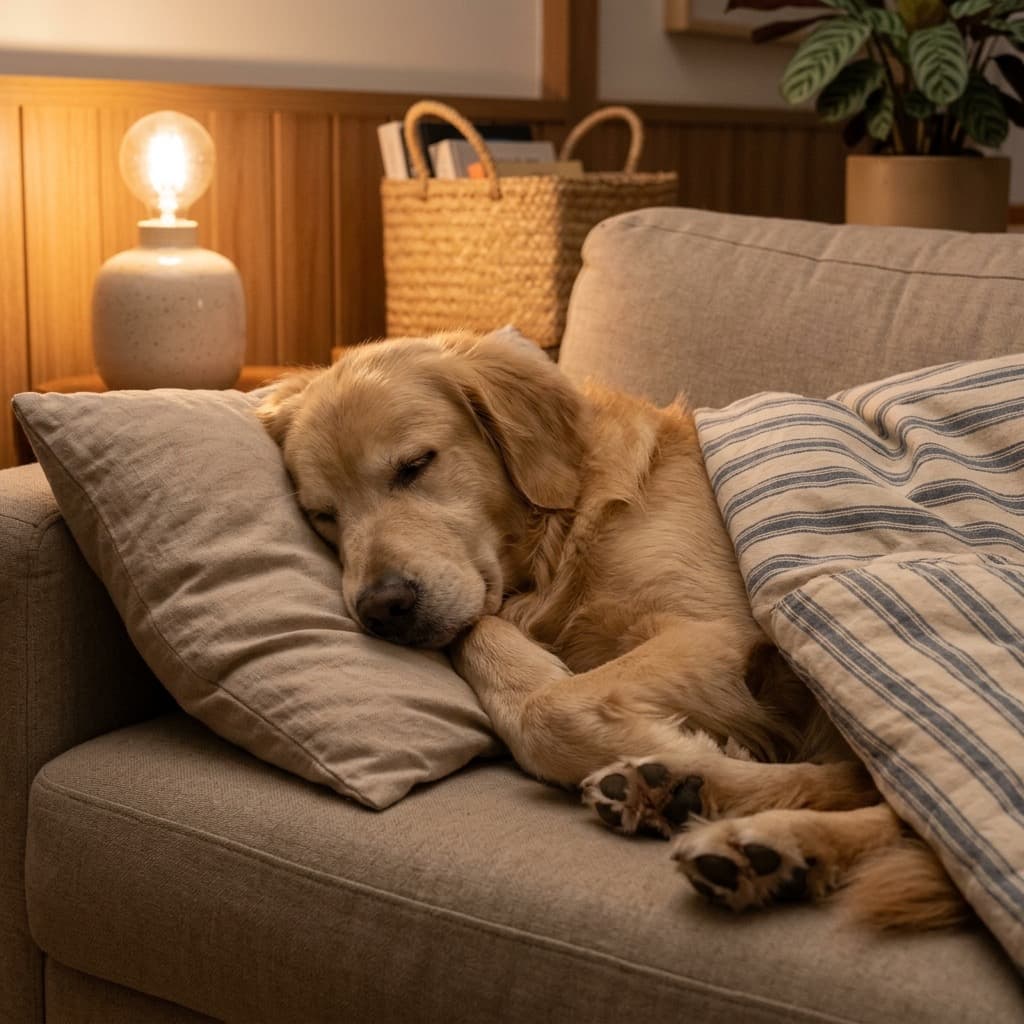
Dogs go through REM sleep — the same stage in which the brain relives the day's experiences — and paw movements and nighttime whimpers are signs of it, according to PetMD. This is healthy sleep, not a nightmare. At night, your dog also patrols, circles, switches spots and — a detail almost nobody notices — comes back to your side, which is the greatest proof of trust he gives you.
| Nighttime behavior | What it means |
|---|---|
| Moving paws and whimpering | REM sleep — the brain relives the day's experiences |
| Circling before lying down | Instinct inherited from trampling grass to make a nest |
| Switching spots in the middle of the night | Thermoregulation — looking for a cooler or warmer surface |
| Patrolling the house | Territory-watching behavior |
| Coming back to your side | A sign of bond and trust |
Why does my dog move and whimper while sleeping?
The dog that "runs in place" and mutters softly is in REM sleep, when the brain is as active as when awake and relives the day's experiences — like the walk or playing in the yard. It is normal, healthy behavior, not a nightmare, and it should not be interrupted.
Why he "runs in place" while sleeping
That moment when the paws move and he mutters softly happens in the deep sleep stage, the same one in which we dream. The dog's brain is active, reliving the day's walk or the play in the yard. It is normal, healthy sleep — a sign that he is resting deeply.
The golden rule: do not wake him. A dog suddenly woken in the middle of a dream can be startled and react by reflex, without recognizing you for the first second. Let the cycle finish on its own.
Circling and switching spots
Before lying down, many dogs turn in the same spot a few times. It is a legacy from ancestors who trampled the grass to make a safe nest at the right temperature. Today the rug is already ready, but the instinct remains intact.
In the same vein is switching spots in the middle of the night: he leaves the soft bed and goes to lie on the cold floor. It is not a rejection of comfort — it is thermoregulation. A dog's body heats up during sleep and he looks for a cool surface to balance his temperature. Offering a cool spot and a warm spot in the house solves this on its own.
Patrolling the house is watchfulness, not insomnia
Getting up in the middle of the night, taking a lap and checking the house is watchfulness behavior — the dog monitoring the territory while the pack (you) rests. In normal doses, it is just him being a dog.
It is worth raising the alert when the pattern changes suddenly: a dog that always slept through the night and starts wandering aimlessly, getting stuck in corners or barking alone in the middle of the night may be signaling pain, discomfort or, in older dogs, cognitive change. At that point the observation becomes a reason for a consultation — the same logic of timing and observation used in training applies to noticing changes in routine.
The behavior that is proof of trust
Of all the corners of the house, he chooses to come back to your side. Sleeping near you, leaning against you, is the dog treating you as part of his group — the place where he feels safe enough to lower his guard. This is the detail almost nobody notices and that says more about your bond than any play during the day.
What NOT to do
- Do not wake the dog in the middle of a dream (paws moving, whimpering). Wait for the cycle to finish; waking him with a start can trigger a reflex reaction.
- Do not force him to stay on the bed if he looks for the cold floor. Switching spots is regulating temperature, not disobedience.
- Do not ignore a sudden change in pattern. A dog that out of nowhere changes how he sleeps deserves observation — not a scolding.
Frequently asked questions
Do dogs really dream?
Yes. In the deep sleep stage the dog's brain is active, and paw movements and whimpers are a sign of it. It is healthy sleep.
Should I let my dog sleep in bed with me?
It is a routine choice, not a health one, as long as the dog sleeps well and has no joint problem. Seeking you out to sleep is a sign of a secure bond.
Why does my dog switch spots several times at night?
It is usually thermoregulation: he looks for a cooler or warmer surface as his body heats up during sleep. Normal behavior.
When does my dog's sleep become a cause for concern?
When the pattern changes suddenly — wandering aimlessly, barking alone, getting stuck in corners or reversing the day/night cycle. At that point a veterinary evaluation is worthwhile.
Why does my dog circle before lying down?
It is an instinct inherited from canine ancestors who trampled grass to create a safe, comfortable nest. The behavior persists even without any practical need.
Nothing he does in the dark is by chance: every turn, every whimper and every change of spot is instinct doing its job. Understanding this nighttime routine is the first step to taking better care of the whole day — and the right food is a big part of that care.
Picked by score from our overall dog ranking, not by the topic of this article. To get it right for your pet — age, weight, spayed or neutered — take the quiz and get a list made for them. A pet with a diagnosed condition needs a diet prescribed by a veterinarian.



