Dog Obedience Training: Timing, Markers and Rewards
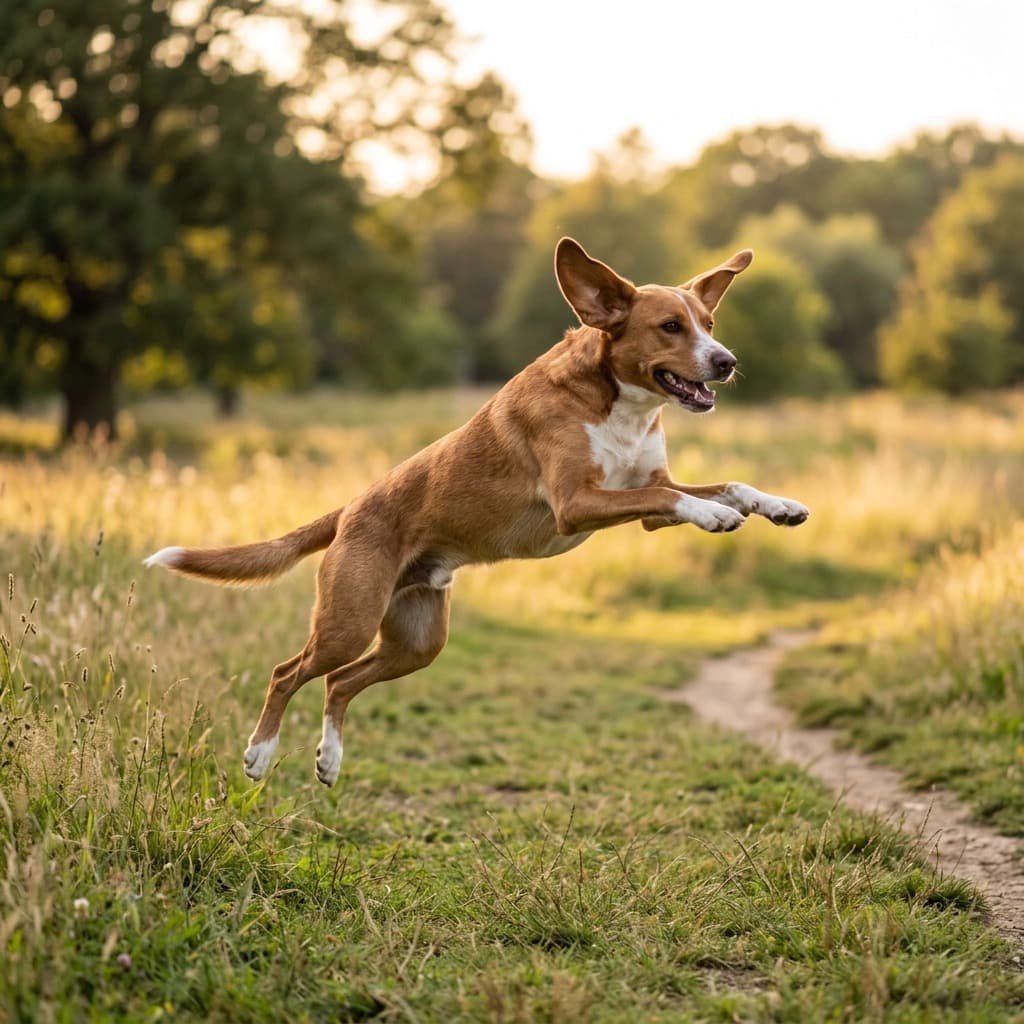
Dogs learn by immediate association: the canine brain links the behavior to what happened at that exact instant, not to the praise that arrived thirty seconds later. According to the American Kennel Club (AKC), positive reinforcement training is based on the science of animal learning — and, according to the animal welfare organization Four Paws International, the reward should ideally arrive within 2 to 3 seconds after the marker for the correct behavior so that this learning window stays open.
Your dog sits in the living room, but on the sidewalk he ignores the command as if he had never heard it. At the training class, the trainer speaks once and the dog performs right away. At home, you repeat it three times and nothing happens. What does that professional do differently?
It is not authority or a special gift. It is a mechanic with three components that have to happen in the right order — and any owner can learn it.
Why doesn't the dog obey even though he knows the command?
The dog's brain learns by immediate association: it links the behavior to what happened at that instant, not to what came thirty seconds later. When the praise is late, when the treat shows up at the wrong moment or when your tone of voice changes with every command, the dog has no way of identifying what he did right.
It is not stubbornness. It is the absence of a clear signal. He is trying to understand — and the signal that reaches him is not precise enough to teach.
The mechanics in three moves — in the right order
Trainers apply the same sequence every time, and it works because it respects how the dog's brain processes information.
| Move | What to do | Time window |
|---|---|---|
| 1. Timing | Capture the behavior at the exact instant it happens | Less than 1 second |
| 2. Marking | A single, always identical sound (clicker or fixed word) as a bridge between the behavior and the reward | Immediate, before the physical delay of the reward |
| 3. Immediate reinforcement | Deliver a treat, petting or toy that the dog finds valuable | 2 to 3 seconds after the marker |
Move 1 — Timing. Capture the behavior at the exact instant it happens. Did your dog sit? The signal comes now — not when he gets up, not when you finish the sentence. In everyday home practice, the owner tends to react late; the dog has already changed position and the reinforcement gets tied to the wrong position.
Move 2 — Marking. This sound has to mean one thing only: "that was it, the reward is coming now." Varying it ("good!", "well done!", "that's it!") dilutes the signal and the dog cannot identify the criterion.
Move 3 — Immediate reinforcement. According to Four Paws International, after that interval the learning window starts to close. In practice sessions, this means having the reward within reach before you start — not looking in your pocket after the dog has already performed the command.
Why yelling doesn't work
Repeating the command in a louder voice or punishing the dog for not obeying does not teach behavior — it creates confusion and stress. The dog that backs away in fear is avoiding the punishment, not performing the behavior. They are different results, and the second does not generalize to new environments.
According to the AKC, dogs trained with positive reinforcement actively look for ways to earn the reward and learn what is expected of them in each situation — the opposite of dogs trained with aversive methods, which the organization describes as less willing to learn and to try new things. In practice, this tends to produce weaker generalization: the dog trained only with punishment usually obeys mainly where the punisher is present.
What NOT to do
- Repeat the command several times. Each repetition teaches the dog to wait for the second or third call, not to respond to the first.
- Punish non-compliance. The dog that backs away in fear has not learned the behavior — he is avoiding the punishment. It is not the same result, and it does not generalize.
- Use intermittent reinforcement without intent. Rewarding sometimes yes, sometimes no (with no clear criterion) only works to maintain behaviors already learned — not to teach them.
Frequently asked questions
Do I need a clicker or can I use a word?
Either one works. The clicker is more precise because the sound is always identical. A word like "yes!" works well as long as it is always used in the same tone and never outside the training context.
How long should a session last?
5 to 10 minutes at a time, two or three times a day. Short sessions keep the dog's focus — long training sessions yield less and end with both of you tired.
My dog is already an adult. Can I still teach him?
Yes. Adult and senior dogs learn well with positive reinforcement — sometimes more easily than puppies, because they have greater concentration. The method works at any stage of life, including for dogs that already carry behavior myths such as "you can't teach an old dog new tricks".
Does the method work with high-energy dogs?
It does. More agitated dogs need even shorter sessions and an environment with fewer distractions at first. The progression is gradual: train at home before training outside.
Why does my dog obey at home but not outside?
The behavior has not been generalized yet. Each new environment is, to the dog, a different context — he needs the criterion to be taught there too. The correct progression is: train at home → train in the yard → train on the sidewalk with few stimuli → train with progressive distractions.
The same mechanics that seem like a trainer's secret are, in practice, a clear sequence: capture the behavior at the exact moment, mark it with a consistent sound, reward in under 2 seconds. Timing + marking + immediate reinforcement — in that order, always.
No special equipment, no dominance techniques. Just precision and repetition. If you want to find out which other aspects of your dog's routine deserve attention — including feeding and well-being — the quiz below helps map that in under two minutes.
Picked by score from our overall dog ranking, not by the topic of this article. To get it right for your pet — age, weight, spayed or neutered — take the quiz and get a list made for them. A pet with a diagnosed condition needs a diet prescribed by a veterinarian.



