How Dog Breeds Have Changed Their Bodies Since 1915
You look at an old photo of a purebred dog and something seems off, though you cannot point to what. The body looks different, even though the breed name is the same as ever. It is not your imagination.
In 1915 a book called Dogs of All Nations photographed purebred dogs in profile, standing, full body — the standard portrait of the time for documenting each breed. A hundred years later, you can repeat exactly the same pose with the descendants of those breeds. Laying the two photos over each other, four of them show the most striking change of body: the Bull Terrier, the Dachshund, the Boxer and the German Shepherd.
Bull Terrier: from a head with a step to the egg head
In the 1915 photo, the Bull Terrier has a straight head, with a clear step between the forehead and the muzzle — the profile common to any terrier of the time. In today's photo, that step has disappeared: the forehead slopes down to the tip of the nose in a single curve, with no break at all. It is the "egg head" that became the trademark of the current breed, and it only exists because it was selected for, generation after generation.
Are the Dachshund and the Basset Hound the same breed?
No. The low-slung dog in this comparison is the Dachshund. And here a distinction is worth making that the 1915 book itself makes clear: besides the Dachshund, the work also includes the French bassets, in smooth-coated and wire-coated varieties. What does not appear anywhere in it is the English Basset Hound, the long-faced, big-eared dog most people picture when they hear the word. Three different dogs; two of them share the French root "basset," which means low.
In the old photo, the Dachshund is already low, but its legs still lift the body off the ground — you can see daylight under the belly. In today's photo, the torso runs almost level with the floor, with very little space between the belly and the ground.
Boxer: shorter muzzle, wider chest
In 1915, the Boxer has a longer muzzle and a narrower body. In today's photo, the face is shorter and flatter, and the chest has gained width. It is the same direction of change that marked other short-muzzled breeds over the century.
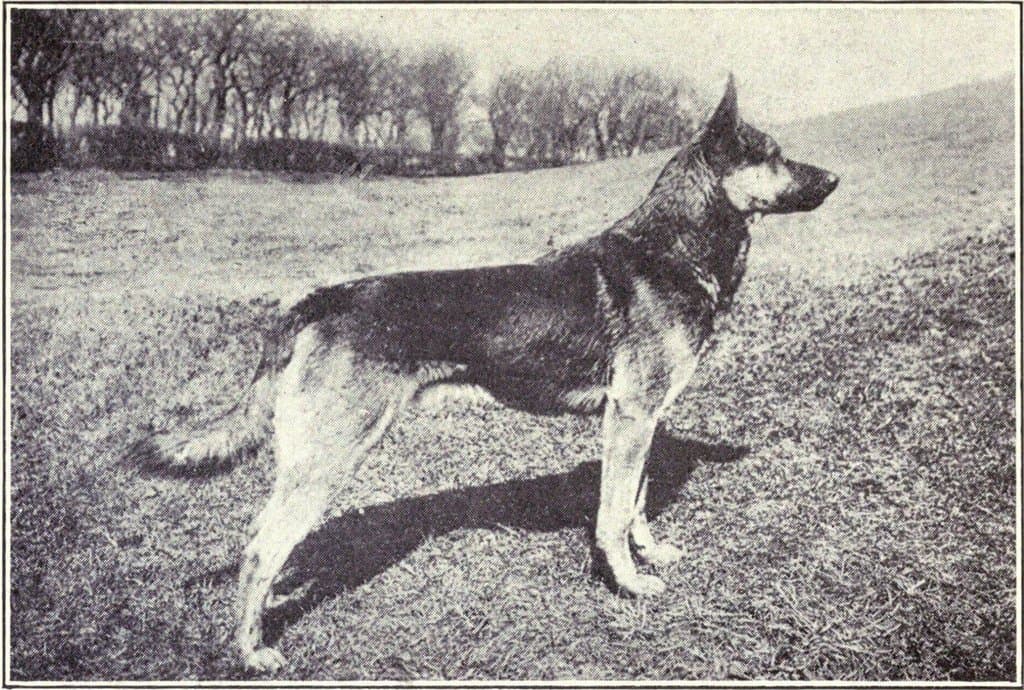
German Shepherd: from a straight line to a slope
In 1915, the German Shepherd's back line is straight from the neck to the tail, and the hind legs sit almost under the body. In today's photo, that line drops in a slope toward the tail, and the hind leg extends much farther out — an angle the old photo simply does not have.
What changes between the 1915 photo and today's photo
| Breed | What the 1915 photo shows | What today's photo shows |
|---|---|---|
| Bull Terrier | Straight head, with a clear step between forehead and muzzle | Egg head, a single curve with no break from forehead to nose |
| Dachshund | Short legs, but with visible space between the belly and the ground | Torso almost level with the floor, very little space to the ground |
| Boxer | Longer muzzle, narrower body | Shorter, flatter muzzle, wider chest |
| German Shepherd | Straight back line from neck to tail, hind legs almost under the body | Back line sloping to the tail, hind leg extended outward |
What these photos do NOT prove
The two photos, side by side, show a silhouette — not a measurement. You cannot extract a percentage, a millimeter or "how much" something changed from a visual comparison of images from different eras, taken with equipment, light and angle that are not identical. What can be stated is what appears in each portrait: the 1915 photo shows one silhouette, today's photo shows another.
That said, the direction of change in these four breeds — a more extreme body, whether in a shortened muzzle, in leg length or in the angle of the joints — is something that breed standards pushed to the extreme have generated debate about among veterinarians, especially when the final shape can affect the animal's breathing, mobility or spine. A study on craniofacial morphometry in popular brachycephalic breeds discusses exactly this point: using the measurement of muzzle shape as a tool for veterinary prevention, not as an accusation against any breeder.
Frequently asked questions
Why have purebred dogs changed so much in appearance in a hundred years?
Because each breed's standard is decided by clubs and breeders, and that standard can be adjusted over time — prioritizing one trait (a rounder head, a shorter muzzle, a more angular back) generation after generation. The accumulated result of decades of selection shows up clearly when you compare an old photo with a current one.
Has the Bull Terrier always had that egg-shaped head?
No. The 1915 photo shows a straight head profile, with a step between forehead and muzzle, common to the terriers of the time. The single, unbroken curve that marks the breed today is the result of later selection — it is not how the Bull Terrier started.
Are the Basset Hound and the Dachshund the same breed?
No. The Dachshund is of German origin. The Basset Hound is an English breed, with long ears and a long face. And there is also a third group, the French bassets — those are indeed present in the 1915 book, in smooth-coated and wire-coated versions. The English one is the only one of the three that does not appear in the work.
Is a breed standard that is too extreme bad for the dog?
It is a point discussed by veterinarians, not a settled rule. The focus is on structures that can compromise function — a very short muzzle and breathing, for example. A recent scientific publication proposes precisely measuring muzzle shape in brachycephalic breeds as a tool for veterinary prevention, which shows that the topic is still under study, with no single verdict for every breed or every individual.
Want to know which breed fits your household's routine today, just as it is? Take the our quiz and get a personalized recommendation.
Picked by score from our overall dog ranking, not by the topic of this article. To get it right for your pet — age, weight, spayed or neutered — take the quiz and get a list made for them. A pet with a diagnosed condition needs a diet prescribed by a veterinarian.



