Dog With No Teeth: What to Feed and How to Soften Kibble
Notice: this content is for information only and does not replace a visit to the veterinarian. If your pet has symptoms, see a veterinarian before acting on this article.
Mouth disease is very common in dogs, and missing teeth do not make a complete diet optional. The MSD Veterinary Manual reports that up to 80% of dogs have periodontal disease by 3 years of age. In our catalog, the 5 senior dog foods range from 3,416 to 3,674 kcal/kg.
This guide covers what changes at mealtime, when the mouth calls for a vet visit before any food change, and how to compare the senior foods in our catalog.
Can a dog with no teeth eat dry food?
It depends on the dog and how many teeth are left, and the veterinarian is the one who assesses that. What is safe to say: missing teeth do not make a complete food optional. The dog still needs a complete and balanced diet, and what changes is the form in which it reaches the mouth.
So the right question is not "which human food replaces kibble" but "how can he eat the food that already covers his nutrients." A dog that eats slowly, drops food or gives up halfway through the bowl is sending a signal, and the signal deserves attention.
How do you soften kibble without losing nutrients?
The idea is the same as with dry food: keep it complete and change only the texture. Owners generally hydrate the kibble with warm water, never hot, and serve it right away. Among the veterinary sources we use on the blog, we found none that sets a soaking time or a water ratio, so we do not give those numbers.
Three precautions apply to any dog:
- Offer only what he will eat right away. Moistened food spoils faster than dry.
- Keep the daily portion. Softening changes the texture, not the amount of food the dog needs.
- Watch the bowl. If he keeps leaving food even after it is softened, it is now a case for the vet.
For the right portion of each food, use the site calculator, which works from the dog's weight and the food's calories.
When do missing teeth call for a vet visit before changing food?
Any time the dog loses teeth suddenly, eats less or seems to be in pain. Periodontal disease is very common in the species: the MSD Veterinary Manual reports that up to 80% of dogs have it by 3 years of age. Only the veterinarian examines the mouth and says whether there is a problem to treat.
For that reason, changing the food without a veterinary exam can leave a mouth problem untreated. Why a particular dog is missing teeth is something to take to the veterinarian, not to decide at home.
Which senior dog food should you choose for a dog that chews little?
The senior foods in our catalog all fall between 3,416 and 3,674 kcal/kg. A dog that eats less gets its calories from a small portion, so energy density and protein are worth comparing. The table below lists the five senior-labeled foods in our catalog, with catalog data.
| Dog food | kcal per kg | Crude protein (min) | Bag size | $ per lb |
|---|---|---|---|---|
| Blue Buffalo Life Protection Formula Senior 7+ Chicken & Brown Rice | 3,416 | 18% | 5 lb | 2.99 |
| Nutro Natural Choice Senior Chicken & Brown Rice | 3,494 | 26% | 30 lb | 2.50 |
| Blue Buffalo Life Protection Formula Small Breed Senior Chicken & Brown Rice | 3,532 | 23% | 5 lb | 2.99 |
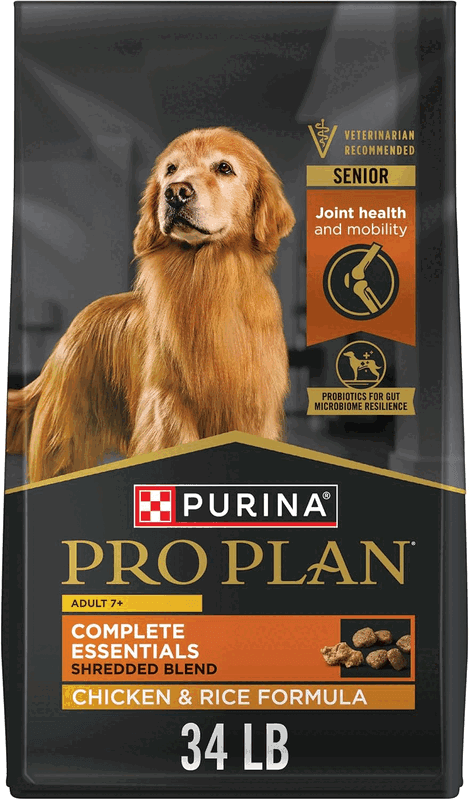
| Purina Pro Plan Complete Essentials Senior Chicken & Rice | 3,672 | 29% | 34 lb | 2.28 |
| Purina ONE +Plus Vibrant Maturity Senior 7+ Chicken | 3,674 | 28% | 8 lb | 2.08 |
Price is the average collected by the site and changes over time. Kibble size and how easily each food softens are not in the catalog, so those two points are left to the label and the veterinarian. Check the life-stage statement on the label (AAFCO "complete and balanced" for the right life stage) and your veterinarian's guidance before buying. For the full list, open the ranking of dog foods for senior dogs.
Frequently asked questions
Can a dog with no teeth eat only wet food?
There may be a reason for it in some cases, but the choice depends on the dog and on what the veterinarian finds in the mouth. A complete and balanced food remains the standard, whether dry, softened or wet.
Does a senior dog that loses teeth need senior dog food?
The dog's age and health set the food, not just the teeth. The senior lines in our catalog run from 3,416 to 3,674 kcal/kg and serve as a point of comparison. The veterinarian decides the diet of a dog with mouth disease.
Can homemade food replace kibble?
Not without veterinary guidance. Homemade food without supervision can leave the diet incomplete, and a dog with no teeth still needs every nutrient.
A dog with no teeth does not need panic, it needs attention to the mouth and a food he can manage to eat. Once the vet has looked into the cause, adjusting the texture is a simple step.
Picked by score from our overall dog ranking, not by the topic of this article. To get it right for your pet — age, weight, spayed or neutered — take the quiz and get a list made for them. A pet with a diagnosed condition needs a diet prescribed by a veterinarian.