Does Light Dog Food Work? What to Check Before Buying

40.5% of the dogs evaluated in the city of São Paulo, Brazil, were overweight or obese, according to a study published in Scientific Reports (Prevalence of canine obesity in the city of São Paulo, Brazil). In the US catalog we analyzed, the 4 light dog foods range from 3,189 to 3,578 kcal/kg, against up to 4,075 kcal/kg in regular adult foods.
A "light" label means less energy per kilo, and nothing more. This guide shows how much less, where the light range overlaps with regular foods, and what to do in practice: measure the portion, count the treats and switch foods gradually.
Does light dog food make a dog lose weight?
Light food delivers less energy per kilo, but the day's balance is set by how much the dog eats. The same bowl of light food has fewer calories than a bowl of regular food; a bigger bowl, extra treats and table scraps erase the difference. The food helps, and the day's math decides the result.
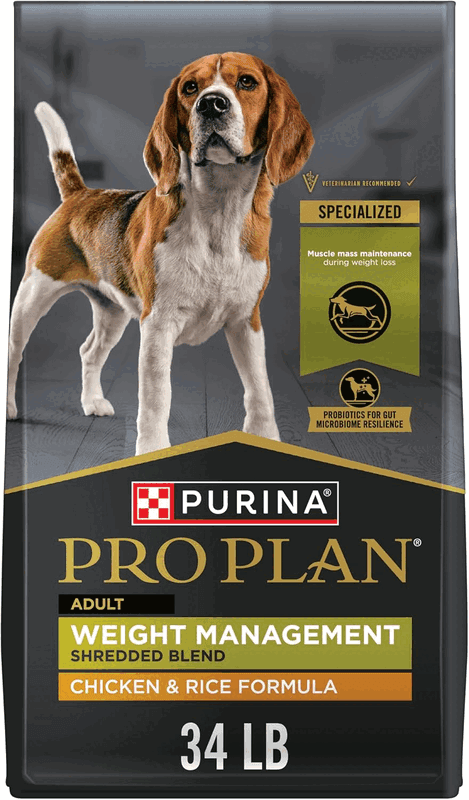
Take one brand. Purina Pro Plan Complete Essentials Shredded Blend Chicken & Rice has 3,790 kcal/kg and Purina Pro Plan Weight Management Chicken & Rice has 3,578 kcal/kg: the same scoop of the light formula has about 6% less energy. For a 10 kg adult dog, the catalog's portion calculator gives 141 to 163 g a day of the regular formula and 149 to 173 g of the light one, for the same maintenance energy. In other words, light food earns you a few more grams a day, not a full bowl without counting.
The São Paulo study points to where weight tends to slip. Its authors found a positive association between the dog's body condition score and "higher snack intake" (P = 0.011), and also with the owner eating more snacks. That is association, not proof of cause, but it fits daily practice: switching foods while keeping the treat bag open does not change the score.
A dog that really needs to lose weight needs a target weight and a portion in grams set with the veterinarian. In this guide, light food is only one piece.
How many fewer calories does light dog food really have?
On average, about 11% fewer. The 4 light dog foods in the catalog average 3,334 kcal/kg; the 30 regular adult foods with declared energy average 3,727 kcal/kg. But the ranges overlap: regular adult foods start at 3,469 kcal/kg, so the most caloric light food (3,578 kcal/kg) sits above 3 of those 30.
Fiber is where light food stands out most clearly. Across the 4 light foods, protein averages 23.5% and fiber 10.4%, as-fed values from the guaranteed analysis , against 27.0% protein and 4.0% fiber in regular adult foods. The table lists the 4 light foods in the catalog.
| Dog food | kcal/kg | Protein | Fiber | USD/kg (avg) |
|---|---|---|---|---|
| Purina Pro Plan Weight Management Chicken & Rice | 3,578 | 27% | 5.5% | $5.03 |
| IAMS ProActive Health Healthy Weight Chicken | 3,380 | 20% | 5% | $3.55 |
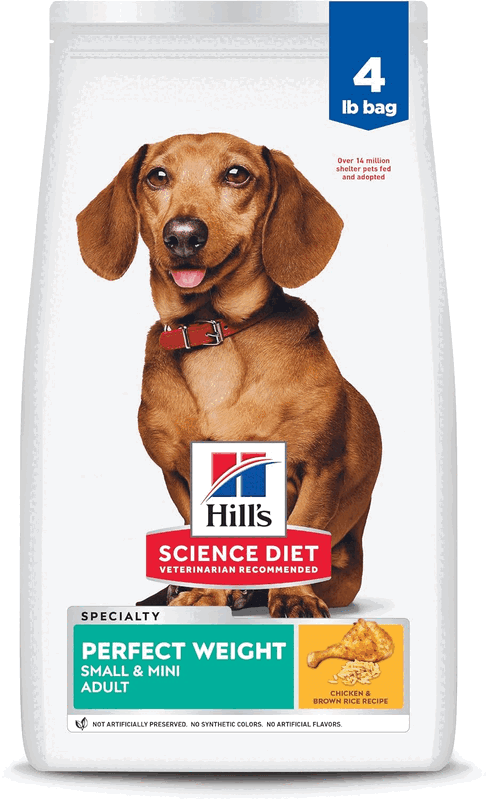
| Hill's Science Diet Perfect Weight Chicken & Brown Rice | 3,189 | 23% | 18% | $8.20 |
| Hill's Science Diet Adult Perfect Weight Small & Mini Chicken & Brown Rice | 3,189 | 24% | 13% | $14.88 |
Price is the catalog average divided by bag weight, and it changes by store and bag size. Protein and fiber are the guaranteed analysis values, as fed. To see the dog foods side by side with scores, open the dog food ranking.
Two things to check on the bag before buying. The first is kcal/kg: if it is close to a regular food's, the "light" label changes little. The second is the portion: the amount for weight loss, calculated on the target weight, is set with the veterinarian.
Is light dog food right for a neutered dog?
It can be, but neutering alone does not pick the food. In the São Paulo study, "the prevalence of overweight and obesity was greater in female dogs ... and in dogs that were neutered". The authors list "reproductive status" and "snack intake" among associated factors. Association does not prove that surgery causes weight gain.
The US catalog has no category specific to neutered dogs, so there is no neutered-food calorie figure to compare here. Read kcal/kg on the label rather than trusting a "neutered" or "spayed" name, the same check that applies to "light".
For a neutered dog already at a healthy weight, a food at the lower end of the calorie range in a measured portion may be enough. For a dog that is already overweight, the conversation is about target weight, portion and follow-up, and the food is just one item on that list.
How do you switch foods without the dog going hungry?
Switch gradually and measure the portion. The American Kennel Club (AKC) says: "Ideally, these transitions should happen over 5-7 days." Its schedule mixes the new food into the old: 25% new on day 1, 50% on day 3, 75% on day 5 and 100% on day 7.
Two habits make the switch go well. The first is to weigh the food on a scale, not in a cup, because light food has fewer kcal per gram and the portion in grams changes. The second is to count the treats: the World Small Animal Veterinary Association (WSAVA) states that "Treats should always make up less than 10% of a dog’s daily calorie intake." In its table, a 10 kg dog's ceiling is 47 kcal a day from treats, less than the 75 kcal of one digestive biscuit, an example from the same document.
The AKC (How to Switch & Transition Dog Foods) warns that switching abruptly "can cause gastrointestinal upset, such as vomiting, diarrhea, and a decreased appetite." It adds that "Some dogs with sensitive stomachs, food allergies, or other gastrointestinal conditions may need a longer transition period." If your dog shows concerning signs during the switch, slow down and talk to your veterinarian. To work out your dog's portion with the food you chose, use the cost and portion calculator.
Frequently asked questions
Can I mix light dog food with what my dog already eats?
Yes, mixing is exactly the transition the AKC describes. Start with 25% new food and 75% old, move to 50/50, then 75/25, and reach 100% in 5 to 7 days. Dogs with sensitive stomachs may need more time.
How many treats can I give during a diet?
WSAVA says treats should stay under 10% of the dog's daily calories. In its table, a 10 kg dog has a ceiling of 47 kcal a day from treats, and a 20 kg dog 79 kcal. Treats count toward the day's total; they are not extras. If a treat label shows no calories, WSAVA advises contacting the manufacturer.
Does the São Paulo study prove that neutering makes a dog fat?
No. The authors report an association between neutering and a higher prevalence of overweight and obesity, but the study does not establish cause. The decision on food, portion and target weight for a neutered dog belongs to the veterinarian.
Light dog food works as a tool, not as a solution. Check the kcal/kg, weigh the portion, count the treats and agree on a target with your veterinarian.
Relevant to the topic of this article. You can narrow it down further by your pet's profile in the quiz.