3 Cat Breeds That Had a Job Before Becoming House Pets
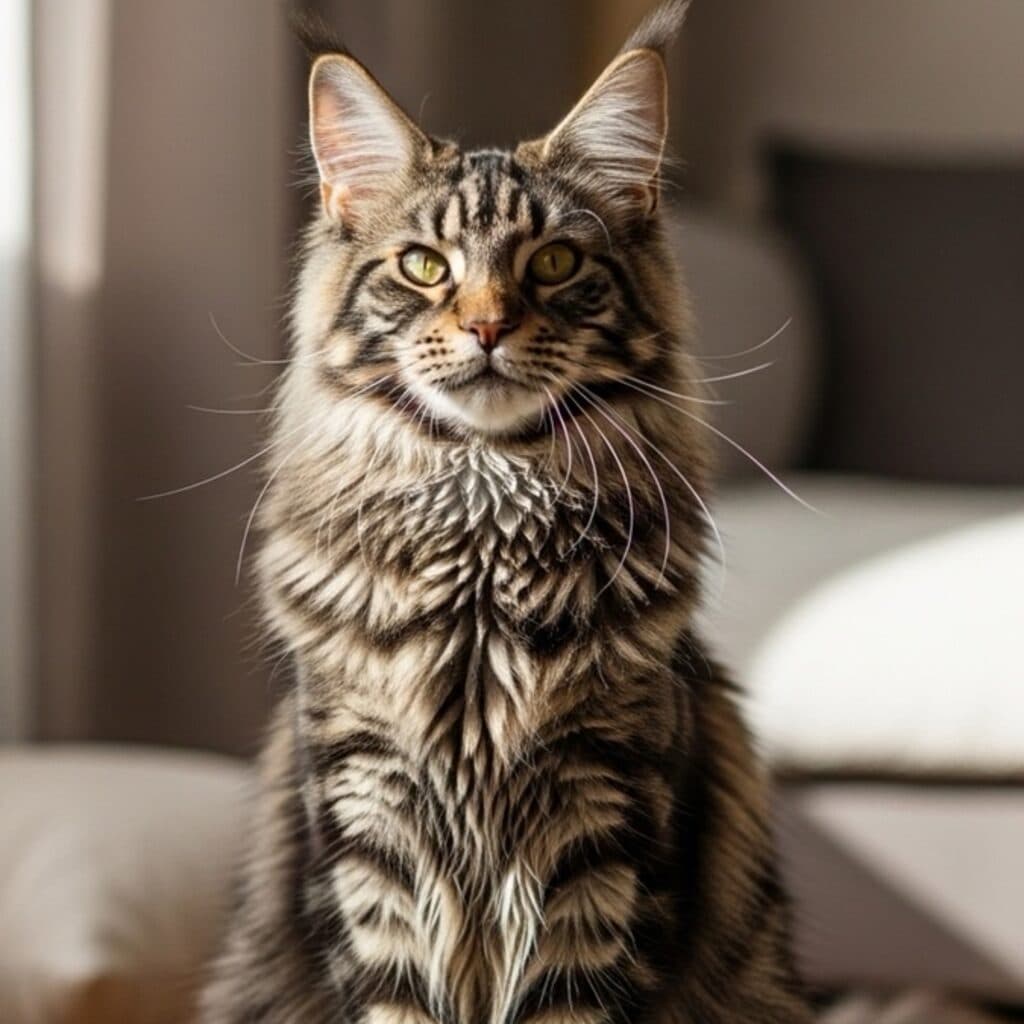
An adult cat spends a good part of the day asleep on some soft surface. Looking at that animal lying on the couch, it is easy to forget that it descends from animals that had a function — and that, in at least three breeds, the body still carries the literal mark of that work.
Maine Coon, Norwegian Forest Cat and Siamese were not selected to keep company. They were selected for a specific job, and the trait that the owner now reads as personality — or, sometimes, as a flaw — is a direct residue of that function.
| Breed | Original job | Trait that stayed |
|---|---|---|
| Maine Coon | Rodent hunter on farms and ships of New England (19th century) | Double, dense, water-resistant coat |
| Norwegian Forest Cat | Rodent hunter on Viking ships, protecting stored grain | Curved claw that locks when climbing down a trunk headfirst |
| Siamese | Guard of temples and royalty in ancient Siam | Loud, constant vocalization |
Maine Coon: basement hunter, waterproof coat
The Maine Coon was born of work, not of a beauty salon. On the New England coast of the 19th century, farmers valued the cat for its skill at catching rats — in a barn, in a warehouse, in a ship's hold. According to VCA Animal Hospitals, the Maine Coon is described as a cat sturdy enough to withstand New England winters, prized precisely for its skill at hunting rodents.
The coat tells that story on its own. It is a two-layer, dense coat, with an outer layer that repels water — the same structure that protected the animal from sea spray and rain while it worked is today the coat that lets a Maine Coon come out of a puddle practically dry. Owners tend to read "cat that likes water" as an isolated curiosity of the breed. It is basement work stored in the body.
Norwegian Forest Cat: the ship gave the job, the forest gave the claw
The Norwegian Forest Cat also worked as a ratter. It traveled on Viking ships, protecting the grain supply from rodents during the crossing. VCA Animal Hospitals records that the breed accompanied the Vikings on their vessels toward the New World to keep rats away from the grain stored on board.
But the ship explains only the job. The physical trait the breed carries to this day does not come from the deck — it comes from the forest that gives the breed its name. The Norwegian Forest Cat is a climbing cat: it comes down a trunk headfirst, a movement most cats do not make. That is possible because its claw is curved and locks in that direction — an adaptation of an animal that climbed up and down trees in the Nordic cold, not of an animal that lived in a ship's hold. It is the same distinction that separates the Maine Coon's coat, of maritime origin, from the Norwegian's claw, of forest origin: the breed's name is not decoration, it is the right clue to the right trait.
Siamese: temple guard, and the voice was the post
In ancient Siam — present-day Thailand — the Siamese lived near royalty and temples, among the most valued animals in the kingdom. VCA Animal Hospitals records the breed as revered by members of the Siamese royal family and by high-ranking priests, and notes that specimens were even offered as diplomatic gifts to European visitors in the 19th century.
The guard function explains the breed's most recognizable trait today. A Siamese that meows loudly and insistently is not being needy — it is doing what the breed was selected to do: warn when someone approaches. The vocalization is not a personality accessory, it is the post. VCA itself describes the Siamese as an extremely communicative breed, capable of producing a wide variety of sounds, including one that resembles the cry of a human baby. The ASPCA also names the Siamese among the breeds prone to excessive meowing and yowling — the same point that the post cat breeds that talk the most covers in depth.
Does a purebred cat need a job today?
No, and none of the three does. No Maine Coon will hunt rats in a basement again, no Norwegian will climb a ship's mast, no Siamese will stand watch at a temple. But the trait that the work left behind remains tied to the body — and treating that trait as a whim is what turns a function with no outlet into a behavior complaint.
A Maine Coon fascinated by water is not messy: it is a remnant of an animal that dealt with sea spray, and giving controlled access to water solves it without trauma for anyone. A Norwegian Forest Cat that climbs bookshelves, curtains and cabinets is not wrecking the house by chance — it is the same body that used to climb trunks in the Nordic cold, and it needs a vertical scratching post and a high shelf to spend that impulse on something other than the curtain. A Siamese that meows too much is doing its job — warning — and responding with attention every time it meows teaches the cat to meow more, not less.
What NOT to do
- Do not treat a Maine Coon that splashes in the water bowl as a troublemaker. It is doing what the breed has always done.
- Do not leave a Norwegian Forest Cat without vertical structure — a tall scratching post, a shelf, a perch — and then complain that it climbs everything. Without a proper option, it climbs whatever is there.
- Do not scold or isolate a Siamese that meows a lot. It does not reduce the meowing and it wears down the relationship with a cat that is precisely fulfilling the function the breed carries.
- Do not adopt any of the three breeds expecting a quiet, still cat. The trait of function does not disappear with a change of address.
Frequently asked questions
Does the Maine Coon still like water today?
Yes, a good share keep the interest — playing in the water bowl, coming into the bathroom during the owner's shower, playing with a dripping faucet. It is behavior consistent with the waterproof coat the breed carries from the original function of hunter in a damp environment.
Why does the Norwegian Forest Cat climb down trees headfirst?
Because its claw is curved and locks in that direction of movement — an adaptation of a cat that climbed up and down trees in Norway's cold climate. Most breeds come down backward or jump; the Norwegian comes down headfirst because the claw allows it.
Will the Siamese stop meowing if I ignore the meowing?
Not the way people usually expect. Ignoring reduces the meowing that exists only to ask for something specific, but the breed is vocal by selection — it keeps commenting on the day, just without the specific request that stopped being granted.
Are these three breeds still used for work today?
No. Maine Coon, Norwegian Forest Cat and Siamese are bred today as companion pets — the work stayed recorded in the body and behavior of each breed, not in the animal's actual function.
If you live with a Maine Coon, a Norwegian Forest Cat, a Siamese — or are thinking of adopting one — understanding the trait as a function helps you build a routine that does not fight the breed. Build your cat's profile and see what to prioritize in its routine →
Picked by score from our overall cat ranking, not by the topic of this article. To get it right for your pet — age, weight, spayed or neutered — take the quiz and get a list made for them. A pet with a diagnosed condition needs a diet prescribed by a veterinarian.



