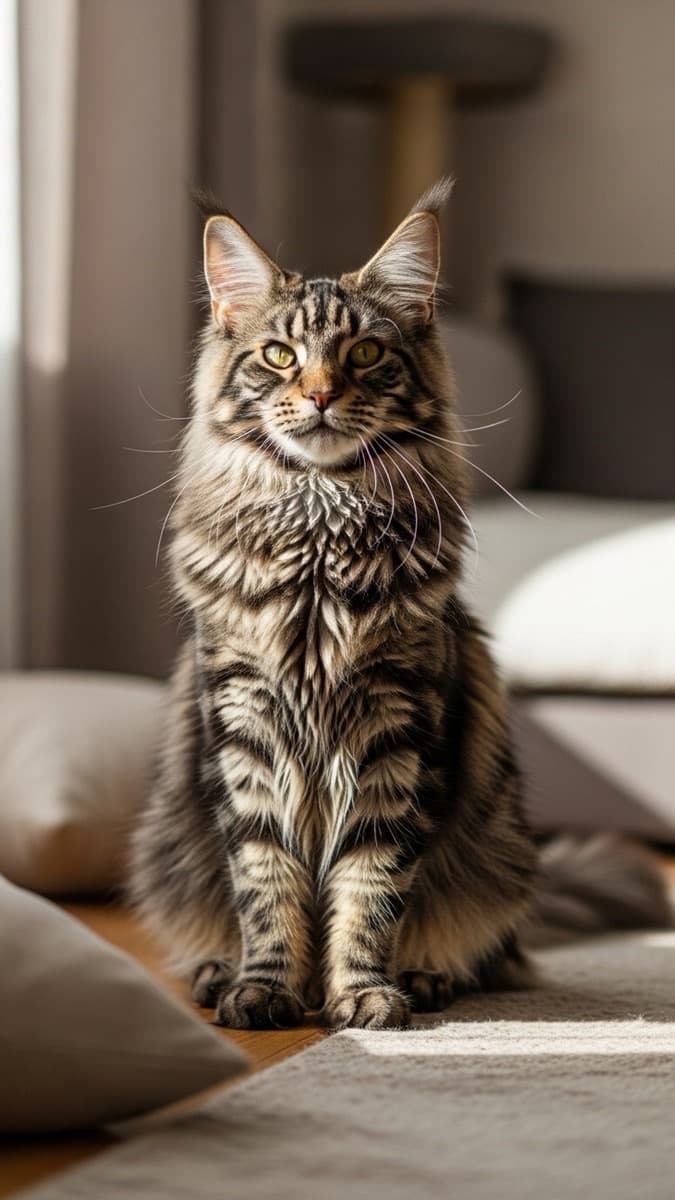
The Maine Coon is giant — 5 to 11 kg as an adult — and medium-energy, the largest domestic cat breed there is. Two things weigh in choosing the food: the heart and the joints. The breed has a documented genetic mutation linked to hypertrophic cardiomyopathy (HCM), so quality protein and adequate taurine come in as cardiac support. And giant size demands strong joints, so controlled growth and joint-support nutrients make a difference.
In the current My Pet Magazine analysis, the best food for the Maine Coon is ACANA Indoor Entrée (ACANA), with a technical score of 89.3/100 (🌟 Superior Quality), calculated with the My Pet Magazine IDNM/IPFI methodology across 50 cat foods reviewed in July 2026. See the full ranking ↓
What to weigh in food for the Maine Coon
Three things guide the choice of a Maine Coon's food: taurine at the right level, quality protein and joint support.
Heart. Taurine is an amino acid the cat does not produce on his own in sufficient quantity — it has to come whole from the food, throughout life. Without taurine, the risk is dilated cardiomyopathy (DCM), a heart problem different from HCM. In the Maine Coon, that care carries extra weight because the breed has a known genetic mutation linked to HCM — the most common heart disease in cats. Good-quality protein comes in here as support for heart-muscle function, without overloading a heart that is already under closer watch in this breed.
Joints. The Maine Coon is born with a bone structure larger than the feline average, and that calls for extra care with the pace of growth. A food that avoids energy spikes helps the bone grow at the right pace, without getting ahead of the joints. EPA/DHA and glucosamine add joint support — relevant in a breed with a higher chance of hip dysplasia precisely because of its giant size.
Criteria scored against the My Pet Magazine nutritional targets (protein, fat, calcium and caloric density ranges by size — see our methodology).
Breed profile and predispositions
The Maine Coon carries two well-documented predispositions, and each one changes what to look for in the food.
The first is hypertrophic cardiomyopathy (HCM), the most common heart disease in cats and the one most genetically associated with the breed. According to the Merck Veterinary Manual — Hypertrophic Cardiomyopathy in Dogs and Cats, mutations in the gene encoding cardiac myosin-binding protein C have been identified in Maine Coon and Ragdoll cats. Food does not treat the mutation — what it does is provide support, with high-quality protein helping cardiac function. A diagnosed cat is followed by a veterinary cardiologist. Taurine remains essential to the feline heart in general — a lack of it causes dilated cardiomyopathy (DCM) — but it is not a specific treatment for HCM.
The second is feline hip dysplasia (FHD), a joint condition linked to the breed's giant size — the Maine Coon is the largest domestic cat breed there is. A study analyzing the OFA (Orthopedic Foundation for Animals) feline hip dysplasia registry found a prevalence of 24.9% in Maine Coons (Loder & Todhunter, Journal of Feline Medicine and Surgery, 2018). Food does not prevent the genetic condition, but it helps: avoiding energy spikes that speed bone gain beyond what the forming joints can support takes load off the problem, and EPA/DHA with glucosamine add joint support across the cat's life.
Recommended foods for the Maine Coon
Ranked by IDNM/IPFI technical score across 50 cat foods — no manual product curation.
- 1
ACANA Indoor Entrée · ACANA
89.3/100 - 2
Nulo Freestyle Cat & Kitten · Nulo
88/100 - 3
Purina Pro Plan Sensitive Skin & Stomach · Purina Pro Plan
87.6/100 - 4
Hill's Science Diet Perfect Weight Cat · Hill's Science Diet
87.3/100 - 5
Tiki Cat Born Carnivore · Tiki Cat
87.1/100
Frequently asked questions about Maine Coon food
- Why does the Maine Coon have a higher risk of hypertrophic cardiomyopathy (HCM) than other breeds?
- The Merck Veterinary Manual identified a genetic mutation linked to HCM — the most common heart disease in cats — in the Maine Coon and the Ragdoll. Being of the breed does not mean the cat will fall ill, but it is reason enough for regular cardiology follow-up.
- Does food prevent or treat the Maine Coon's hypertrophic cardiomyopathy?
- No. The cause is genetic, and no food changes that. What the diet does is provide support: good-quality protein helps heart-muscle function, and taurine at an adequate level is essential to a cat's heart throughout life — a lack of it causes a different heart problem, dilated cardiomyopathy (DCM). A cat diagnosed with HCM is followed by a veterinary cardiologist, not treated by food alone.
- Does hip dysplasia in the Maine Coon have anything to do with what he eats?
- It does, indirectly. The cause is genetic and linked to the breed's giant size — a study of the OFA (Orthopedic Foundation for Animals) registry found hip dysplasia in 24.9% of the Maine Coons assessed (Loder & Todhunter, Journal of Feline Medicine and Surgery, 2018). What the diet can do is avoid speeding up the cat's growth too much: avoiding energy spikes while the bones are still forming takes weight off the joints, and EPA/DHA together with glucosamine give extra support.
- Does every Maine Coon develop hypertrophic cardiomyopathy?
- No. The genetic mutation linked to the disease was found in the breed, but it is not in every individual — and not every carrier goes on to develop the disease. Even so, it is worth having periodic echocardiograms and choosing a food with good-quality protein as part of cardiac support, with taurine always present.
- Why does the Maine Coon's growth need to be more controlled than that of an ordinary cat?
- Because he is the largest domestic cat breed, and that means more bone to form. According to the WSAVA Global Nutrition Toolkit (2021), the point of attention is the pace: keeping the cat from gaining weight too quickly protects joints that are still forming — the same care that reduces the risk linked to the breed's hip dysplasia.
Methodology
The block of recommended foods on this page is ordered by My Pet Magazine's IDNM/IPFI technical methodology, which evaluates the nutritional density and ingredient purity of each product in the active dataset for the Maine Coon's giant-size profile — with no manual curation or brand influence.
The score takes into account how well the food fits the breed profile: the presence of taurine, joint support and control of the pace of growth are factors that weigh in the ranking, recalculated whenever the product dataset is updated.
The ranking on this page is a projection of the My Pet Magazine IDNM/IPFI scoring engine over the cat dataset, with no manual product curation. See the full methodology →
Want a recommendation tailored to your Maine Coon?