Dog Eating Poop: Is It a Food Deficiency? What Science Says
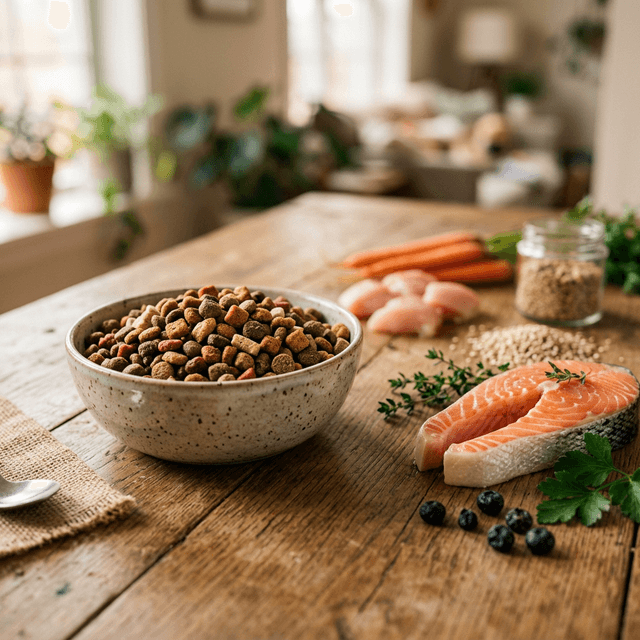
Coprophagia is not a sign of nutritional deficiency. The largest survey ever done on the behavior — Hart et al. (2018), "The paradox of canine conspecific coprophagy", published in Veterinary Medicine and Science (PMC5980124) — gathered about 3,000 owner responses across two questionnaires and found no relationship between eating poop and the dog's diet. Among frequent poop eaters, 82.3% ate dry food as their main diet; among dogs that never ate poop, 78.3% did — practically the same thing.
If food does not explain it, what does? The authors themselves propose an answer that has nothing to do with nutrition: a leftover of den hygiene. This article shows what the evidence supports, what it knocks down, and when the case deserves a veterinarian.
Does a dog that eats poop have a vitamin deficiency?
No. This is the most widespread belief about coprophagia, and the available evidence does not support it. In the Hart et al. (2018) survey, coprophagic and non-coprophagic dogs did not differ in diet, in general health, or in how easily they were taught to do their business in the right place (78% of frequent eaters were described as easy to train, versus 82% of non-eaters — a difference with no practical relevance). There was also no relationship with the age at which the puppy was separated from its mother.
It is also worth remembering that a food sold as complete and balanced must meet the minimum nutrient profiles defined by AAFCO (Association of American Feed Control Officials) (AAFCO — Selecting the Right Pet Food). A dog fed a complete food is unlikely to be "missing" something it would look for in feces.
How does food digestibility influence coprophagia?
Nobody knows — and it is important to understand why. The idea that a low-digestibility food would leave an "attractive nutritional residue" in the feces is a popular hypothesis, repeated on many websites, but no one has tested it. The Hart et al. (2018) survey asked owners about the type of food (dry food or other foods), not its digestibility, and in that cut the two groups were practically equal: 82.3% of frequent eaters and 78.3% of dogs that never ate poop had dry food as their main diet. Digestibility itself was not measured there — nor, as far as the literature shows, in any other study of the behavior.
So the honest reading is: evidence is lacking, and there is no contrary evidence. That gives no basis for switching food because of the behavior — but it also does not allow treating the digestibility explanation as fact, because it never left the page.
Two findings of the study point in another direction. The first is appetite, not diet: 51.1% of coprophagic dogs were described by owners as greedy eaters, versus 28.2% of non-coprophagic dogs. That is a trait of the dog, not of the food. The second is the age of the feces: 85% of the coprophagic dogs in the second questionnaire were identified eating fresh feces — at most two days old.
That preference for fresh feces is the heart of the authors' hypothesis. The worm eggs shed in feces take a few days to become infective larvae, depending on the parasite species and the temperature of the environment. A wolf that cleaned the den by eating freshly deposited material would reduce the risk of contaminating the group — "the lesser of two evils," in the authors' words. In this reading, coprophagia would be a functional remnant of ancestral hygiene behavior, not a cry for nutritional help.
There is also an indication of a breed component, which likewise is not explained by diet: among Shetland Sheepdogs, 41% were coprophagic, versus 17% of the other breeds. Poodles did not appear in the coprophagic group.
So food and health do not matter at all?
They matter for ruling out disease — not for explaining the behavior. Coprophagia can occasionally have a medical cause, according to the Merck Veterinary Manual (Behavior Problems of Dogs), although the source does not specify which conditions. That is why the sensible path starts with the veterinarian, not the pet store.
| Situation | What to do |
|---|---|
| Healthy dog, adequate weight, eats fresh feces from its own yard | Probably normal behavior for the species — environmental management, no food change |
| Weight loss, excessive appetite or greasy stools along with the behavior | Veterinary visit: malabsorption and other diseases need to be investigated |
| New behavior in an adult dog that never did this | Veterinary visit before any change of diet |
| Puppy in the first weeks | Common and transient — monitor |
No line in this table says "switch the food." Not because food does not matter for the dog's health — it matters a great deal — but because the available evidence does not link coprophagia to diet.
What to do when your dog eats poop
What works is blocking access. Picking up feces from the yard immediately is the most reliable measure, because it removes the object of the behavior instead of trying to change the dog's mind.
Prepare for modest expectations with everything else. Hart et al. (2018) measured the reported success of the best-selling interventions, and the result is discouraging: commercial products that promise to make the feces taste bad had 0% to 2% success as reported by owners. The most widely used, For-Bid, came in at 1% (352 responses); the one with the highest rate, Coproban, reached 2% (58 responses). Behavior-modification techniques came in at 1% to 2%, with the exception of the "leave it" command, slightly better at 4%.
In other words: if coprophagia bothers you, the path is environment management. If it comes with a clinical sign, the path is the veterinarian.
What NOT to do
- Do not switch food expecting it to solve coprophagia. The best available evidence does not link the behavior to diet. Change food for nutrition reasons, never as a treatment for eating poop.
- Do not punish the dog in the act. Punishment can create anxiety and teach the dog to eat the feces in hiding, faster.
- Do not assume it is "just a quirk" without ruling out a medical cause first, especially when there is weight loss, altered stools or a sudden change in behavior.
- Do not reduce the amount of food believing the dog "already helped itself." That creates a real nutritional problem where there was none.
Frequently asked questions
Does a vitamin supplement fix coprophagia?
There is no evidence that it does. Since the behavior was not associated with diet or health status in Hart et al. (2018), supplementing vitamins attacks a cause the study did not find. Products formulated specifically for the problem had reported success between 0% and 2% in the same survey.
Is eating poop dangerous for the dog?
The main risk is parasitic, and it exists even with fresh feces. The "few days" clock described in the study applies to worm eggs, which need that time in the environment to become infective larvae. Other agents do not follow that clock: protozoa such as Giardia can already be transmitted in freshly passed feces. In other words, fresh feces are not safe feces — up-to-date deworming, periodic fecal exams and a conversation with the veterinarian still apply.
Is a puppy eating its mother's feces a concern?
Not necessarily. It is common behavior in the first weeks and usually fades on its own. Marked persistence in an adult dog, accompanied by any clinical sign, deserves evaluation.
Does a dog that eats the feces of other animals (cat, horse) have the same problem?
It is a different behavior. The Hart et al. (2018) survey dealt specifically with coprophagia among dogs (the dog eating its own feces or those of other dogs), so its conclusions do not transfer automatically. In practice, the management is the same: control access to the litter box and to droppings.
How common is it?
Common. In the first questionnaire of Hart et al. (2018), 16% of dogs qualified as frequent eaters — seen eating dog feces (their own or other dogs') at least six times. It is not a rare deviation — it is a behavior that a large share of the canine population shows.
A dog that eats poop is almost never "missing something." The largest available survey on the subject found no difference in diet, health or trainability between dogs that eat it and dogs that do not. The explanation the authors propose is behavioral and ancestral — but they themselves warn that it is tentative, with no field observation in wolves to support it. It stands as the best available hypothesis, not as established fact. Rule out a medical cause with the veterinarian, pick up the feces from the yard — and choose your dog's food for the right reasons, which are different ones.
See the dog food ranking → · Use the quiz to find the ideal food for your dog →
Picked by score from our overall dog ranking, not by the topic of this article. To get it right for your pet — age, weight, spayed or neutered — take the quiz and get a list made for them. A pet with a diagnosed condition needs a diet prescribed by a veterinarian.



