Why Do Dogs Eat Grass? What a Survey of 1,571 Dogs Shows
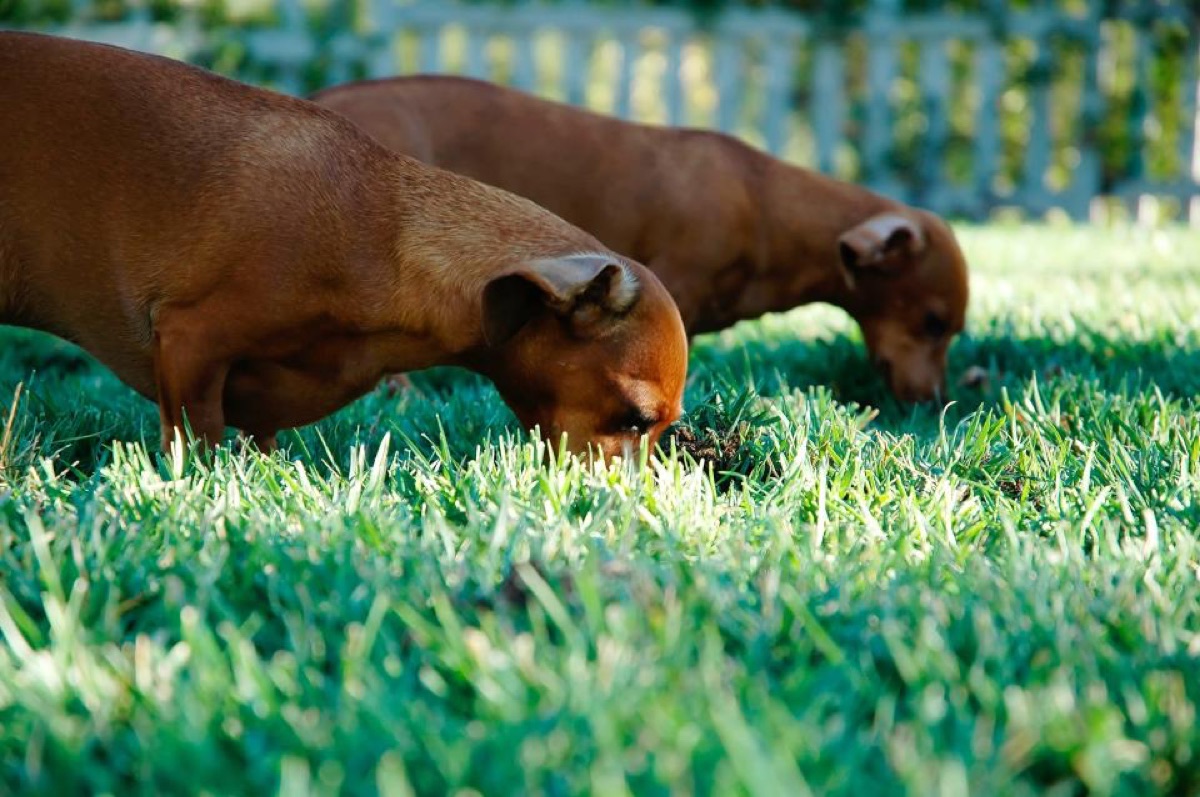
For most dogs, eating grass is a common behavior, not a sign of illness. In a survey of 1,571 owners of plant-eating dogs, run by UC Davis researchers, only 9% said their dog frequently seemed ill before eating the plant, and only 22% said their dog frequently vomited afterward (Sueda, Hart and Cliff, 2008). The authors read the data as supporting the idea that plant eating is mostly a normal behaviour.
This guide covers what the study shows and what it does not prove, the signs that call for a vet, and what dog food does (and does not) have to do with it.
Is a dog eating grass because its stomach is upset?
In most cases, no. In the Sueda, Hart and Cliff survey, only 9% of dogs frequently seemed ill before eating plants, and grass was the plant eaten most, by 79% of them. It is an owner questionnaire: it shows a pattern, not the cause in any individual dog.
The study also does not say why dogs do it. It records that 68% of the dogs ate plants daily or weekly, and that younger dogs ate plants more often and showed fewer signs of illness beforehand and less vomiting afterward.
| What the survey recorded | Result |
|---|---|
| Owner responses analyzed | 1,571 |
| Dogs that eat plants daily or weekly | 68% |
| Dogs for which grass was the plant eaten most | 79% |
| Dogs that frequently seemed ill before eating the plant | 9% |
| Dogs that frequently vomited afterward | 22% |
All respondents were owners who already knew their dog eats plants, so the survey cannot say how many dogs overall do it. It also cannot separate cause from consequence: it is an association between plant eating and other signs, not proof that one leads to the other.
Is eating grass normal, or a sign of too little fiber in the food?
The study does not answer that question. It compared commercial diets with home-prepared or raw diets and found no relationship between diet type and how often, or which kind of, plants a dog eats, but it did not measure fiber, so the fiber question stays open.
That does not make fiber irrelevant to digestion. It only means that for the question "is my dog eating grass because the food lacks fiber?", this study has no answer. If you are seeing loose stools or recurring gas, our guide to the sensitive-stomach dog and what the label must show covers the role of fiber with the right sources.
One practical note: if your dog eats grass and is otherwise fine, with a normal appetite, firm stools and usual energy, that is the most common scenario the study describes. A change in the pattern is what deserves attention.
When does eating grass and vomiting call for a vet?
When the vomiting is repeated, long-lasting or comes with other signs. The Merck Veterinary Manual says that long-term vomiting, vomiting that occurs more often than once or twice daily, and vomiting accompanied by blood, abdominal pain, depression, dehydration, weakness, fever, weight loss, or other signs requires a more detailed examination.
The same manual says that short-term or even occasional vomiting is generally not associated with other abnormalities. The manual covers vomiting in dogs and does not mention grass, so the link between the two does not come from it.
Signs that justify calling the vet, based on the Merck list:
- vomiting more often than once or twice a day, or lasting a long time;
- vomiting with blood;
- lethargy, weakness, fever or weight loss;
- signs of abdominal pain or dehydration.
At the visit, according to the manual, the vet asks among other things about possible access to garbage or poisons.
Which dog food helps a dog that keeps eating grass?
None "cures" the habit: the study found no relationship between diet and plant eating. What a food can do is keep digestion regular, and the usual criteria apply: a complete and balanced formula for the life stage, a gradual transition and the right portion.
If you want to compare what the label shows, here are three complete adult dog foods from our US catalog, with the crude fiber (max) on the guaranteed analysis and the first ingredients:
| Dog food | Crude fiber (max, as-fed) | First ingredients |
|---|---|---|
| Hill's Science Diet Adult Chicken & Barley | 4% | Chicken, cracked pearled barley, brown rice |
| Purina Pro Plan Shredded Blend Chicken & Rice | 3% | Chicken, rice, whole grain wheat |
| Royal Canin Medium Adult | 3.4% | Brewers rice, chicken by-product meal, oat groats |
The three sit within about one percentage point of each other, and a crude fiber figure on the label does not say how much of it is fermentable or how your dog will react. To see these and other foods side by side, with scores and ingredients, use the dog food ranking.
If your dog eats grass and vomits often, the vet comes before any change of food. If your dog is doing well, watch the pattern and keep the diet steady.
Frequently asked questions
Is it normal for a dog to eat grass?
For most dogs, yes. The UC Davis survey, based on owner responses, read the data as supporting the idea that plant eating is mostly a normal behaviour. It is an observed association, not a diagnosis for your dog.
Do dogs eat grass to make themselves vomit?
The study recorded that only 22% of dogs frequently vomited after eating plants, so most do not. The data do not explain why dogs eat grass, and repeated vomiting should be checked by a vet.
Will more fiber in the food stop a dog from eating grass?
The study does not answer that: it compared commercial diets with home-prepared or raw diets, found no relationship with how often dogs eat plants, and did not measure fiber. Any change of food, when needed, should be discussed with your vet.
Picked by score from our overall dog ranking, not by the topic of this article. To get it right for your pet — age, weight, spayed or neutered — take the quiz and get a list made for them. A pet with a diagnosed condition needs a diet prescribed by a veterinarian.