When to Start Kitten Food: Weaning Schedule and Protein
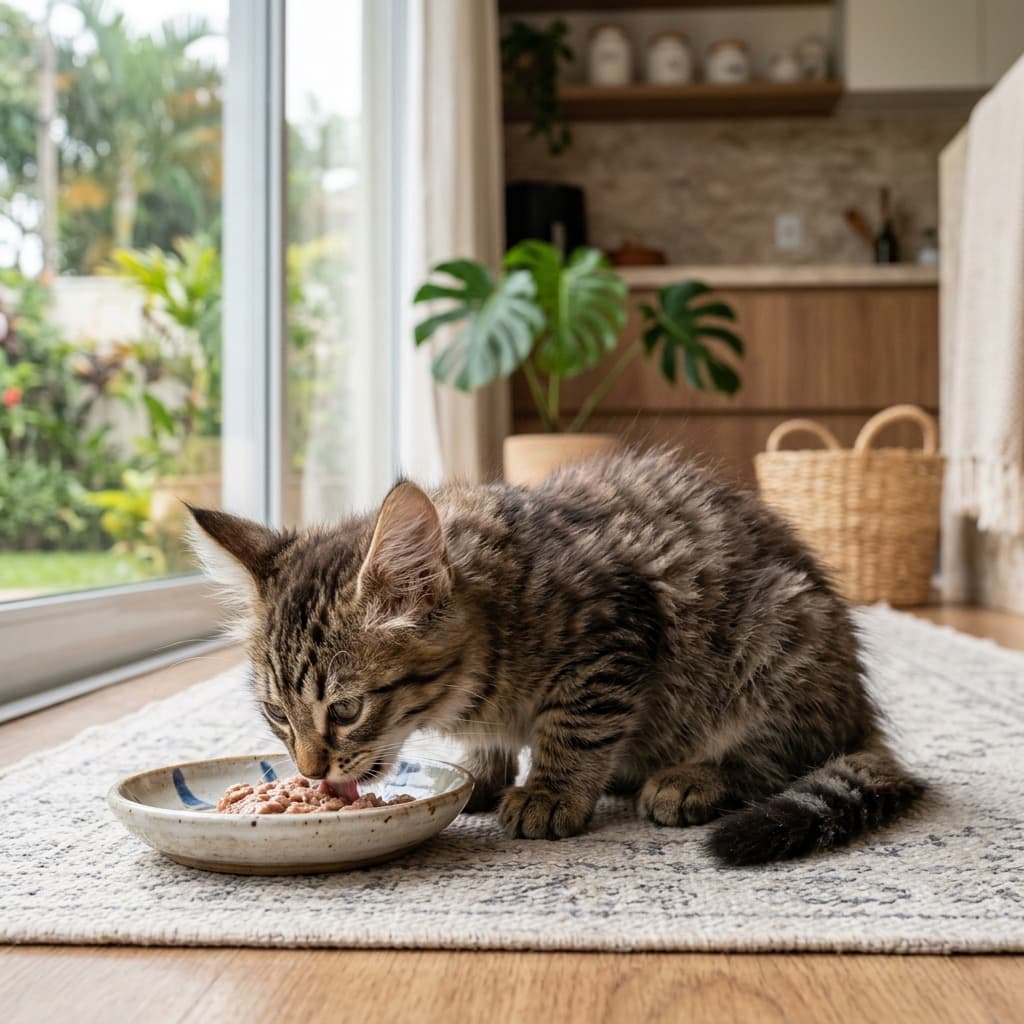
Solid food is introduced to kittens between 4 and 8 weeks of age. The AAFCO (Association of American Feed Control Officials) recommends a minimum of 30% crude protein on a dry matter basis for kittens; FEDIAF (European Pet Food Industry Federation) recommends a close range, between 28% and 30%, depending on the growth stage. Respecting that window and that criterion shapes the cat's digestive health and eating behavior for the next 15 years. To compare kitten formulas already filtered for this life stage, see the kitten food ranking for cats.
This is the first time you are choosing solid food for a kitten. The bottle of milk replacer is still there, but the veterinarian said it is time to start the transition. You look at the pet store shelf and see dozens of brands with "kitten" on the label — but none of them explains when to start, how much to give, or whether you can mix it with milk. The kitten meows in front of you, and you do not know whether you are too early or too late.
The doubt is fair: the window for introducing dry food is short — between 4 and 8 weeks of age — and what happens in that period shapes the cat's digestive health and eating behavior for the next 15 years. This article covers the 3 practical criteria that matter for a first food, the exact weaning schedule, and the 2 mistakes that cause food rejection or chronic diarrhea in kittens.
1. When to start offering dry food (4 to 8 weeks)
The kitten is born dependent on its mother's milk. At 21 days, lactase production (the enzyme that digests milk) starts to drop, and the digestive tract starts producing more amylase (an enzyme for carbohydrates) and protease (an enzyme for proteins). That is the biological signal to start the transition.
In practice, you will notice:
- The kitten starts biting the bottle nipple or investigating the mother's food bowl.
- It already walks on its own and does not depend on the warmth of the litter to regulate its temperature.
- The baby teeth (small canines) have already broken through the gum — this happens between the 3rd and 4th week.
The ideal schedule:
- Week 4: offer wet food, or dry food softened in warm water (the texture of thick porridge). Leave the bowl available for 20 minutes, 3 times a day, even if the kitten does not eat it all.
- Week 5: gradually reduce the amount of water — the porridge becomes a firmer mash.
- Week 6: offer dry food without water, but still alternate with one wet meal a day.
- Week 8: full weaning. The kitten eats only dry or wet food, with no milk.
If the kitten was separated from its mother before the 4th week (rescue or orphan cases), use a milk replacer made specifically for cats (not cow's milk, which causes diarrhea) until the 4th week, and only then start the transition to solid food.
What percentage of protein should you look for on a kitten food label?
Kitten foods have similar labels — they all say "healthy growth", "strong bones", "immunity". What really matters is in the nutrition table: the crude protein (min.) percentage — the number that confirms whether the food meets the AAFCO minimum of 30%, within the 28% to 30% range also accepted by FEDIAF.
Kittens need at least 30% protein (AAFCO recommends 30%, FEDIAF recommends between 28% and 30%). Below that, growth slows down, muscle does not develop, and the kitten may develop a dull coat and low resistance to infections.
What you will notice if protein is below the minimum:
- The kitten eats a lot but stays thin — because it is burning muscle to make up for the lack of protein.
- A coat without shine, and slow growth of the permanent teeth (which come in between 3 and 6 months).
- Recurring soft stools — the intestine does not mature without enough amino acids.
How to check: Pick up the food bag. Look for the line "Crude Protein (min.): X%". If it is between 30% and 40%, it is adequate. If it is 26% or 28%, discard it — no matter what the package promises on the front. Compare the available options in the kitten food ranking for cats before deciding, or use the cat food comparison tool to put two products side by side.
Second criterion: the first ingredient on the list should be a named meat (e.g., "chicken", "chicken meat", "poultry by-product meal") — never "cereals", "ground whole corn" or "plant by-products". The list is ordered by weight: the first ingredient is the one with the most in the formula.
2. How to make the transition without causing diarrhea
Introducing dry food to a kitten that has only had milk can upset the intestine if it is abrupt. The gut flora needs 7 to 10 days to adapt to the new source of nutrients (solid proteins and carbohydrates in place of milk fat).
Transition schedule:
| Days | Milk (replacer or maternal) | Porridge/solid food |
|---|---|---|
| 1-3 | 75% | 25% (dry food softened in warm water) |
| 4-6 | 50% | 50% |
| 7-9 | 25% | 75% (firmer mash) |
| 10 onward | 0% | 100% (dry or wet) |
What NOT to do during the transition:
- Do not change brand or flavor in the middle of the process — that restarts the digestive adaptation.
- Do not offer regular cow's milk — cats cannot digest lactose after weaning, and it causes explosive diarrhea.
- Do not leave the food bowl available all day in the first week — the kitten needs to learn mealtimes (3 to 4 portions a day until 6 months).
Signs the transition is going well:
- Firm stools (not pebbles, but soft cylinders that do not stick to the fur).
- The kitten finishes the portion in 10-15 minutes and is not meowing from hunger afterward.
- Weekly weight gain — weigh the kitten every Friday on the same scale. Healthy kittens gain 100 g (about 3.5 oz) per week until 4 months.
Why wet food helps (but is not mandatory)
Wet food (pouch or can) is 70-80% water, while dry food is 10%. Kittens do not yet have a fully developed thirst reflex — they do not go to the water bowl as often as they should. If the diet is 100% dry food from the start, the kitten can become underhydrated, and that thickens the urine, increasing the risk of crystals and early urinary infection.
In practice:
- Offering 1 pouch of wet food a day (morning or evening) + dry food at the other mealtimes helps ensure hydration.
- If you cannot buy wet food every month, soften the dry food in warm water (not boiling) for 5 minutes before serving — this adds moisture at no extra cost.
Criterion for choosing wet food:
- Same rule as for protein: minimum 8-10% crude protein (since wet food has much more water, the percentage looks low, but it is equivalent to 30-35% on a dry matter basis).
- Avoid wet foods with "jelly", "artificial gravy" or "water" as the first ingredient — they are just palatants with no nutritional value.
What NOT to do with the first food
- Do not buy adult cat food thinking it "works for any age". Adult food has less protein (26-28%) and less calcium — the kitten does not grow properly.
- Do not change brands every week to "test which one he likes best". The kitten's intestine is still forming — each change restarts the adaptation process and raises the risk of chronic diarrhea.
- Do not cut back the food abruptly if the kitten is overweight. Kittens need calories to grow — obesity in kittens is rare (unlike adults). If it is fat, the problem may be lack of exercise or low-quality food (lots of carbohydrate, little protein).
Frequently asked questions
Can I mix kitten food with adult cat food?
No. Adult food has a different nutritional profile (less protein, less calcium, less phosphorus) and can slow the kitten's bone and muscle growth. Use food made specifically for kittens until 12 months (or until 18 months in large breeds, such as the Maine Coon).
How many times a day should a kitten eat?
From 4 to 12 weeks: 4 meals a day (breakfast, lunch, snack, dinner).
From 3 to 6 months: 3 meals a day (breakfast, lunch, dinner).
From 6 to 12 months: 2 meals a day (morning and evening).
After 12 months, you can keep 2 meals or move to 1, depending on the owner's routine and the cat's behavior.
What if the kitten refuses dry food?
Warm the dry food for 10 seconds in the microwave (not hot, just lukewarm — cats prefer food at the body temperature of prey). If it still refuses, soften it with warm water or unsalted chicken broth. Do not add a pouch of wet food on top of the dry food on the very first day — this teaches the kitten to eat only if there is a "prize", and it will always reject the dry food.
Can I give treats to a kitten?
Yes, but only after the 8th week (full weaning). Treats cannot exceed 10% of daily calories — the rest has to come from the food. Prefer freeze-dried pure-meat treats (chicken, fish) with no dyes or sugar.
How do I know if the food is causing an allergy?
Signs of food allergy in kittens: intense itching (especially on the head and neck), sores from excessive licking, chronic diarrhea (more than 3 weeks), recurring vomiting after meals. If you notice these signs, switch to a food with hydrolyzed protein (protein broken into small pieces that the immune system does not recognize as a threat) and consult the veterinarian — allergy in kittens is rare, but when it happens, it needs an elimination diet.
The bottle of milk is already out of the routine. Now you know that a kitten's first food needs at least 30% protein (AAFCO, with FEDIAF in the same range, between 28% and 30%), that the transition takes 10 days, and that the right introduction prevents food rejection and chronic digestive problems. The kitten is ready to grow — and you are ready to choose the food that supports that growth.
Picked by score from our overall cat ranking, not by the topic of this article. To get it right for your pet — age, weight, spayed or neutered — take the quiz and get a list made for them. A pet with a diagnosed condition needs a diet prescribed by a veterinarian.



