Sniff Walks: Why Letting Your Dog Sniff Tires Him Out More
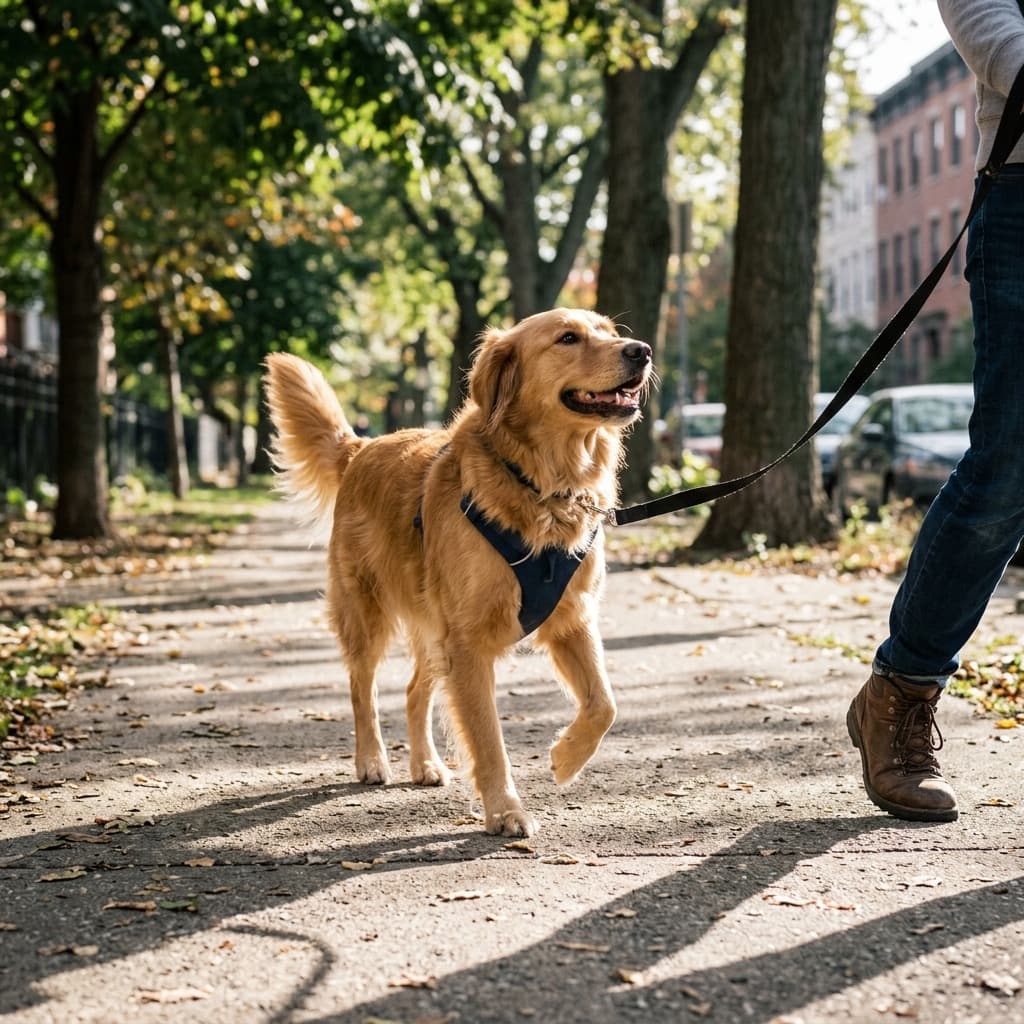
Your dog freezes at the first pole on the street. You wait two seconds, lose your patience and yank the leash. Thirty meters later, he freezes again. The scene repeats the whole walk, and you get home with a dog that walked a lot and is still wired.
The problem is not his energy. It is that the walk was spent entirely on muscle and almost nothing on the brain.
Sniffing is not a distraction: it is processing
When the dog stops at a pole, he is not dawdling. He is reading. According to a study published in the Journal of Neuroscience (2022), the dog's olfactory bulb is about 30 times larger than the human one, and the olfactory epithelium carries between 200 million and 1 billion receptors. A scent on the ground carries who passed by, how long ago, and what state the animal was in.
This means that sniffing is cognitive work, not a break. And cognitive work is tiring — VCA is explicit in saying that exercising the mind is also exercise, burns calories and leaves the dog tired.
Why does the military-style walk frustrate the dog?
The walk most people take follows a human training logic: head out, walk fast, come back. Short leash, constant pace, no stops. From the dog's point of view, it is crossing a library at a run without being allowed to open a book.
The result is a dog that spent legs and did not spend head. He comes back panting and, half an hour later, is nudging you again — because physical tiredness and mental satisfaction are not the same thing.
How to turn it into a sniff walk
It does not require expensive equipment or a new technique. It requires changing who sets the pace.
| Aspect | Traditional walk | Sniff walk |
|---|---|---|
| Leash | Short, constant pace | Long, three meters or more |
| Who chooses the scent | No one stops | The dog decides where and for how long |
| Expenditure | Physical only (legs) | Physical and mental (head) |
- A long leash, three meters or more. A short leash forces the dog to keep up with your step; a long leash gives him back the choice to stop.
- He chooses the scent. The value lies precisely in the dog being the one who decides what to investigate and for how long. Choosing is part of the enrichment.
- Ten minutes is enough. You do not need to replace the whole walk. Set aside a stretch — a square, a tree-lined block — where the rule is: nobody pulls.
- A new route once in a while. An always-identical route becomes a scent already read. Varying the corner renews the material.
What NOT to do
- Do not pull the dog away from the pole in the middle of a sniff. Interrupting halfway is the equivalent of tearing out the reading halfway through — and it is what generates the most accumulated frustration.
- Do not turn the whole walk into free sniffing if he also needs physical exercise. Dogs of working breeds usually need both; sniffing complements, it does not replace.
- Do not use a retractable leash thinking it solves things. It keeps constant tension on the collar and teaches the dog to pull — the effect is the opposite of what you want.
The pole is not the enemy
That dog that freezes at the first pole is not challenging you. He is trying to do the one thing the walk truly offers for his head. Loosening the leash for ten minutes costs less than half an hour more of walking and delivers more.
And a dog that spends his head also eats differently: caloric need changes with the type of expenditure.
Frequently asked questions
Is letting the dog sniff everything on the street bad for him?
The real risk is not the sniffing, it is what he might lick or ingest — food scraps, other animals' feces, baits. Let him sniff freely and intervene only when the mouth gets involved.
How long should a sniff walk last per day?
Ten to fifteen minutes already change behavior at home in most adult dogs. Very anxious or high-energy dogs usually need more, and the sign that it is working is him lying down on his own when you get back.
Does a sniff walk work for a senior dog?
It works especially well. The senior dog loses physical stamina before losing his sense of smell, so sniffing keeps the mind busy without demanding anything of the joints — it is one of the few activities that does not need to be reduced with age.
My dog won't stop pulling. Does loosening the leash help?
A long leash alone does not correct pulling; it can even make it worse if he has already learned that pulling works. Work on tension-free walking first, and use the free-sniffing stretch as a reward within the walk.
Picked by score from our overall dog ranking, not by the topic of this article. To get it right for your pet — age, weight, spayed or neutered — take the quiz and get a list made for them. A pet with a diagnosed condition needs a diet prescribed by a veterinarian.



