Puppy Food: When to Start and What to Choose by Size
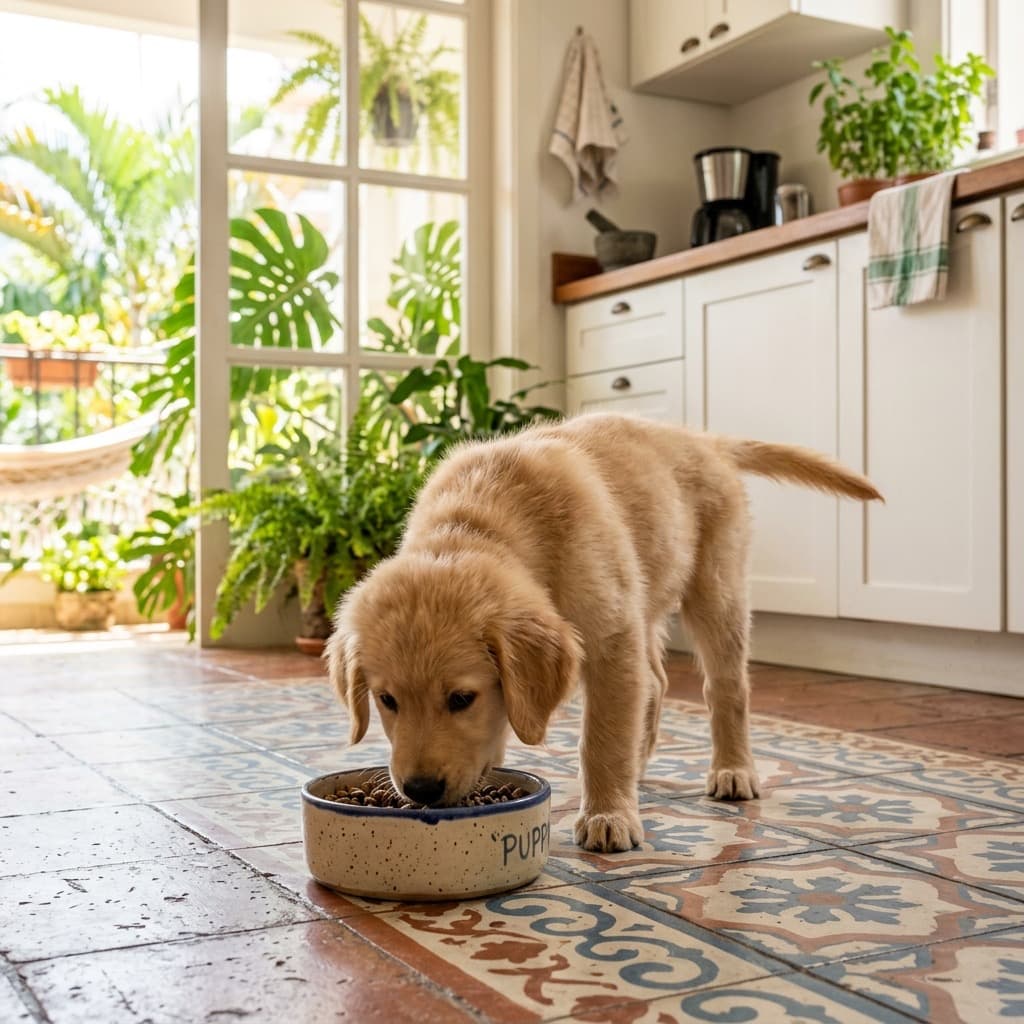
Puppies start eating solid food (as a mush, still mixed with milk replacer) at around 3 to 4 weeks of age, with full weaning extending to 8-10 weeks, but the right food depends on expected adult size — not just age. AAFCO treats growth as its own nutritional stage, with a specific nutrient profile separate from the adult maintenance profile — and excess calcium is particularly risky in this stage (from weaning to 1 year) for large and giant breed puppies, worsening cases of osteochondrosis and altering bone remodeling in fast-growing dogs, which overloads joints that are still forming, according to the Merck Veterinary Manual (Merck Veterinary Manual — Nutritional Requirements of Small Animals).
Choosing the wrong puppy food — generic when it should be large-breed-specific, or the other way around — is one of the most common and least noticed mistakes among first-time owners. This article shows the introduction schedule and how to choose by expected size; to see growth formulas side by side, open the ranking of foods for puppies.
When can a puppy start eating solid food?
The transition from mother's milk to solid food starts around the 3rd-4th week, with food moistened into a mush, still combined with nursing. The full weaning process usually ends around 8-10 weeks, when the puppy already chews dry kibble normally without depending on mother's milk.
How do you move from mother's milk to solid food?
Introduce dry food made specifically for puppies, crushed or moistened with warm water (or milk replacer) until it forms a mush, offered 3-4 times a day alongside access to the mother. Gradually reduce the amount of liquid in the mix over 2-3 weeks, until the puppy accepts the dry kibble whole.
Why does expected adult size change the choice of puppy food?
Small-breed puppies (up to 10 kg / 22 lb) reach adult size between 9-12 months and have a fast metabolism, needing food with more calories. Large and giant breed puppies (over 25 kg / 55 lb) grow until 18-24 months and need large breed puppy food with controlled calcium — excess calcium worsens osteochondrosis in this group (Merck, cited above).
| Expected adult size | Growth stage | What the food needs to have |
|---|---|---|
| Small (up to 10 kg / 22 lb) | 9-12 months until reaching adult size | High caloric density, small kibble |
| Medium (10-25 kg / 22-55 lb) | 12-15 months | Standard intermediate profile |
| Large/giant (over 25 kg / 55 lb) | 18-24 months | Controlled calcium and phosphorus, moderate calories |
How much protein and calcium should puppy food have?
Growth food must have at least 22.5% crude protein on a dry matter basis, according to the AAFCO nutrient profiles for dogs, above the 18% minimum for adult maintenance. For calcium, large-breed puppies need a label that declares formulation for large breeds — excess calcium, not a shortage, is the real risk in this group.
When should you switch from puppy food to adult food?
The switch should happen when the dog reaches about 90% of expected adult weight, not at a single universal age: around 9-12 months in small breeds, 12-15 in medium ones, 18-24 in large and giant ones. Switching too early cuts off growth support; switching too late keeps calories and calcium elevated, favoring weight gain.
What NOT to do when feeding a puppy
- Do not use adult food thinking "it's the same thing." Insufficient protein and calcium for the growth stage compromise the puppy's muscle and bone development.
- Do not give large-breed puppy food to a small-breed puppy (or vice versa). The wrong caloric density and calcium proportion for the size get in the way of development through both excess and shortage.
- Do not skip meals or reduce frequency before 4 months. Puppies have small energy reserves and a real risk of hypoglycemia with long fasts — the recommendation is at least 3 meals a day until 4 months.
Frequently asked questions
Until what age can a puppy eat moistened food?
There is no hard limit — the criterion is chewing ability, not age. Most puppies already chew dry kibble normally by around 8 weeks, but toy-breed puppies or those with delayed teething may need moistened food for a few more weeks.
Does "all breeds" puppy food exist, and does it work?
It exists, but it is a compromise solution. Generic "all sizes" food does not control calcium and phosphorus at the level recommended for large breeds, nor does it offer the ideal caloric density for small breeds. Whenever possible, choose the size-specific line — see the ranking of foods for puppies filtered by expected size.
My large-breed puppy is growing too fast — is it the food?
It could be. Growth that is too fast in large puppies is associated with excess calories or calcium in the diet. If the puppy is visibly "rounder" than his littermates or the veterinarian flags a high body condition score, adjust the portion — never reduce the quality of the food, only the amount, under veterinary guidance.
Can I mix puppy food with adult food during the switch?
Yes — and it is recommended. Use the same gradual transition protocol (75/25, 50/50, 25/75 over 7 days) used for any food change, to avoid diarrhea during the life-stage change.
The question "which food for my puppy" has no single answer — it depends on the size he will be when he grows up, not the size he is today. Getting this variable right from the first weeks avoids two opposite and equally common mistakes: growth that is too fast in large breeds, or a calorie deficit in small breeds with a fast metabolism.
See the ranking of puppy foods by size → · Use the questionnaire to find the ideal food for your puppy → · Compare two puppy food lines side by side →
Picked by score from our overall dog ranking, not by the topic of this article. To get it right for your pet — age, weight, spayed or neutered — take the quiz and get a list made for them. A pet with a diagnosed condition needs a diet prescribed by a veterinarian.



