Obese Dog: Is the Food Helping or Making It Worse?

Notice: this content is for information only and does not replace a visit to the veterinarian. If your pet has symptoms, see a veterinarian before acting on this article.
40.5% of dogs evaluated in a study in the city of São Paulo, Brazil, were overweight or obese, with higher prevalence in females and in spayed or neutered animals, per research published in Scientific Reports and indexed on NCBI (Prevalence of canine obesity in the city of São Paulo, Brazil). In the US dog food catalog we track, the 4 formulas classified as "light" average 23.5% protein (as fed) and 10.4% fiber — a fiber level about two and a half times the rest of the catalog, with protein noticeably lower, which is exactly the trade-off worth questioning before buying.
Noticing that food is working against you does not require waiting until the dog is visibly overweight. There are earlier signs — in behavior and on the label itself, not only on the scale.
How do you know whether a dog is obese or just stocky?
The most reliable method is the body condition score (BCS), not weight alone. On the 1-to-9 scale, ideal sits between 4 and 5: ribs palpable under a light layer of fat, a waist visible from above, no pendulous abdominal accumulation. From 6/9 onward, the risk of diabetes and joint problems rises measurably.
Signs the food is hurting rather than helping
- Constant hunger even on the "correct" portion from the label: foods with low protein and lots of carbohydrate satisfy less per calorie — the dog eats the recommended portion and still begs.
- Weight gain even when you weigh the food on a kitchen scale: if weight rises despite a controlled portion, the food's caloric density may be too high for the dog's real energy expenditure.
- Muscle loss alongside excess fat: a "fat but weak" dog — a large abdomen but little muscle over the back and legs — indicates insufficient protein for a weight-loss phase.
- Very bulky or loose stools on a generic "light" food: poorly balanced excess fiber used to offset calories can cause that; it is not normal and points to a badly adjusted formulation.
What to look for on the label to support weight control
| Criterion | What helps | What hurts |
|---|---|---|
| Protein (dry matter) | At least 26% — preserves muscle during weight loss | Low — muscle is lost along with fat |
| Fiber | Moderate to high — sustains satiety | Absent — the sensation of hunger persists |
| Caloric density | At or below 3,500 kcal/kg — compatible with a controlled deficit | "Standard" for an active dog, applied to a sedentary one |
| Carbohydrate | Secondary to protein as an energy source | Predominant — satisfies less per calorie |
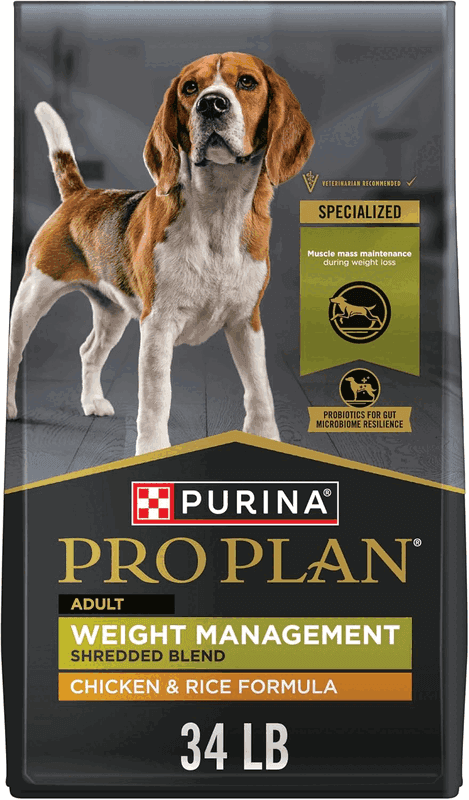
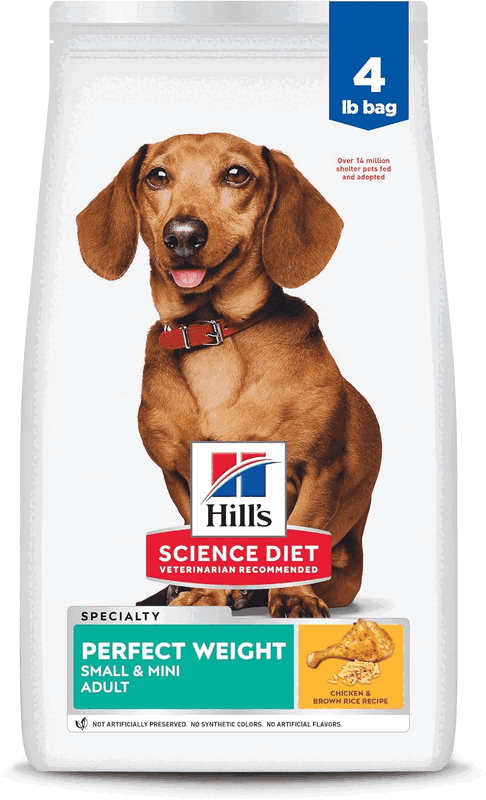
In the US catalog, the light lines cut fat and raise fiber but do not keep protein high — the "light" badge alone does not guarantee the food supports weight loss. Compare the options in the dog food ranking, or place the protein and caloric density of two "light" foods side by side in the dog food comparison tool.
Before switching food, confirm the cause
Not all weight gain is about food. Hypothyroidism, joint problems that reduce activity, or a change in routine (fewer walks, more time still) also add weight on the same food as always. Spaying and neutering is a documented risk factor too — the São Paulo study found higher overweight prevalence precisely in altered dogs. If the weight gain is fast (more than 10% in a few weeks) or comes with unusual lethargy, testing is worthwhile before simply switching food.
What NOT to do
- Do not cut the portion in half without changing the formula. That reduces protein and other essential nutrients along with the calories — the dog loses muscle, not just fat.
- Do not choose "light" on the name alone. Check the real protein and caloric density — many "light" formulas only cut fat without adjusting the rest.
- Do not expect rapid weight loss. Accelerated weight loss in dogs carries metabolic risks of its own — the safe pace is gradual and, ideally, supervised by a veterinarian.
Frequently asked questions
Does "light" food always help an obese dog lose weight?
Not necessarily. If protein is also low, the dog loses muscle along with fat and feels hungrier. The ideal is reduced calories with protein kept high — not both cut at the same time.
Are spayed or neutered dogs at higher risk of obesity than intact dogs?
Yes — the São Paulo study found a higher prevalence of overweight and obesity in altered dogs, which is also consistent with the drop in resting energy expenditure after surgery.
How long does it take a dog to lose weight on the right food?
The safe pace is usually between 1% and 2% of body weight per week. Faster loss than that raises the risk of metabolic complications — which is why weight loss should be gradual and, when possible, supervised by a veterinarian.
How do you calculate body condition score (BCS) at home?
Run your hand over the ribs: at an ideal BCS (4-5/9), you feel the ribs under a light layer of fat, without having to press. Look at the dog from above: there should be a visible waist behind the ribs. If the ribs are hard to feel and there is no waist, BCS is probably above 6.
An obese dog rarely got there through "greed" — it got there because the combination of portion, caloric density and activity level did not add up. Adjusting the food by the right criteria, and not just by the word "light" on the package, is what actually changes the number on the scale.
Picked by score from our overall dog ranking, not by the topic of this article. To get it right for your pet — age, weight, spayed or neutered — take the quiz and get a list made for them. A pet with a diagnosed condition needs a diet prescribed by a veterinarian.