Why Does Your Dog Put a Paw on You? The 3 Real Meanings
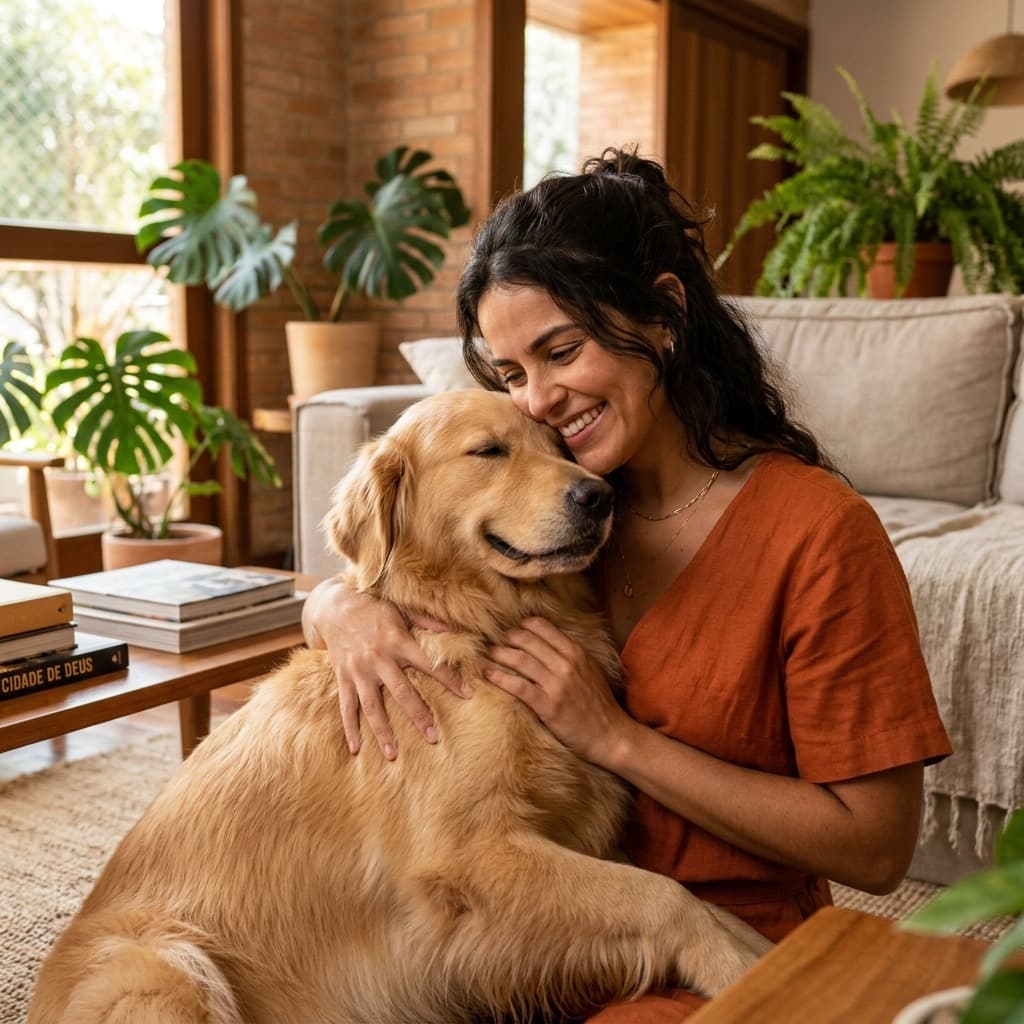
The paw he rests on your knee looks like a "request for petting," period. But the same gesture can mean three very different things — and anyone who guesses a single reason usually responds wrong. The good news: you can tell which one it is by watching the context in which the paw appears.
There isn't just one reason — there are three
Dogs use the paw to communicate because they learn quickly what works with us. Early on they notice that touching the owner produces a response, and the gesture becomes a social tool. The detail that changes everything is that the same paw carries three distinct requests: getting attention, controlling the interaction and self-regulating. Reading the right intention depends less on the paw and more on the body posture at that moment. The American Kennel Club describes the resting paw as a gesture of communication — the dog "talks" with the paw because he has learned that it produces a response (why your dog puts a paw on you).
Light paw and soft eyes: he wants something
This is the most common message. The paw comes light, almost a touch, the body stays relaxed and the gaze softens — often with a short whimper. Here the dog is asking: for petting, food, a walk or for the play to continue. It is an invitation, not a demand.
The sign that it is attention: if you respond and he relaxes or wags, the request was met. Notice that the movement is gentle and goes away as soon as he gets what he wanted.
Firm paw on top: he is in control
When the paw comes firmer, on top of your arm or hand, the reading changes. In this context the dog tries to hold your attention for himself and decide the pace of contact — it is the gesture of someone who wants to lead that moment.
It is not "dominance" in the old, exaggerated sense of the term; it is control of the interaction. If every time you stop petting the paw comes back with weight, he is saying "keep going, my way." It is worth noticing whether this becomes a habit of insistence, so you can adjust limits gently.
And when the paw is to calm down?
There is a third use, more subtle: self-regulation. In tense situations — noise, a visitor, a scare — the dog rests his paw on you or on himself as a gesture of appeasement, almost a request for calm to lower his own anxiety.
The clue here is the whole picture: ears back, tense body, maybe a yawn or a nose lick. The paw, in this case, is not asking for a treat — it is asking for security. Responding with a low voice and a calm presence usually helps more than ignoring it.
The 3 signs side by side
| Meaning | Paw pressure | Body posture | Situation |
|---|---|---|---|
| Attention | Light, almost a touch | Relaxed, soft eyes, sometimes a short whimper | Calm — he wants petting, food or for the play to continue |
| Control of the interaction | Firm, on top of the arm or hand | Insistent, comes back with weight when you stop | Repetitive — he tries to lead the pace of contact |
| Self-regulation | Variable, often against his own body | Ears back, tense body, yawn or nose lick | Tense — noise, a visitor or a scare |
What NOT to do
- Don't treat every paw as petting: always responding with a treat teaches the dog to poke for food, even when the request was something else.
- Don't scold the self-regulation paw: scolding a tense dog increases insecurity instead of solving anything.
- Don't decide from the paw alone — read the whole body (gaze, ears, posture) before responding.
Frequently asked questions
Why does my dog put his paw on me all the time?
Probably because it worked before: he learned that the paw gets a response from you. Notice whether it is a light request (attention), a firm paw (control of the interaction) or a tense gesture (self-regulation) so you can respond in the right way.
Is giving a paw a sign of dominance?
Not in the cartoon sense. A firm paw on top may indicate that he wants to lead the contact, but that is adjusted with routine and clear limits, not with confrontation.
Should I always respond when he gives me his paw?
It depends on the context. If it is a healthy request, it is fine to oblige sometimes; if it has become insistence for food, it is worth not reinforcing it. If it is tension, comfort him calmly.
How can I tell which of the three meanings it is?
Look at three clues: the pressure of the paw (light vs. firm), the posture of the body (relaxed vs. tense) and the situation (calm vs. stressful). They give you the message.
Next time the paw lands on you, resist the automatic guess of "it's affection" and read the context: he is talking to you, and each version of the gesture calls for a different response.
Picked by score from our overall dog ranking, not by the topic of this article. To get it right for your pet — age, weight, spayed or neutered — take the quiz and get a list made for them. A pet with a diagnosed condition needs a diet prescribed by a veterinarian.



