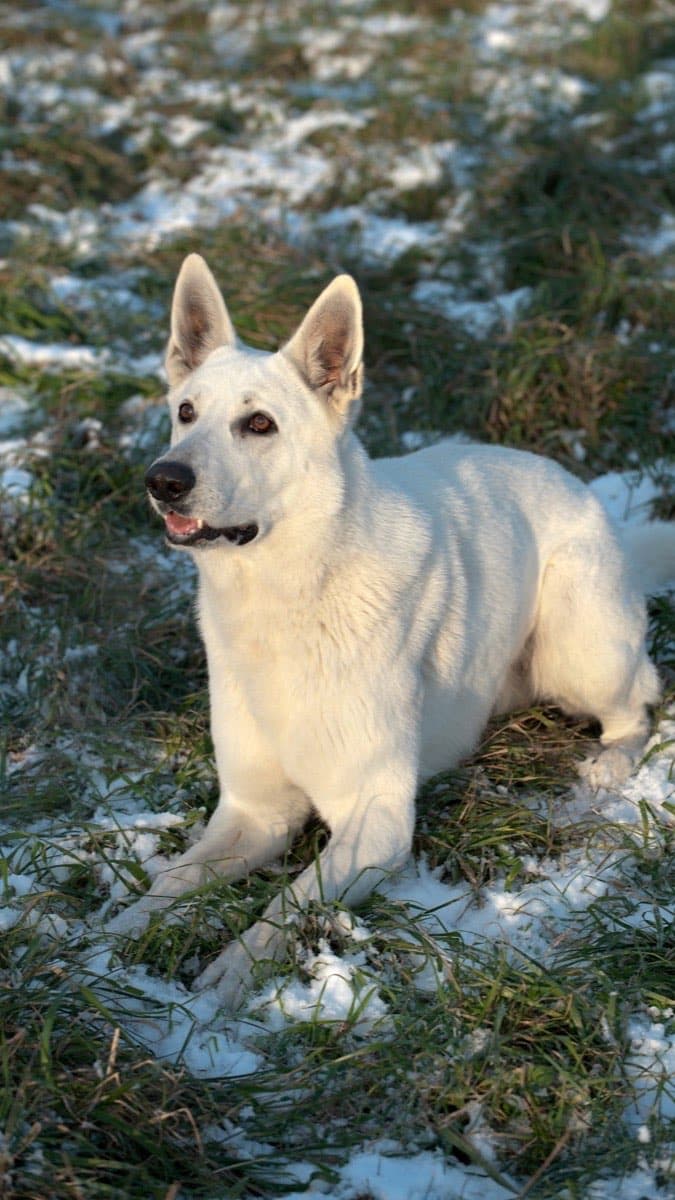
The White Swiss Shepherd is a large dog (25 to 40 kg) with a long coat and high energy. Descended from white lines of the German Shepherd, the breed carries the same predisposition to hip dysplasia, screened by the OFA. That is why the ideal food limits calcium to up to 1.8% of dry matter during growth and controls adult weight.
In the current My Pet Magazine analysis, the best food for the White Swiss Shepherd is Purina Pro Plan Complete Essentials (Purina Pro Plan), with a technical score of 91.7/100 (🌟 Superior Quality), calculated with the My Pet Magazine IDNM/IPFI methodology across 49 dog foods reviewed in July 2026. See the full ranking ↓
What to weigh in food for the White Swiss Shepherd
The White Swiss Shepherd has one issue that stands above the rest when choosing food: the joints.
Protected joints. As a white line derived from the German Shepherd, the White Swiss Shepherd carries the same predisposition to hip dysplasia, common in large herding breeds and screened by radiographic assessment (OFA/FCI). A large-breed puppy does not control well the calcium he absorbs, and extra calcium makes the bone grow faster than the joint can handle — which is why large-breed puppy food limits calcium to up to 1.8% of dry matter, according to FEDIAF. In the adult dog, omega-3 fatty acids (EPA/DHA) and chondroprotectives help provide continuous support to the joint.
Weight and energy. The White Swiss Shepherd is a high-energy, large breed, so the food also needs to deliver caloric density matched to that expenditure — but keeping weight under control remains the factor that most protects the breed's already predisposed joints.
Criteria scored against the My Pet Magazine nutritional targets (protein, fat, calcium and caloric density ranges by size — see our methodology).
Breed profile and predispositions
The White Swiss Shepherd has one well-documented predisposition: hip dysplasia.
The breed is a white-coated line derived from the German Shepherd, recognized by the FCI since 2011, and carries the same tendency toward hip and elbow dysplasia observed in the breed of origin. The Orthopedic Foundation for Animals (OFA) assesses the condition by standardized radiography, classifying the hip into seven categories — from Excellent to Severe — and that is the screening method used in responsible breeding programs.
The FEDIAF Nutritional Guidelines 2024 set the calcium ceiling at 1.8% of dry matter in the large-breed puppy, and VCA Animal Hospitals reinforces that growing too fast stresses bones and joints still under development — which is why controlled growth, and not the calcium ceiling alone, is what protects the breed's predisposed joint. The predisposition is inherited from the line of origin and is more frequent in the breed than in the canine population in general, but it does not affect every dog — it justifies preventive nutritional attention, not a presumed diagnosis, and radiographic screening with veterinary assessment is what confirms the condition in each dog.
Recommended foods for the White Swiss Shepherd
Ranked by IDNM/IPFI technical score across 49 dog foods — no manual product curation.
- 1
Purina Pro Plan Complete Essentials · Purina Pro Plan
91.7/100 - 2
Blue Buffalo Life Protection Formula Small Breed · Blue Buffalo
91.3/100 - 3
Blue Buffalo Life Protection Formula · Blue Buffalo
91.1/100 - 4
Wellness Complete Health Large Breed Adult · Wellness
90.1/100 - 5
Wellness Complete Health Small Breed · Wellness
90.1/100
Frequently asked questions about White Swiss Shepherd food
- Does the White Swiss Shepherd need a special food?
- He needs attention to the joints. As a white line derived from the German Shepherd, the breed carries the same predisposition to hip dysplasia, screened by the OFA in responsible breeding programs. A good food for a White Swiss Shepherd controls calcium during growth and keeps the adult dog's weight under control.
- Why does the White Swiss Shepherd tend toward hip dysplasia?
- Because it is a white-coated line derived from the German Shepherd, recognized by the FCI since 2011, and it inherits the same tendency toward hip and elbow problems as the breed of origin. The condition is assessed by standardized radiography, the method the OFA uses to classify the hip into seven categories, from Excellent to Severe.
- Why does calcium in the food matter so much in the breed's puppy?
- Because a large-breed puppy, like the White Swiss Shepherd, does not control well the calcium he absorbs during growth. Extra calcium speeds bone growth beyond the pace the joint can handle, raising the risk of dysplasia. FEDIAF recommends a ceiling of 1.8% of dry matter for large-breed puppies.
- The White Swiss Shepherd has a lot of energy — does that change the food?
- It does. It is a high-energy, large breed (25 to 40 kg), so the food needs caloric density matched to that expenditure. Even so, keeping weight under control remains what most protects the breed's already predisposed joints.
- Does every White Swiss Shepherd develop hip dysplasia?
- No. It is a predisposition inherited from the German Shepherd line — more frequent in the breed than in the canine population in general — but it does not affect every dog. That is why responsible breeding programs use OFA radiographic screening before breeding the dogs.
Methodology
The food list on this page is ordered by My Pet Magazine's IDNM/IPFI technical score, which evaluates the nutritional quality and ingredient purity of every product available for large-breed dogs. The order is calculated automatically and updated whenever the catalog changes — no brand pays to appear, and there is no manual product selection.
The ranking on this page is a projection of the My Pet Magazine IDNM/IPFI scoring engine over the dog dataset, with no manual product curation. See the full methodology →
Want a recommendation tailored to your White Swiss Shepherd?