Why Cats Meow at Humans but Almost Never at Other Cats
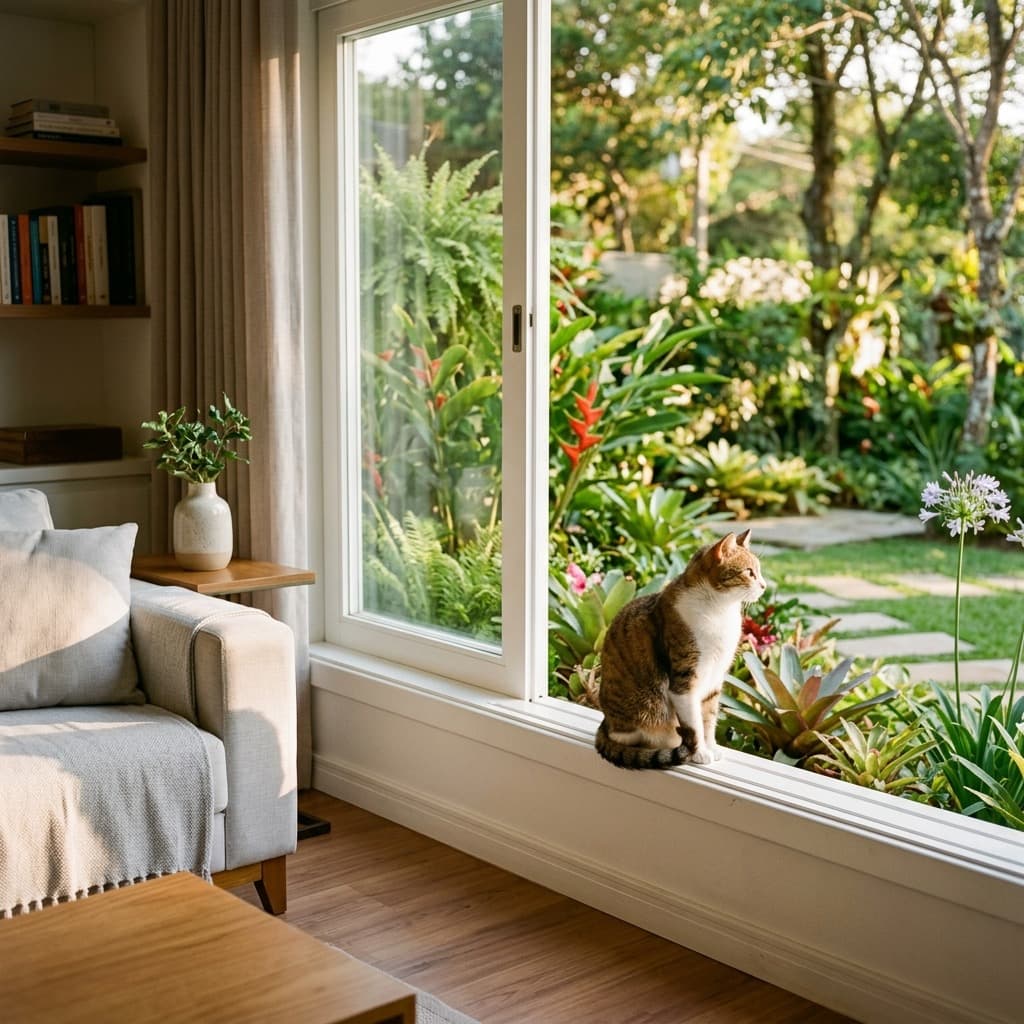
You get home and he is already there, in the hallway, letting out that short meow the moment he sees you. With the neighbor's cat outside the window, the same cat does not make a sound — just growls or hisses, if anything. The reason is that the adult meow practically does not exist between cats. It exists between cat and human, and your cat invented that part just for you.
Adult cats barely meow at each other. Among themselves, the conversation is different: scent, body posture, physical contact. The meow he saves for you is different — it emerged from living together, because at some point he noticed that this sound made you pay attention, and you responded. Repeated hundreds of times, that is what builds the "language" only the two of you speak.
Why is the meow reserved just for you?
Kittens meow at their mother to ask for food and attention — that is kitten behavior, universal among cats. What changes in the adult cat is that this vocalization, which should fade with age, stays reserved for you. Animal behavior researchers describe the adult meow as a tool learned specifically for interaction with humans, almost absent from exchanges between adult cats. Every meow that works — that makes you open the door, serve the food, give attention — reinforces the habit.
Three types you probably already hear every day
| Type | Sound | When it happens | What it means |
|---|---|---|---|
| Greeting | Short, high-pitched | As soon as you walk in | Immediate reaction to your presence — the feline "you're back" |
| Insistent | Repeated in sequence | Until you respond (food, attention, door) | Direct request |
| Long and low | Drawn out, lower pitch | When something in the routine is out of place | Complaint |
1. The greeting meow. Short, high-pitched, let out as soon as you walk in. It is an immediate reaction to your presence — the feline equivalent of a "you're back". Clear context: it happens in the first seconds, before any other interaction.
2. The insistent meow. Repeated, in sequence, until you respond. Food at the wrong time, the door that should be open, the attention he wants right now — this is the direct request meow, and he knows it works because you always respond to it, one way or another.
3. The long, low meow. More drawn out, lower pitch than the other two. It shows up when something has been moved — a changed routine, a door closed that should be open, an object out of its usual spot. It is the complaint meow, and the low pitch is exactly what signals urgency.
According to the ASPCA, adult cats do not meow at each other, only at people: the meow is a kitten talking to its mother and, once grown, the cat stops meowing at other cats.
What NOT to do
- Do not treat every meow as a synonym for hunger — food is just one of the reasons, and treating it that way teaches the cat to meow more for everything.
- Do not ignore repeated meowing assuming it is spoiled behavior — it may be a broken routine or real discomfort worth checking.
- Do not expect your cat to meow at ANOTHER cat the same way it meows at you — that is not how communication between them works.
Frequently asked questions
Why doesn't my cat meow at other cats?
Because the adult meow is, in practice, a communication tool created to work with humans. Among themselves, cats use scent, body posture and physical contact — channels that already work well without needing sound.
My kitten used to meow at its mother — does that change as it grows up?
Yes. Meowing at the mother is kitten behavior and tends to fade. What continues (and sometimes increases) is the meowing directed at you, because it learned that it works in this specific relationship.
Does each type of meow sound different?
Yes, pitch, duration and intensity vary noticeably between a request, a greeting and a complaint — but the exact meaning depends on the context in which it happens, not just on the sound alone.
Should I respond to every meow from my cat?
It is worth paying attention to the pattern: a greeting meow calls for quick acknowledgment; an insistent meow can be a legitimate request or a reinforced habit; a low meow outside your cat's normal pattern deserves attention, because it can signal discomfort.
Each cat develops its own way of talking to you, shaped by your response to every sound. Recognizing the patterns is the first step toward understanding what it is asking for — the second is making sure the rest of its routine, from food to environment, is also aligned with what it needs.
Picked by score from our overall cat ranking, not by the topic of this article. To get it right for your pet — age, weight, spayed or neutered — take the quiz and get a list made for them. A pet with a diagnosed condition needs a diet prescribed by a veterinarian.



