Why Cats Rub Against You at the Door: The Real Reason
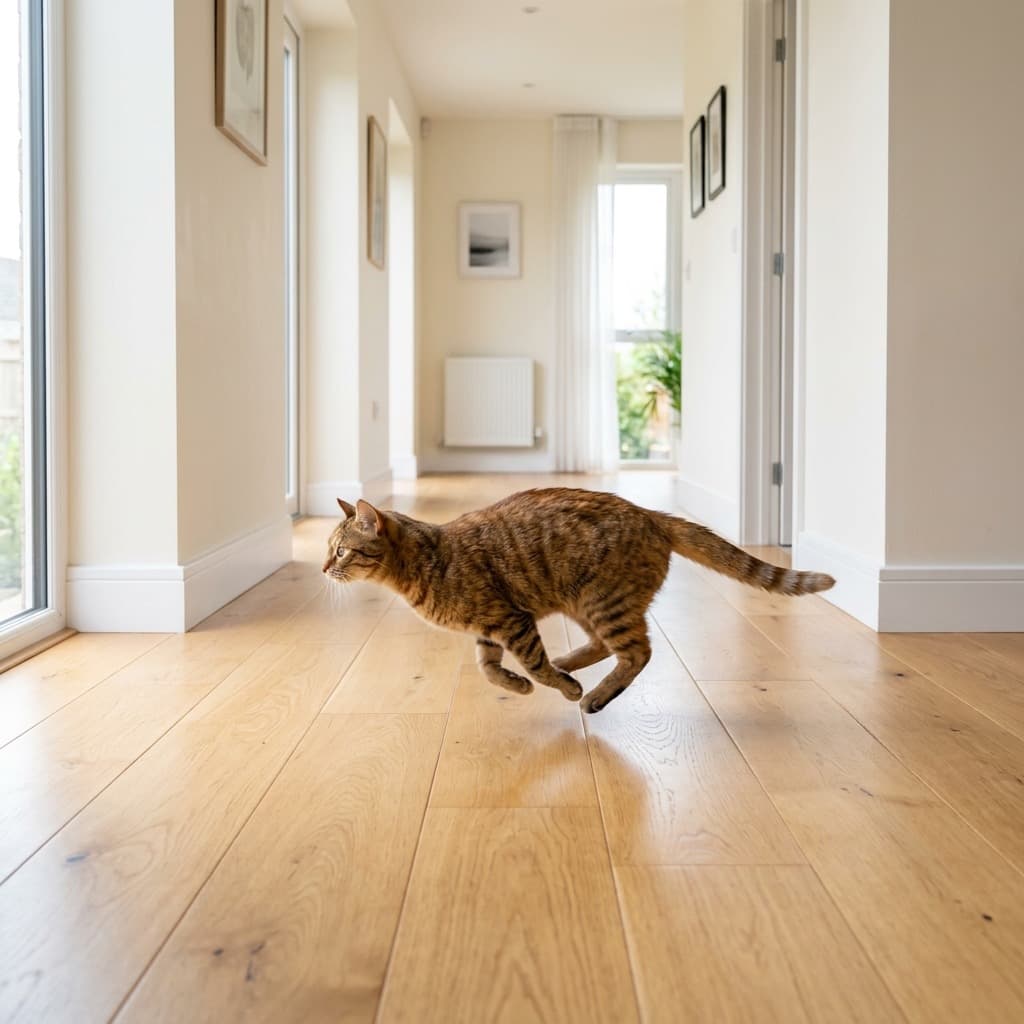
You turn the key, the door opens, and he is already there: rubbing his head against your shin before you set your bag on the floor. It looks like the most affectionate scene of the day. Except the gesture has less to do with missing you and more to do with a problem only he can perceive — you left smelling one way and came back smelling another.
The greeting at the door is about scent, not time
It does not matter whether you were gone for 20 minutes or the whole day: the cat runs to the door the same way, because the trigger is not the clock. It is the strange scent you brought back from outside — from the office, transit, other people, other animals. For an animal that organizes the world by smell, you coming back "smelling wrong" is a small inconsistency that needs to be corrected right away. The rub is that correction.
Why does your scent change when you leave the house?
Every environment and every contact leaves a chemical residue on you — on clothes, skin, hair. Inside the house, that scent stays stable and makes up what researchers call the group's olfactory signature: the mix of smells the cat recognizes as "my territory, my people." Leaving the house dilutes that signature. A cat's cheeks, chin and forehead have facial pheromone glands — when he rubs that area on you, he deposits his own mark that reorganizes your scent back to the home pattern. Washington State University summarizes the mechanism: cheek rubbing releases facial pheromones used to mark territory and, in the case of familiar people and objects, to reinforce the cat's own sense of security (Ask Dr. Universe, WSU).
Where he rubs first tells the story
Pay attention to the ORDER: leg, ankle, outstretched hand — each spot is where the "wrong" scent is most concentrated (near the floor, where you walked outside; or on the hand, if you just touched something). A cat that rubs and then walks away satisfied, without insisting, has solved his problem. A cat that keeps coming back and rubbing again may be signaling something else — hunger, anxiety, or wanting a lap — and it is worth observing the context beyond scent.
| Behavior at the door | What it indicates |
|---|---|
| Rubs and walks away satisfied, without insisting | Resolved the scent inconsistency — protocol complete |
| Keeps coming back and rubbing again | May be something else: hunger, anxiety or a request for a lap |
The affection behind it is real: only those who trust get close enough to rub their face on someone. But the protocol is chemical before it is emotional — first he resolves the scent inconsistency, then he relaxes and moves on to "normal" affection (rubbing his whole body, purring, lying nearby).
Try the test with your cat
Next time you get home, do not pet him back right away — just watch where he rubs first. Leg, ankle, outstretched hand? How long does it take until he relaxes and stops on his own? Does that change if you switch perfume, soap or come back from a place with other animals? These are questions any owner can answer without knowing anything about animal behavior — you just have to pay attention once.
What NOT to do
- Do not push or move the cat away during the rub thinking he is "asking for food" or "getting in the way" — interrupting the ritual does not change his need, it only delays it.
- Do not change perfume/soap often expecting the cat to "get used to it" faster — the more your scent changes with each arrival, the more re-marking work he has ahead.
- Do not confuse the rub with a request for food — they are different gestures; the door rub is short and stops on its own, the food request is insistent and continues even after contact.
Frequently asked questions
My cat doesn't come greet me at the door — is that worrying?
Not necessarily. Elderly, sick, very shy cats, or those who simply learned another routine (waiting on the couch, for example) can skip the door rub without it indicating a problem. It is worth observing whether the change was sudden — then it does deserve attention, because it may signal pain or stress.
Is rubbing against you always a sign of affection?
The gesture comes from a marking mechanism, not from pure affection — but that does not cancel out the affection. Cats only rub against those they consider part of the trusted group; a neighborhood cat will not rub its face on just any stranger on the street.
Why does he rub on furniture and doors too, not just me?
They are the same facial glands, but the function changes: on objects, the cat marks fixed territory; on you, he updates a scent signature that moves (because you leave and come back all the time, unlike the couch).
Does switching soap make the cat act stranger when greeting me?
Yes, especially strong perfumes or ones very different from usual — the bigger the distance between the new scent and the usual one, the more intense the correction rub tends to be, because there is more "inconsistency" to resolve.
Next time the door opens and he comes running, you already know: that is not just affection welcoming you home — it is the family scent being restored, one rub at a time.
Picked by score from our overall cat ranking, not by the topic of this article. To get it right for your pet — age, weight, spayed or neutered — take the quiz and get a list made for them. A pet with a diagnosed condition needs a diet prescribed by a veterinarian.



