Why Cats Knock Things Over: Hunting Instinct, Not Spite
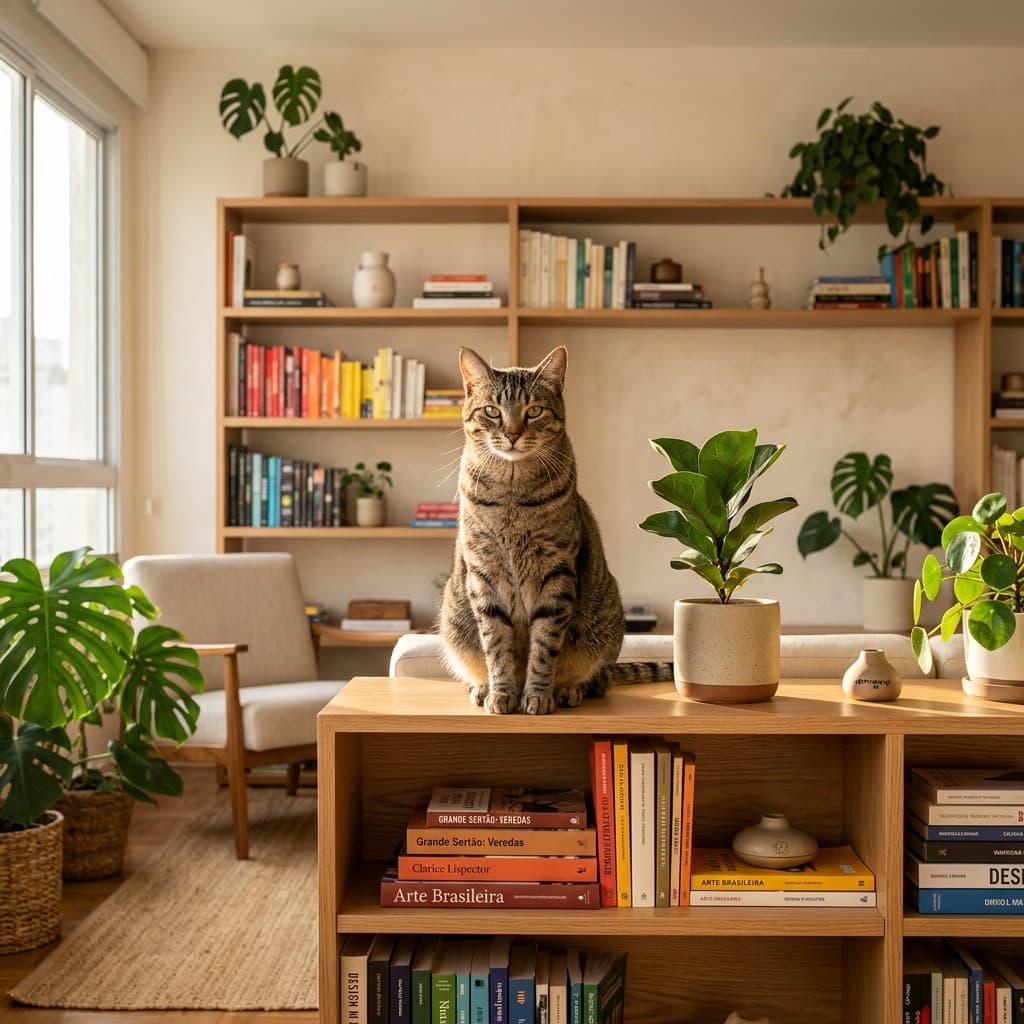
Cats knock objects over out of hunting instinct, not spite or revenge. The tap on the shelf is a sensory sweep — the little paw tests whether the object reacts like prey. The American Association of Feline Practitioners (AAFP) describes this behavior as a normal expression of the feline predatory repertoire, present even in house cats that never had to hunt for food — and a lack of environmental enrichment increases the frequency of this kind of exploratory behavior. The fall of the object confirms the stimulus; the owner's reaction can turn an isolated episode into a habit through associative reinforcement.
Your shelf is intact in the morning. By afternoon, the glass has fallen, the plant is on the floor and the remote is under the couch — and the cat is sitting right next to it, looking at you with complete indifference.
The most common conclusion among owners is that the cat is angry or throwing a tantrum. That reading is understandable, but wrong — and understanding what is actually happening completely changes how you deal with the behavior.
What the little paw is testing
Cats are predators by nature. Even when raised in an apartment, never having to hunt for food, the feline brain keeps circuits for detecting and capturing prey active — the AAFP/AAHA feline life stage guidelines recognize that toys "offer an outlet for normal predatory sequences" as part of play, an expression of this repertoire present even in cats that never had to hunt.
When the cat touches an object on the shelf, the gesture has no punitive intent: it is a sensory sweep. The paw assesses whether the object reacts — whether it trembles, falls, rolls or makes a sound. An object that moves fits the prey profile. The fall is confirmation that the stimulus was real.
The instinct, therefore, is not directed at you — it is directed at the environment. The shelf became a hunting ground because it offers objects with the potential to move.
How your reaction enters the game
A second factor turns the isolated behavior into a habit: the owner's response.
When you rush to pick up the object, scold the cat or react in any way — even with irritation — you inadvertently provide positive reinforcement. In feline logic: the gesture produced movement, noise and the immediate presence of the owner. That is equivalent to a successful hunt.
The cycle sets in: push → reaction → play. The more expressive the reaction, the more the behavior tends to repeat. Not because the cat is manipulative, but because associative learning works this way in felines.
| Owner's reaction | Effect on the cat | What to do instead |
|---|---|---|
| Rushing to pick up the object | Positive reinforcement — equivalent to a successful hunt | Reorganize without expression, without calling out |
| Scolding after the fact | The cat does not link the scolding to the past act — it only creates confusion and anxiety | Never scold, especially after the fact |
| Restricting access to the room | Shifts the behavior to another environment, does not eliminate the instinct | Offer hunting toys and environmental enrichment |
| Physical punishment | Compromises trust and can cause other behavior problems | Never use |
How do you redirect a cat that knocks things over at home?
Redirecting the instinct does not require changing the cat — it requires offering better outlets for the same need that takes it to the shelf. The three strategies that work together: daily hunting toys, which mimic prey behavior; environmental enrichment with scratching posts and accessible windows; and a neutral owner reaction, which does not reinforce the behavior with attention.
-
Daily hunting toys. Feather wands, plush mice, balls with irregular movement — items that mimic prey behavior activate the same circuits as the shelf. Two sessions of 10 to 15 minutes a day already significantly reduce the search for stimulation in the static environment.
-
Environmental enrichment. Vertical scratching posts, cat shelves, accessible windows with outdoor stimuli and varied hiding places give the cat multiple ways to explore and keep watch without depending on the objects in the living room. The more the environment responds to the cat, the less the shelf is needed.
-
Neutral owner reaction. Hard in practice, but effective: not giving the behavior attention right away removes the interaction component that reinforces it. Reorganize the objects without expression, without calling out, without eye contact at that moment — and save your attention for legitimate play.
What NOT to do
- Scold the cat after the fact. Cats do not connect a scolding with a behavior that happened seconds earlier. The association the cat makes is with the present moment — and a late reprimand only creates confusion and anxiety, without changing the pattern.
- Restrict access to the space without offering an alternative. Closing a room does not eliminate the instinct — it shifts the behavior to another environment. The solution must be replacing the stimulus, not suppressing access.
- Use physical punishment. Besides being ineffective for changing feline behavior, it compromises the trust between cat and owner and can trigger other behavior problems.
Frequently asked questions
Why does my cat do this mostly in the middle of the night?
Cats are crepuscular animals — they have natural activity peaks in the early morning and at dusk. At those times, the hunting instinct is most active. A play session before you go to sleep helps the cat burn off energy productively.
Do older cats do this too?
Yes, although less often. The hunting instinct persists throughout a cat's whole life; what varies is the intensity. Adult cats may show the behavior especially when the environment does not offer enough stimulation.
Does this mean my cat is stressed?
Not necessarily. The isolated behavior is, in most cases, a normal expression of instinct. If it comes with other signs — hiding, excessive vocalization, changes in appetite — a veterinary visit is worthwhile to rule out causes related to stress or pain.
Should I take everything off the shelf?
Reorganizing what is sentimental or fragile is a practical measure while the behavior is intense. In the long run, the most effective solution is redirection through enrichment — not emptying the environment.
Your cat does not act with the intent to cause damage. He acts as a hunter — because that is what he is. The shelf is just the available environment that responded to the instinct. With regular hunting toys and a more stimulating environment, it stops being the most interesting option in the house.
Picked by score from our overall cat ranking, not by the topic of this article. To get it right for your pet — age, weight, spayed or neutered — take the quiz and get a list made for them. A pet with a diagnosed condition needs a diet prescribed by a veterinarian.



