Persian, Himalayan and Exotic: What Is the Real Difference?
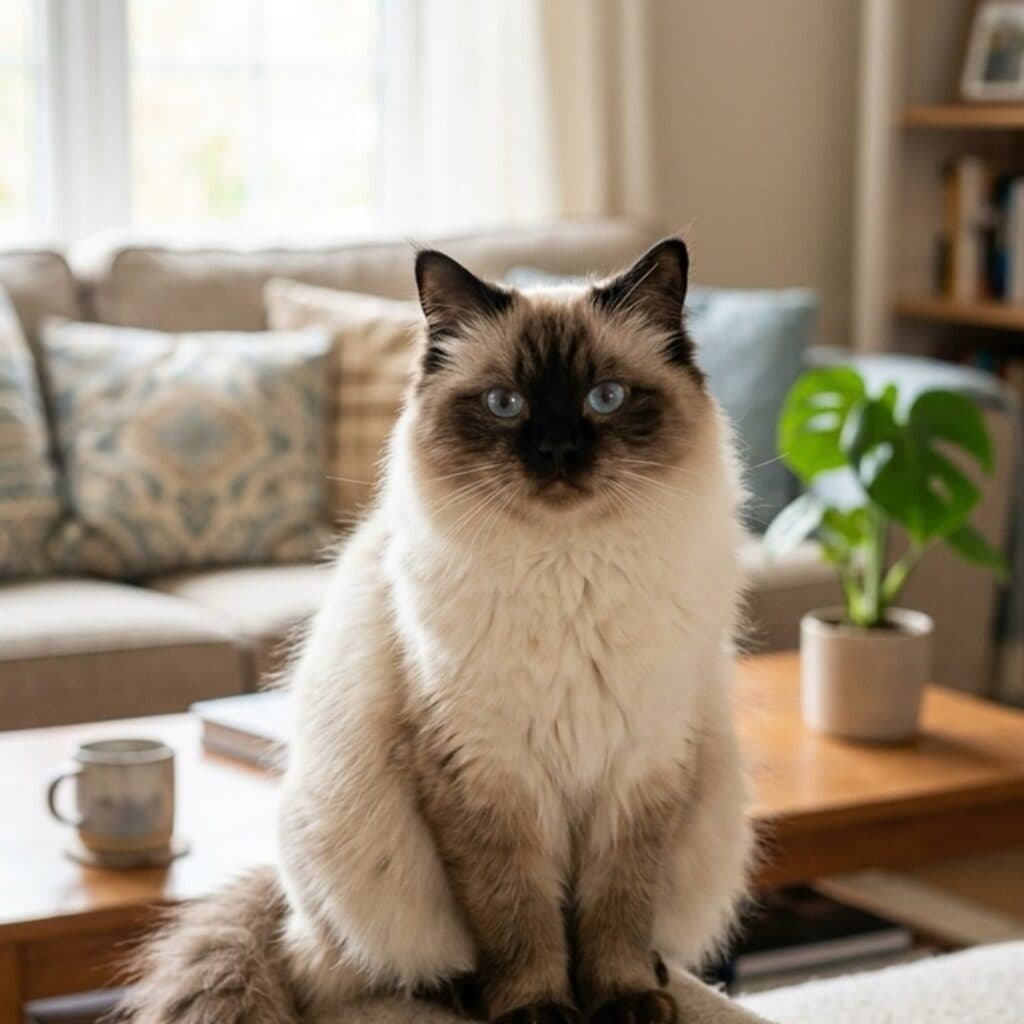
Three ads, three prices, three names — and the same face. Persian, Himalayan and Exotic show up in classified ads as if they were completely separate breeds, but two of those three names describe the same animal with one genetic piece added or removed. Before deciding which one to take home, it is worth understanding what really changes between them — and what all three share, including what is not an advantage at all.
The Himalayan is a Persian with the Siamese gene
The Himalayan comes from a cross between a Persian and a Siamese. From that mix, it inherits the color-point gene — the same one that darkens the muzzle, ears, paws and tail of the Siamese, creating that contrast between the light body and the dark extremities. The rest of the genetic package comes from the Persian: sturdy body, long coat, flat face and the same homebody temperament.
In practice, a Himalayan is a Persian colored in a specific way. Body structure, coat type and face shape are identical to those of a traditional Persian. The color distribution changes — and that is all that changes.
The Exotic is a short-haired Persian
The Exotic follows the same logic as the Himalayan, only in the opposite direction. It comes from a cross between a Persian and an American Shorthair, and what it inherits from that mix is precisely the short coat. It kept the massive body, round head and flat face of the Persian, but without the long coat that demands daily brushing.
Anyone looking for the Persian look without the upkeep of a long coat finds that combination in the Exotic. It is the same animal on the inside, with one specific swap: short hair in place of long hair.
Are Himalayans and Exotics real breeds?
Genetically, they are not independent lineages — they were born from controlled crosses of the Persian with another breed, aiming at a specific trait (color in the Himalayan, coat length in the Exotic). The rest of the breed standard — body, head, temperament — remains that of the Persian.
That is why the most honest way to describe the three is as variations of the same trunk: a Persian with the Siamese gene, a short-haired Persian, and the original Persian between the two. They are not three different animals competing in distinct categories of personality or size — they are the same physical base with different visual results.
This changes the question a prospective adopter should ask. It is not "which of these three breeds suits me," but "which of these three combinations of coat and color do I prefer to care for day to day."
The flat face: the same breathing cost in all three
Here is the point most ads do not mention: Persian, Himalayan and Exotic share the same flat face — brachycephaly — and the breathing cost that comes with it.
A flattened skull reduces the internal space of the airways. In daily life, this shows up as:
- Snoring and noisy breathing, even at rest.
- Lower tolerance for heat and physical effort — the cat tires faster and seeks cool places more often.
- Constant tearing (epiphora), because the shape of the skull also affects drainage of the tear duct, leaving dark stains under the eyes.
- Deeper facial folds, which trap moisture and dirt and need regular cleaning so they do not irritate the skin.
None of these three cats escapes this, because the flat face is not an isolated aesthetic detail — it is skull structure shared by all three. Coat color and hair length do not change this trait at all. Before choosing any of the three, it is worth talking to a veterinarian about routine respiratory and eye monitoring, and about how to identify signs of discomfort beyond the expected snoring. The Cornell Feline Health Center gathers materials on feline health that support this routine monitoring in flat-faced breeds.
Coat and upkeep: the real choice among the three
Since the physical base is the same, the decision among Persian, Himalayan and Exotic is about care routine, not temperament or size:
| Breed | Coat | Origin of the cross | Upkeep |
|---|---|---|---|
| Persian | Long | Original lineage, no outside cross | Daily brushing; tangles and hairballs need constant attention |
| Himalayan | Long, with color-point markings | Persian × Siamese (color-point gene) | Daily brushing, plus more attention to cleaning the color-point areas |
| Exotic | Short and dense | Persian × American Shorthair | Weekly brushing, simpler upkeep |
None of these routines is optional. The difference is only the time each one takes per week.
What NOT to do
- Do not pay more thinking Himalayans or Exotics are "rarer" breeds or genetically distinct from the Persian. The price should reflect responsible breeding and the animal's health, not a supposed status as an independent breed.
- Do not choose by color or hair length and ignore the respiratory history of the lineage. Ask the breeder about the muzzle type of the parents — the flatter it is, the higher the risk of breathing discomfort in the kitten.
- Do not skip the daily cleaning of eyes and facial folds thinking it is only aesthetic. Moisture buildup in those areas becomes an entry point for skin infection.
- Do not buy from anyone who claims Himalayans or Exotics "have nothing to do" with the Persian. It is a way of hiding the shared respiratory risk behind a name that sounds like a separate breed.
Frequently asked questions
Does a Himalayan cost more than a Persian?
It depends on the breeder, not the breed itself. Since the Himalayan is not a genetically separate lineage from the Persian, there is no technical justification for a higher price based on "genetic rarity." Price differences usually reflect the quality of breeding, the parents' health history and the region — not a supposed exclusivity of the color-point variation.
Does the Exotic have the same breathing problems as the long-haired Persian?
Yes. The Exotic's short coat does not change the skull structure, which is inherited from the Persian. The breathing cost of the flat face is the same in both, because it comes from skull anatomy, not from the coat.
Can a regular Persian and a Himalayan come from the same litter?
Yes, it is possible. Since the color-point pattern depends on a specific gene inherited from both parents, a litter from parents that carry this gene can produce kittens with and without the color-point markings — even though they are all genetically Persians.
Which of the three is easiest to care for day to day?
In terms of coat, the Exotic requires the least brushing time. But the routine of cleaning eyes and facial folds, plus respiratory monitoring, is the same in all three — because it comes from the same flat-face structure, not from the coat.
Picked by score from our overall cat ranking, not by the topic of this article. To get it right for your pet — age, weight, spayed or neutered — take the quiz and get a list made for them. A pet with a diagnosed condition needs a diet prescribed by a veterinarian.



