4 Involuntary Cat Reflexes Your Cat Doesn't Choose to Do
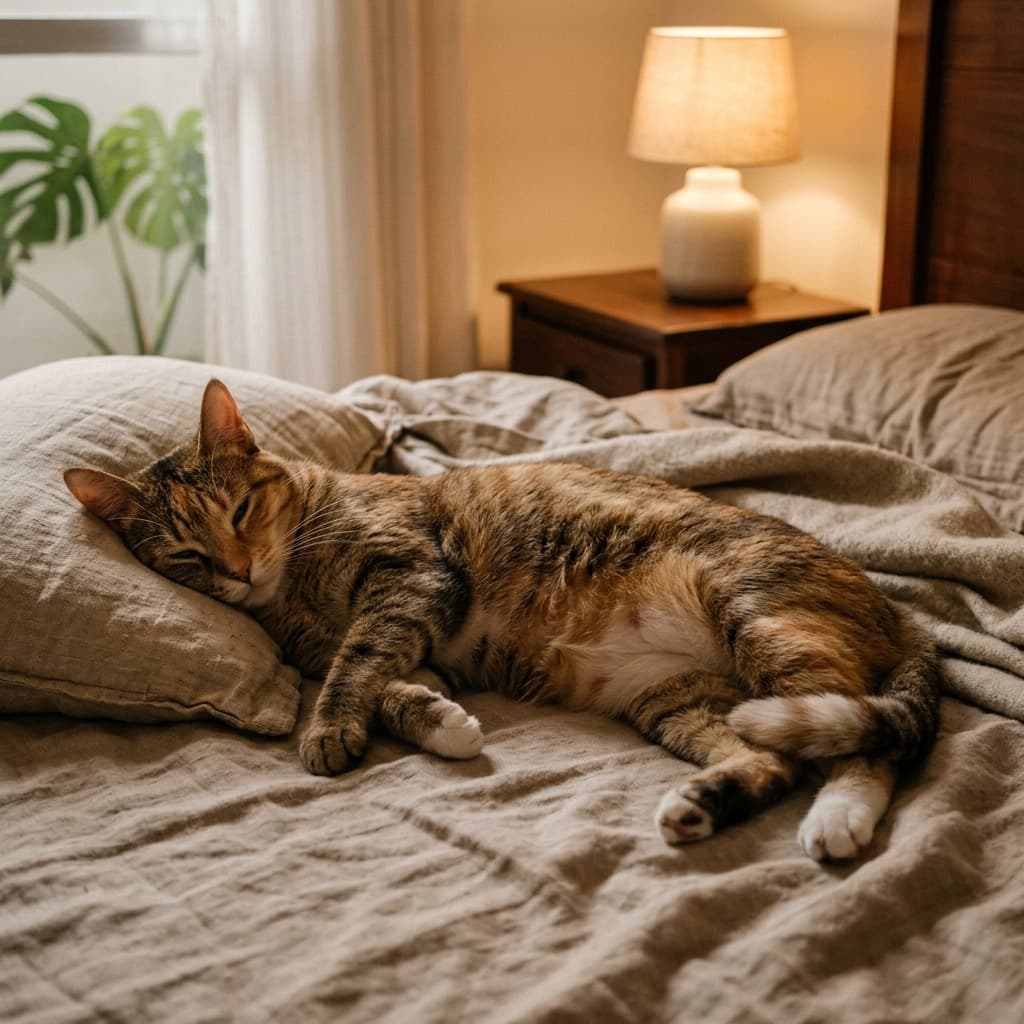
Your cat turns an ear backward without even looking, arches his back when you touch near the tail, and swings his tail like a wound-up metronome. None of this is him deciding anything — it is the nervous system reacting on its own, the same way the knee reacts to the little hammer at the doctor's office. These are reflexes, not chosen behavior, and you can check all 4 right now, on your cat.
1. Lordosis: why the back arches when you touch the base of the tail
When a hand passes near the base of the tail, some cats' backs arch and the hips lift on their own — that is lordosis, a spinal reflex: the message does not even go up to the brain, it comes straight back at the spinal cord. It is the same circuit that becomes more evident during heat, but it does not depend on heat — males, spayed females and kittens can also show the reflex, to different degrees.
Why does a cat's ear swivel on its own toward a sound?
Each cat ear has about 32 muscles — about five times more than the human ear — and uses them to rotate up to almost 180 degrees without looking at the source of the sound. It is a way of triangulating the sound: by turning the two ears independently, the brain compares the time difference between them and calculates where the noise is coming from. It does not require conscious attention — it happens even when the cat is dozing.
Whiskers sense the air before any other sense
Vibrissae — the technical name for whiskers — grow out of a follicle far more innervated than that of an ordinary hair, with receptors specialized in pressure and vibration. This turns them into a kind of contact radar: they pick up the air current that any nearby object displaces, and send the brain the size and distance of the thing before the whisker even touches it. That is why you should not cut the whiskers — removing the hairs removes part of the sensory map the cat uses to move in the dark, according to VCA Animal Hospitals (source).
Is a swishing tail anger or joy?
Unlike in dogs, a quickly moving tail in a cat is not joy — it is a motor discharge of irritation or overstimulation. The body lashes the tail from side to side before the cat gets to growling or scratching: it is a warning before the bite, the kind of signal worth learning to recognize early, especially in the middle of a petting session.
| Reflex | What triggers it | What it means |
|---|---|---|
| Lordosis (arched back) | hand touching near the base of the tail | spinal reflex that returns at the spinal cord; does not depend on heat |
| Ear rotation | sound coming from any direction, even with the cat dozing | about 32 muscles rotate the ear up to almost 180° to triangulate the source |
| Whiskers on alert | air current displaced by a nearby object | map size and distance before the whisker touches |
| Rapid tail swishing | repeated contact or overstimulation | motor discharge of irritation — a warning before the bite |
What NOT to do
- Do not keep touching the base of the tail repeatedly thinking the reflex is always welcome — repeated too much, it can become discomfort.
- Do not confuse a swishing tail with the same signal in a dog — in a cat, it is usually the opposite of joy.
- Do not cut or trim the whiskers for aesthetics — it removes part of the cat's sensory system.
Frequently asked questions
Is lordosis in cats always a sign of heat?
Not exclusively. It is a spinal reflex present in females and males, neutered or not — it becomes more evident during heat because of circulating hormones, but the reflex arc itself does not depend on that.
Does a deaf cat also turn its ear toward a sound?
Only if some hearing remains in at least one ear — the rotation depends on the sound reaching the eardrum. In total deafness on both sides, this specific reflex is simply not triggered.
Does cutting a cat's whiskers hurt?
It does not hurt like cutting an ordinary hair, but it disorients: the base of the whisker is far more innervated than that of an ordinary hair — without them, the cat loses part of the distance map it uses in the dark.
Is every tail swish irritation?
The quick, sharp movement from side to side, yes. A slow, soft swing usually accompanies concentration, like when the cat is stalking — the difference is in the speed, not just the gesture.
In the end, the cat is not "deciding" to communicate every time an ear turns or the tail swishes — the body reacts before the head takes part, the same way the knee reacts to the little hammer at the doctor's office. Recognizing the reflex avoids over-reading an automatic gesture — and helps you notice when he is truly bothered.
Picked by score from our overall cat ranking, not by the topic of this article. To get it right for your pet — age, weight, spayed or neutered — take the quiz and get a list made for them. A pet with a diagnosed condition needs a diet prescribed by a veterinarian.



