Does Your Cat Think You're a Cat? What Science Says
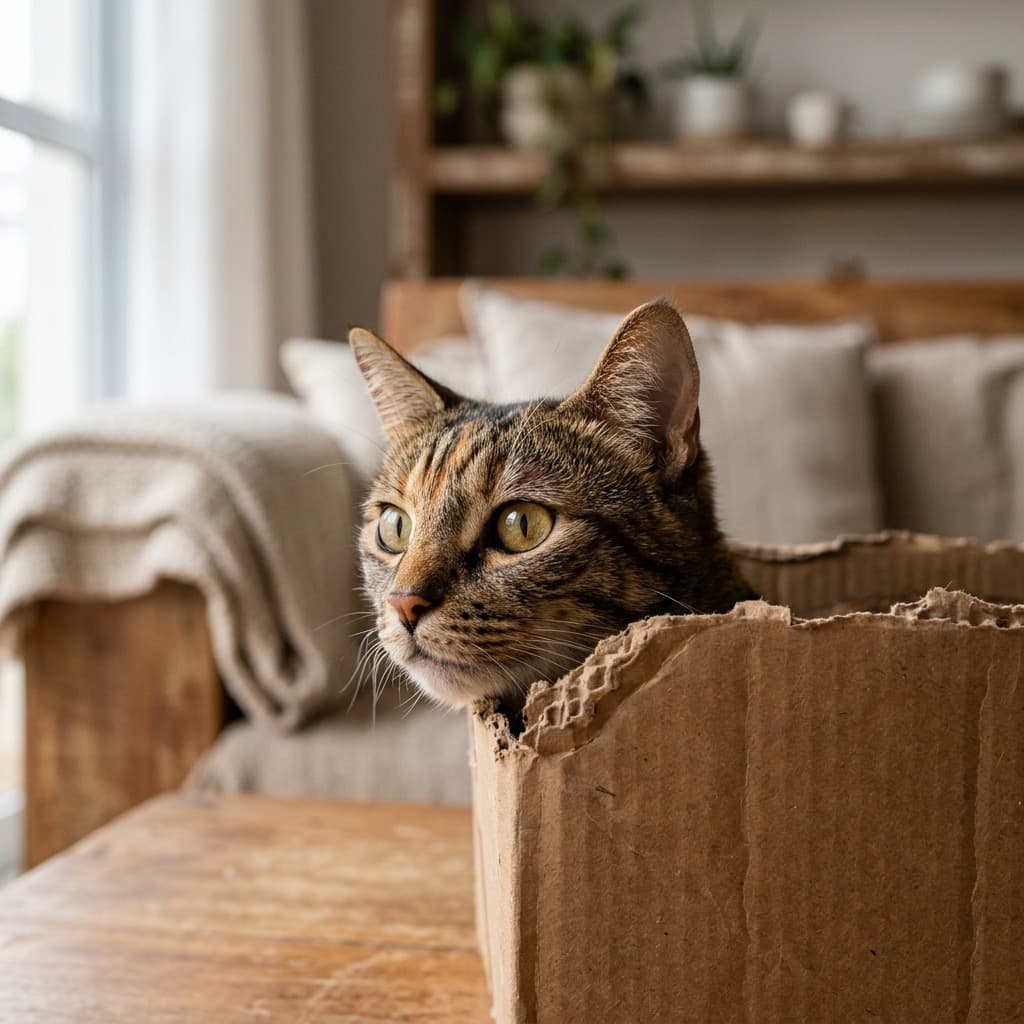
Adult cats barely meow at each other — frequent meowing is a behavior developed specifically to communicate with humans, according to a study published in Animal Cognition and indexed in PMC/NCBI. That already says a lot: your cat does not have one way of treating humans and another way of treating cats. He uses the same repertoire with you that he would use with any other feline. In practice, to him, you are just a big, somewhat clumsy cat that joined the family.
Why does my cat treat me like another cat?
The cat does not distinguish a "human mode" from a "cat mode" in his own social repertoire. He applies to his owner the same signals he would use with another feline — slow blinking, rubbing his face, meowing to ask for something — because, in practice, daily life together has put the human in the category of "group member", not a separate species.
The cat did not demote you or promote you — it included you
Dogs organize life together around a figure who leads. Cats do not work that way. The cat does not see the human as a superior species that serves the food, or as a boss to obey. He simply applies to you the same social codes he would use with another feline.
This seems like a detail, but it flips the key to reading everything. When you understand that each of his gestures is cat-to-cat language, you stop misreading what he does — and you stop getting frustrated thinking he is "ungrateful" or "cold".
The slow blink is treating you as an equal
Perhaps the most beautiful signal is the easiest to ignore. When the cat looks at you and slowly closes his eyes, he is making the nod of trust that one feline makes to another feline he trusts. The study "The role of cat eye narrowing movements in cat-human communication" (Humphrey et al., 2020, Scientific Reports via PMC) confirmed this effect in the laboratory. It is not submission to a superior: it is equal recognizing equal.
And the conversation goes both ways. If you return the slow blink, with a relaxed gaze, many cats respond. It is one of the simplest ways to say "I trust you too" in his language, with no treat or toy.
Why he rubs his face on you
When the cat rubs his face and body on you, it is not just a request for affection. He has scent glands on his face and flanks, and he is mixing his scent with yours. The goal is to merge the two scents into one — the group's scent, the scent of the home where you live.
It is the same reason he rubs the door frame and the corner of the couch: marking the territory as safe and familiar. The difference is that, with you, this gesture includes you in the family scent.
The meow was invented for you
Here is the detail almost nobody knows. Adult cats almost never meow at other cats. Among themselves, communication is through scent, posture and facial expression. Frequent meowing is a behavior the cat develops specifically to communicate with humans, because he learned that it works with us.
In other words: that conversation of meows he has with you is a language he created just for your home. Each cat adjusts his meows to the owner he has. It is intimate, and it is only yours. To find out which other words your cat actually recognizes, see what your cat understands when you talk.
| Signal | What it means | Equivalent between cats |
|---|---|---|
| Slow blink | Nod of trust | Equal recognizing equal |
| Face rubbing | Mixing his scent with yours | Same gesture used on the door frame and the couch |
| Meow | Communication created specifically for humans | Adult cats barely meow at each other |
What NOT to do
- Do not force affection when he backs away: insisting breaks the trust that the slow blink built.
- Do not treat the meow as whining: he is trying to communicate with you. Always ignoring it teaches him the conversation is not worth having.
- Do not confuse independence with indifference: a cat that watches from a distance still considers you part of the group.
Frequently asked questions
Does my cat really think I'm a cat?
Not in the literal sense, but he treats you with the same social codes he would use with another cat: slow blinking, rubbing his face, meowing to call. To his behavior, you are part of the feline group.
Why does my cat meow so much at me?
Because the meow is speech he developed for humans. Adult cats barely meow at each other; your cat learned that meowing works with you and adjusted those sounds to your routine.
What does it mean when my cat blinks slowly at me?
It is a nod of trust between equals: the slow blink reduces facial tension and replaces physical contact as a signal of safety, something an alert or distrustful cat does not do — he keeps a fixed gaze. You can answer by blinking slowly back, with a relaxed gaze, and strengthen the bond.
Why does my cat rub his face on me?
He has scent glands on his face and is mixing his scent with yours, to create a shared family scent and a safe territory.
Why are cats more independent than dogs in showing affection?
Cats signal bonding in subtle ways — slow blinking, face rubbing, purring nearby — while dogs seek active physical contact. Both species form strong bonds; the codes are different.
Your cat does not see you as an owner or as a superior species: he has adopted you as one of his own. The slow blink, the face rubbing and the meow invented just for you are his way of saying that every day. Reading those signals is the first step. The second is taking care of what sustains that bond in the daily routine, starting with the right food for him.
Picked by score from our overall cat ranking, not by the topic of this article. To get it right for your pet — age, weight, spayed or neutered — take the quiz and get a list made for them. A pet with a diagnosed condition needs a diet prescribed by a veterinarian.



