Do Cats See You as Human? 5 Hypotheses From Science
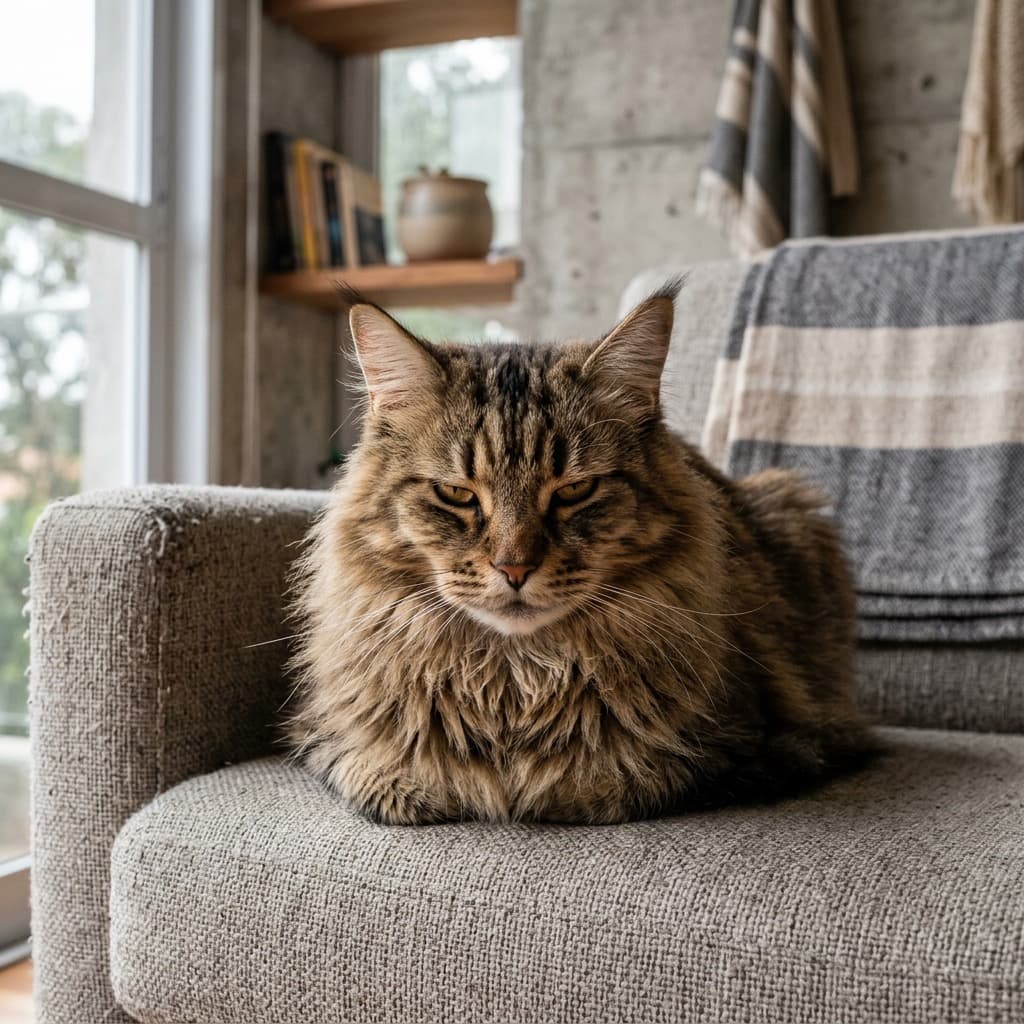
You come home, your cat rubs his head against your shin and purrs loudly. It looks like affection from someone who knows exactly who takes care of him. But in the cat's mind, that scene probably does not involve the word "human" — because his social repertoire has no such category. Feline behavior research has raised at least five hypotheses about how a cat actually classifies his owner, and none of them is "a different species that I respect because it is bigger."
The most accepted hypothesis: a big, weird cat
The strongest reading among ethologists is that the cat places you as a big, weird cat. He uses on you the same gestures he would use with another cat: rubbing his body (bunting), sleeping pressed against you and marking with his own scent those who belong to the group. It is not a put-down — it is the only social mold he has available, and you fit into it for lack of a better category.
Why does food weigh so much in the bond?
Another hypothesis, less romantic: part of the cat's relationship with you is about resource predictability. Whoever opens the can at the right time, keeps the water clean and the temperature steady enters the cat's radar as a reliable source — and that earns real points in the bond, even if it is not the whole explanation. Consistent care (schedule, amount, environment) tends to produce a more relaxed cat than erratic care, even with the same amount of affection.
A fellow cat without hierarchy — and that changes everything
Unlike the dog, which structures the relationship around clear signals of submission and leadership, the cat does not show hierarchy with the owner. He does not "obey" in the canine sense; he coexists. The Cornell Feline Health Center describes this trait as a central part of feline sociability: the cat accepts closeness and cooperation without positioning himself as subordinate — which explains why dominance-based training methods simply do not work with them.
The echo of kitten behavior
The fourth hypothesis comes from a behavioral detail studied for decades: an adult cat almost never meows at another adult cat — meowing is, at its origin, a kitten's conversation with its mother. With the owner, that repertoire is never switched off: the cat keeps meowing, kneading with his paws (the nursing gesture, reactivated) and seeking out your lap. These are kitten signals that he reserves specifically for whoever plays that caregiving role — which supports the idea of a parental bond that carries through adult life.
Social peer: the hypothesis with the most scientific evidence
The fifth hypothesis has the most solid backing. A study published in Current Biology by Oregon State University put cats through the same test used to measure attachment between human infants and caregivers (the "Secure Base Test") and found that most cats use the owner as a secure base: they explore a new environment more when the owner is nearby and show signs of stress when the owner leaves. The pattern is comparable to that found in dogs and young children.
The 5 hypotheses, summarized
| Hypothesis | What it says |
|---|---|
| Big, weird cat | The cat uses on you the same social gestures he would use with another cat (rubbing, sleeping pressed against you, scent marking) |
| Resource predictability | Whoever offers food and care on a steady schedule enters the cat's radar as a reliable source |
| Fellow cat without hierarchy | The cat shows neither submission nor leadership with the owner — he coexists, he does not obey |
| Echo of kitten behavior | Meowing, kneading with the paws and seeking your lap are kitten signals reserved for whoever cares for him |
| Social peer (most scientific evidence) | A study using the "Secure Base Test" showed the cat uses the owner as a secure base, a pattern comparable to dogs and children |
What NOT to do
- Do not treat these hypotheses as mutually exclusive — most likely your cat mixes a little of each, depending on the situation and life stage.
- Do not confuse "no hierarchy" with "no rules" — the cat still responds better to a predictable routine than to chaos, even though he does not see you as a leader.
- Do not ignore sudden changes in behavior (stopping rubbing, stopping seeking your lap) — they can signal pain or stress, not just a personality choice.
Frequently asked questions
Does my cat really love me, or does he just use me for food?
Both coexist: the bond is real (seen in the secure base test), but it is built on a layer of resource — predictable food and care strengthen attachment, they do not replace it.
Why does my cat meow at me but almost never at other cats?
Because meowing is, at its origin, a kitten's request to its mother; adult cats use other channels (scent, posture, physical contact) among themselves, but keep meowing specifically for whoever cares for them — usually the owner.
If he doesn't see me as a leader, why does he sometimes "obey"?
He does not obey out of hierarchy the way a dog does — he cooperates when the action is predictable and non-threatening. It is association, not submission; that is why punishment usually makes the behavior worse instead of correcting it.
Do senior or rescued cats form this kind of bond the same way?
Yes, but the pace changes: rescued cats, or cats with little social contact early in life, may take longer to show signs of secure attachment — a stable routine is still the most reliable path to get there.
Whatever hypothesis best fits your cat, his behavior toward you is not indifference in disguise — it is the bond he knows how to build, with the repertoire he has. Find the ideal food for your cat →
Picked by score from our overall cat ranking, not by the topic of this article. To get it right for your pet — age, weight, spayed or neutered — take the quiz and get a list made for them. A pet with a diagnosed condition needs a diet prescribed by a veterinarian.



