Cats With Unusual Bodies: The Genetics Behind Them
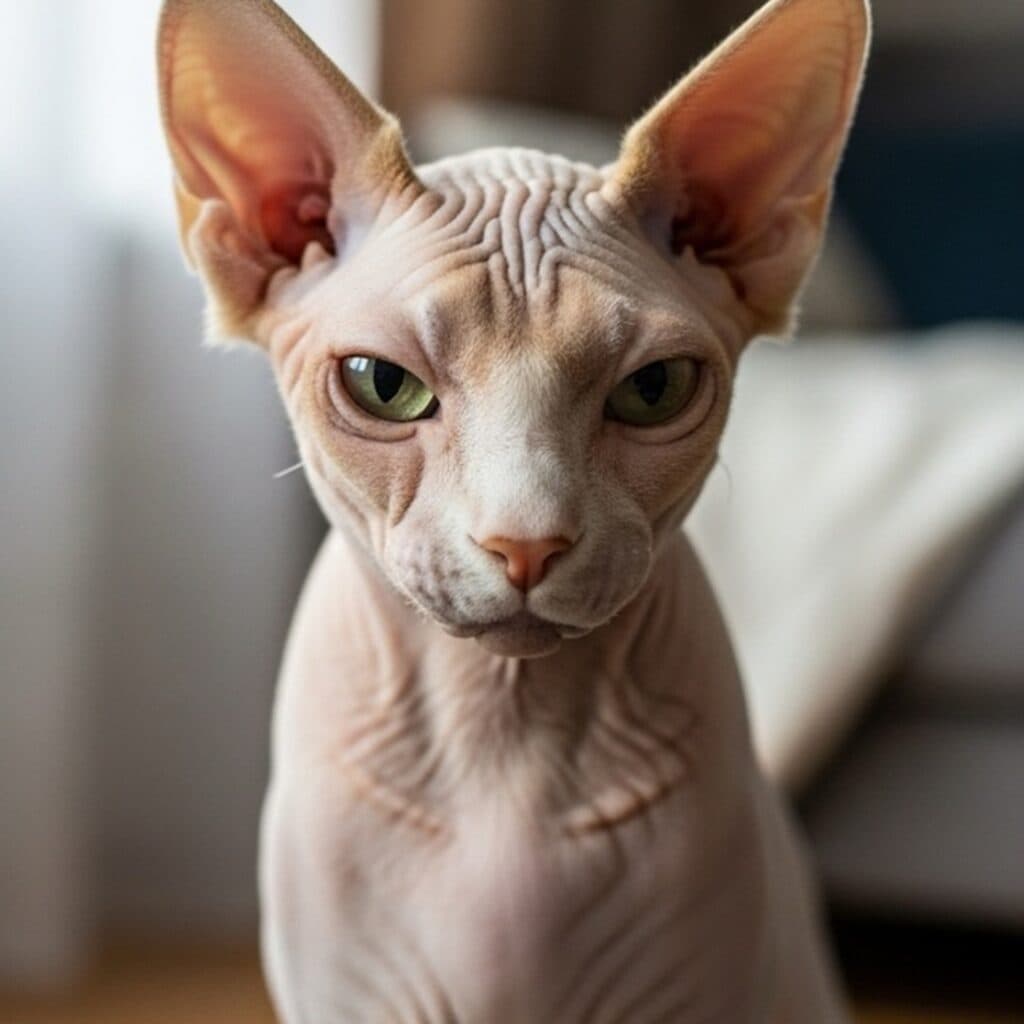
You see a cat with no fur at all, or one with a coat full of curls, and the first reaction is often to think something is wrong with it. There isn't. Four cat bodies that depart from the standard each have a documented genetic explanation behind them. What looks like a defect is inheritance.
Is an unusual body a health problem?
Not always. Each of the four traits below comes from a mutation identified in a specific gene, passed from parent to offspring like any other characteristic. The hairless skin of the Sphynx, the wavy coat of the Devon Rex and the Cornish Rex, the short tail of the Japanese Bobtail — none of these came from an accident or from mistreatment. They came from genetics.
That doesn't mean the trait is neutral for the cat's body. Some call for extra care precisely because of the mutation they carry — as is the case with the Sphynx's skin, as you'll see below.
The 4 bodies and the gene behind each
| Breed | Unusual trait | Documented gene |
|---|---|---|
| Sphynx | No coat | KRT71 (needs two copies of the variant) |
| Devon Rex | Wavy coat | KRT71 (different variant from the Sphynx's) |
| Cornish Rex | Wavy coat | LPAR6 (different gene from the Devon Rex's) |
| Japanese Bobtail | Short, curved tail | HES7 |
Sphynx: the mutation that removes the coat
The Sphynx's lack of fur comes from a mutation in the KRT71 gene. This gene takes part in forming the hair shaft, and the variant present in the breed interrupts that process before the hair actually grows — what is left on the skin is a fine down, almost imperceptible to the touch. A study published in the journal Mammalian Genome mapped this mutation in KRT71 and showed that it is also behind the Devon Rex's wavy coat — only in a different variant of the same gene.
The point many people don't know: the mutation only shows up when the kitten inherits two copies of the altered gene, one from each parent. A cat with just one copy doesn't go bald — it carries the mutation without showing it. That is why two Sphynx bred together produce a litter of Sphynx, but a Sphynx bred to an ordinary-coated cat can produce kittens with a normal coat, depending on how many copies each parent carries.
In day-to-day care, the lack of fur changes what the owner needs to watch for: without the layer of protection that fur normally provides, the Sphynx's skin is more exposed to sun, cold and oil buildup. It is not a breed that needs no care — it is a breed that swaps fur care for skin care.
Devon Rex and Cornish Rex: similar coat, different gene
From a distance, the Devon Rex and Cornish Rex look like the same breed in different bodies: both have a wavy, short, almost frizzy coat. Up close, the genetics tell a different story. Each breed's waviness comes from a different gene — it is not the same mutation repeated in two bodies, it is two distinct causes that arrived at a similar visual result.
That difference under the surface matters more than it seems when it comes to breeding. Two different mutations don't add up the same way or behave the same way in inheritance — treating the Devon Rex and the Cornish Rex as genetically interchangeable is a common mistake, but it is a mistake. A study published in the journal PLOS ONE identified the Cornish Rex gene as LPAR6 — confirming that the cause behind the two breeds' wavy coats is not the same.
For the owner, the wavy coat of both breeds tends to be finer and sparser than that of an ordinary straight-coated cat. That calls for the same attention the Sphynx demands, to a lesser degree: protection against cold and extra care for exposed skin in areas where the coat is thinner.
Japanese Bobtail: the gene for the short, curved tail
The Japanese Bobtail rounds out the list with a trait that is in its very name: the short, curved tail, quite different from the long, straight tail of most cats. Behind it is the HES7 gene, responsible for this different formation of the tail spine.
Unlike the Sphynx, the Bobtail's short tail is not about a missing structure — it is about a structure formed in a different way. The cat is born with the tail already in that shape, and it doesn't grow or develop like that of a cat with an ordinary tail. A study published in the journal Scientific Reports mapped the mutation in HES7 and confirmed the link with the Japanese Bobtail's short tail.
What the four have in common
Put the four cases together and a pattern appears: a hairless cat and a curly-coated cat can come from the same type of gene, just in a different dose. The Sphynx gene interrupts hair formation; the Devon Rex and Cornish Rex genes alter the shape of the hair without eliminating it; the Bobtail gene changes the bone formation of the tail, not the hair. These are distinct mechanisms, all documented, and none of them a "factory defect".
Understanding this origin changes how you evaluate any of these four breeds. It isn't about accepting or not accepting an unusual appearance — it is about knowing that an unusual appearance, in these cases, comes with a genetic explanation and, in at least one of them, with extra skin care.
What NOT to do
- Don't treat the Sphynx's lack of fur as purely cosmetic. The exposed skin calls for cat-appropriate sunscreen, a warm environment and regular cleaning of the oil that fur would normally absorb.
- Don't assume the Devon Rex and Cornish Rex are the same thing genetically. The similar waviness hides two different mutations — relevant information for anyone who breeds or researches the lineage.
- Don't confuse the Japanese Bobtail's tail with an injury or amputation. It is a genetic conformation from birth, not a cut or injured tail.
- Don't choose a breed just for its unusual appearance, without understanding the care that the specific genetic trait demands day to day.
Frequently asked questions
Do Sphynx cats feel the cold more easily than other cats?
Yes. Without the layer of fur that normally helps regulate body temperature, the Sphynx loses heat faster in cold environments and needs extra protection, such as blankets and a controlled room temperature.
Can Devon Rex and Cornish Rex be bred together?
The genetic overview of each breed doesn't address that combination. What is documented is that the waviness of each one's coat comes from a different gene — information that any breeding decision needs to take into account.
Does the Japanese Bobtail's tail hurt or bother the cat?
There is no report of pain associated with the tail conformation in the breed; the short, curved tail is the natural structure the Bobtail is born with, formed by the HES7 gene.
Does a hairless cat need to be bathed more often?
The Sphynx's skin accumulates oil that fur would normally absorb in other breeds, which usually calls for cleaning more often than for an ordinary-coated cat.
Every unusual body has an explanation behind it, but each breed's daily care is still what sustains its health — including when it comes to choosing the right food. Find the ideal food for your cat →
Picked by score from our overall cat ranking, not by the topic of this article. To get it right for your pet — age, weight, spayed or neutered — take the quiz and get a list made for them. A pet with a diagnosed condition needs a diet prescribed by a veterinarian.



