Cat Stopped Jumping on High Places? Could Be Joint Pain
Notice: this content is for information only and does not replace a visit to the veterinarian. If your pet has symptoms, see a veterinarian before acting on this article.
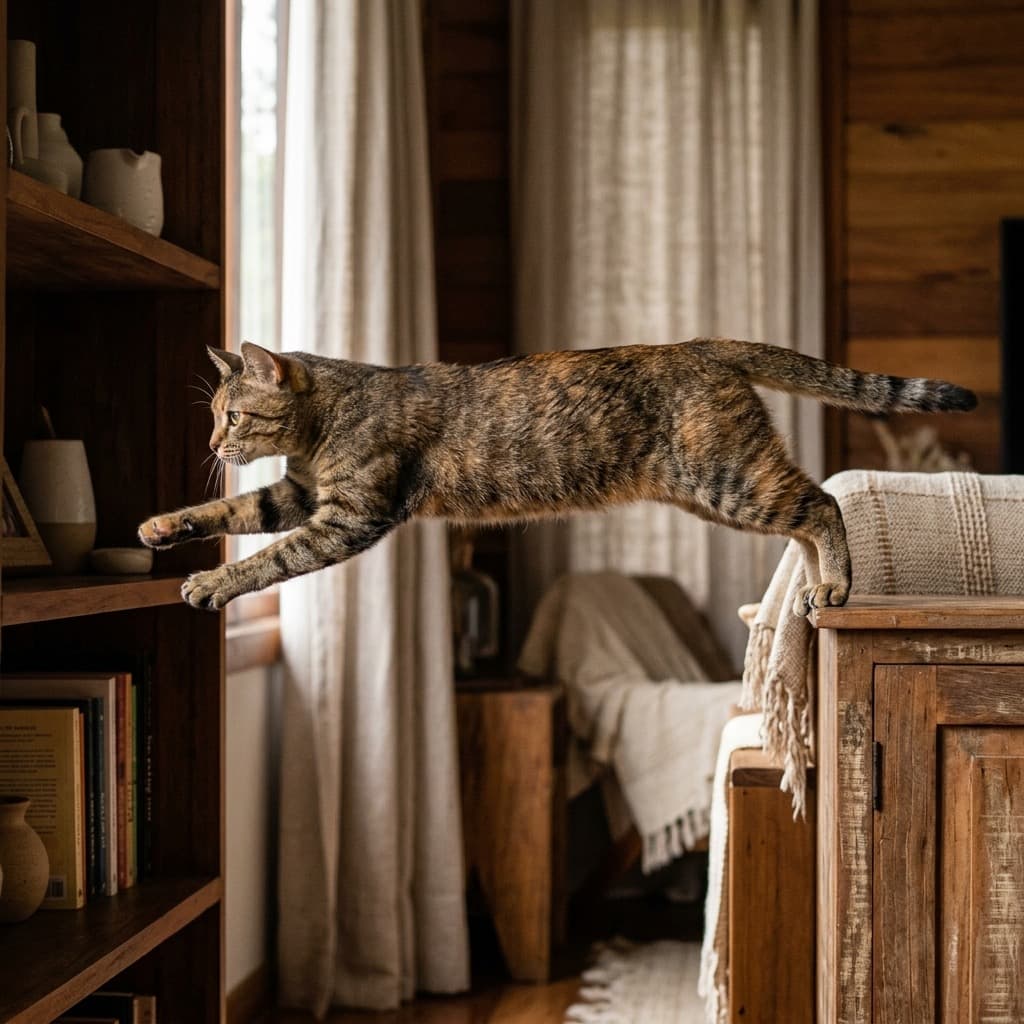
He always climbed the bookshelf to watch the street, slept on top of the cabinet, and jumped onto the fridge without a second thought. For a while now, he stays on the floor. The most repeated explanation out there is that he "got lazy" with age. In most cases, that is not it.
Climbing high places is instinct, not whim
A cat does not climb furniture by accident. A high place is an observation post — from there it sees who comes in, who goes out, where the dog of the house is, where the food is. It is also a safety zone: in feline instinct, up high is where nothing catches you by surprise. A cat that has always sought out this kind of place does not lose that instinct overnight. When it disappears from the top of the cabinet, something has changed — and it is rarely the desire.
Why is a drop in interest usually pain?
The most common cause in adult and senior cats that reduce their jumping is joint pain, mainly osteoarthritis. According to the Merck Veterinary Manual, more than 90% of cats older than 12 years have degenerative joint disease — and the same manual lists, among the clinical signs of joint disease, slowness in getting up, difficulty going up or down stairs, and reduced jumping and play. It is not the cat losing interest in high places. It is the knee, the hip or the spine charging a price it does not announce out loud.
Why do cats hide pain so well?
Here is the reason for the delayed diagnosis: a dog limps, and the owner notices right away. A cat does not limp obviously — it changes strategy. Instead of showing weakness (which, in its instinct, would be an invitation to become prey), it simply avoids the movement that hurts. It disappears from the shelf, starts jumping onto lower steps, stops chasing the toy with the same enthusiasm. To someone watching from outside, that reads as "he became more of a homebody" or "he matured". To someone who understands the pattern, it is a yellow flag.
3 signs that also point to joint pain
- Hesitation before the jump
- It calculates, backs off, tries again, instead of leaping straight up as it always did.
- A harder or unbalanced landing
- It loses the typical smoothness of a feline landing.
- Grooming less, stiffer when getting up
- Joint pain also reduces the willingness to groom and leaves the body "hard" right after a nap.
None of these signs alone is proof. Together, and combined with the drop in interest in high places, they form a pattern that deserves veterinary evaluation, not just observation at home.
| Observed sign | What it usually indicates |
|---|---|
| Stopped climbing the cabinet, bookshelf or fridge | Joint pain — osteoarthritis is the most common cause in adult and senior cats |
| Hesitates before the jump, backs off and tries again | The cat calculates the movement to avoid the pain, instead of leaping straight up |
| Harder or unbalanced landing | Loss of the typical smoothness of a feline landing |
| Grooming less, stiffer when getting up | Joint pain reduces the willingness to groom and to move |
| Starts jumping onto lower steps | A strategy to avoid the effort that hurts, since the cat does not limp obviously |
What NOT to do
- Do not conclude "he got lazy" without ruling out pain. Laziness does not usually come with hesitation and clumsy landings.
- Do not force the jump to "see if he still can". If there is pain, that only reinforces the association between the movement and the discomfort.
- Do not wait for the condition to get worse before seeing the veterinarian. Joint pain in cats tends to be progressive, and early diagnosis opens more management options.
The silence that hides the pain
A cat that disappears from up high has not lost its taste for watching the world from above. Most of the time, it is the body asking not to have to prove it every day. Noticing the change — and taking it seriously — is what separates "he matured" from a cat that has been suffering in silence for months.
Caring for your cat's body starts at the food bowl, too.
Frequently asked questions
My cat stopped climbing the cabinet. Is it always osteoarthritis?
Not necessarily, but it is the most likely hypothesis in adult and senior cats with no other obvious explanation (new furniture, a move). The safe path is to rule out pain with the veterinarian before assuming it is just a personality change.
Why doesn't my cat limp if it has joint pain?
Limping exposes weakness, and in feline instinct that is a risk. Instead of limping, the cat avoids the movement that hurts — it stops jumping, hesitates before the leap, lands harder. It is a survival strategy, not an absence of pain.
At what age should I start paying attention to this?
Prevalence rises a lot after 10 years, but joint pain can show up earlier in cats with a history of trauma, obesity or certain breeds. A change in behavior at any age is worth observing.
Is there treatment for osteoarthritis in cats?
Yes. Weight management, adjustments to the environment (ramps, a litter box with low sides) and medication under veterinary guidance help reduce pain and restore some mobility. The first step is the diagnosis.
My cat still climbs sometimes. Does that rule out pain?
No. Joint pain tends to vary by day and by effort — it may manage the easy jump and avoid the hard one. A reduction in frequency is already a relevant sign, even without a complete stop.
Picked by score from our overall cat ranking, not by the topic of this article. To get it right for your pet — age, weight, spayed or neutered — take the quiz and get a list made for them. A pet with a diagnosed condition needs a diet prescribed by a veterinarian.



