Cat Not Eating in Hot Weather: When It's Normal vs. Not
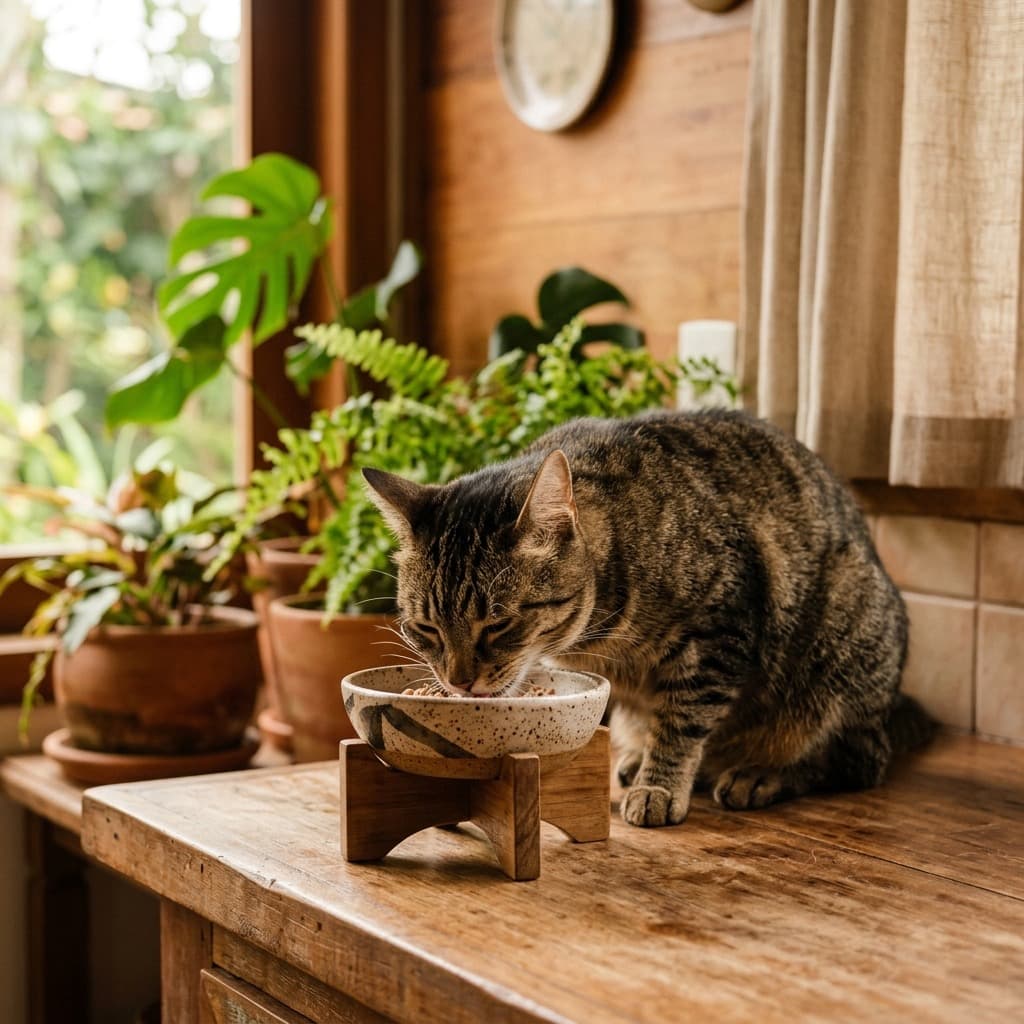
Notice: this content is for information only and does not replace a visit to the veterinarian. If your pet has symptoms, see a veterinarian before acting on this article.
A University of Liverpool study with the Royal Canin Research Centre, which followed 38 cats for four years, showed that they eat about 15% less in summer than in winter — the body prioritizes not generating extra metabolic heat, and digesting protein generates a lot of heat. That is normal physiology. The critical limit is a different matter: according to the Cornell Feline Health Center and the veterinary literature (Merck Veterinary Manual, VCA Hospitals), the risk of hepatic lipidosis (fat buildup in the liver, a veterinary emergency) starts at 48 to 72 hours of near-total anorexia — and overweight cats enter this risk zone more easily, even with short periods without eating.
The practical distinction between normal adaptation to heat and a warning sign depends on three criteria — total time of refusal, the animal's general behavior, and parallel hydration. This article explains each one and what to do in each scenario.
1. The 36-hour safety margin
Cats are not dogs. They do not safely compensate for prolonged fasting by mobilizing fat — the liver becomes overloaded quickly, and the documented medical risk of hepatic lipidosis starts between 48 and 72 hours of near-total anorexia. That is why the practical recommendation is to act earlier: if the cat has eaten less than 50% of the expected portion for a day and a half (36 hours), it is already worth calling the veterinarian — a safety margin before the risk window begins.
How to measure in practice:
- Morning of day 1: you offered 60 g (2.1 oz), it ate 20 g (0.7 oz).
- Evening of day 1: you offered 60 g (2.1 oz), it ate 15 g (0.5 oz).
- Morning of day 2: you offered 60 g (2.1 oz), it ate 10 g (0.4 oz).
- Total in 36 hours: 45 g (1.6 oz) of 180 g (6.3 oz) expected = 25% of normal intake.
In that scenario, call the veterinarian before the end of day 2 — before entering the 48-72 hours window where the risk of hepatic lipidosis becomes real. Hepatic lipidosis starts silently — by the time the signs become visible (yellow eyes, extreme lethargy), the condition is already advanced.
Why heat changes a cat's appetite
Cats are evolutionarily desert animals — but that does not mean they handle intense heat well without adjustments. Their bodies do not sweat the way ours do. They dissipate heat through radiation (finding cool surfaces), minimal evaporation through the paws, and panting (only in extreme situations).
When the ambient temperature rises a lot, the basal metabolism tries not to add internal heat load. Digesting protein generates heat (the thermic effect of digestion). So the cat eats less — especially if the food is dry, which requires chewing and produces more metabolic heat than wet food.
What you will notice:
- It eats more at night or in the early morning, when it cools down.
- It prefers wet food or pouches over dry food.
- It sleeps more during the day, especially in cool spots (bathroom floor, under furniture).
This is normal adaptation, not disease. But it only counts if it goes back to eating during the cooler hours. If it refuses even at night, the problem is not just the heat.
2. Hydration: the mandatory parallel sign
A cat that eats less in the heat needs to drink more — but many owners do not notice that water intake has dropped along with food intake. And then dehydration becomes a trigger for kidney or urinary problems in predisposed cats.
Practical hydration test (does not replace a visit):
- Gently lift the skin at the scruff of the cat's neck.
- Let go.
- If the skin returns to its original position in less than 1 second: normal hydration.
- If it takes 2-3 seconds or stays "tented": dehydration — veterinarian the same day.
If the cat is eating little BUT drinking more water, it is functional adaptation. If it is eating little AND drinking less (or the same), the situation is riskier.
How can you tell if your cat is not eating just because of the heat, or if it's illness?
| It's just the heat | It's NOT just the heat |
|---|---|
| Normal overall behavior (plays at night, responds to you, grooms regularly) | Vomiting, even just once |
| Goes back to eating in the cooler hours (early morning, dawn) | Diarrhea or very dry/hard stools |
| Refusal lasts less than 36 hours in total (sum of all meals) | Apathy even in the cool hours — does not play, does not interact |
| Persistent panting (open mouth for more than 5 min) | |
| Gums very red or very pale |
Any one of these signs + food refusal = immediate veterinarian, regardless of the heat. If the refusal has nothing to do with temperature, also see the 6 most common causes of a cat not wanting to eat its food.
What NOT to do
- Do not force-feed. A stressed cat eats even less — and can develop food aversion.
- Do not offer seasoned human food. Fat, salt and condiments worsen nausea if there is an underlying digestive problem.
- Do not wait for it to "get better on its own" past 48 hours. Hepatic lipidosis does not give a second chance.
- Do not put the bowl in the sun or in a stuffy area. Food heats up, the smell gets stronger (cats hate it), and bacteria multiply.
Frequently asked questions
Can a cat go 24 hours without eating if it's very hot?
Yes — one day of greatly reduced intake due to intense heat is tolerable in healthy adult cats. But if it has not gone back to eating at least 50% of the expected portion within 24 hours (counting all offers of the day), consider intervention. Never let it go past 36 hours.
Wet or dry food in hot weather — which one to offer?
Wet is always better in the heat. It hydrates, is easier to chew (generates less metabolic heat), and the smell is more appealing when fresh. If the cat only eats dry food, lightly moisten it with filtered water before serving — do not make it soggy, just moist enough to reduce the crunch.
Can I put ice in the water or make homemade ice pops?
Do not offer ice directly. Cats rarely lick ice (unlike dogs) and very cold water can cause stomach discomfort. Fresh water (room temperature or slightly chilled) is ideal. Ice pops made from unsalted, unseasoned chicken broth can work as a treat, but they do not replace a meal.
Does air conditioning solve the problem?
Partially. Air conditioning between 22-24°C (72-75°F) improves comfort and reduces food refusal — but it does not eliminate the problem if the cat is already in a fasting pattern for more than 24 hours. Use the air conditioner as a support tool, not as the only solution.
How long does the low-appetite phase last in summer?
In isolated heat waves (3-5 days above 35°C / 95°F), the cat returns to normal when the temperature drops. If the refusal lasts more than a week even with mild weather, it is no longer just the heat — investigate with a veterinarian (it could be dental, kidney, or thyroid).
The bowl that was full this morning now has half a portion eaten — because the cat waited for the house to cool down. You have learned to recognize that. But if tomorrow morning the bowl is still full, you already know: it is no longer adaptation, it is an alert. The line between normal and urgent in the heat is how long the cat takes to go back to eating — and now you have the criterion.
Compare foods side by side in our comparison tool.
Picked by score from our overall cat ranking, not by the topic of this article. To get it right for your pet — age, weight, spayed or neutered — take the quiz and get a list made for them. A pet with a diagnosed condition needs a diet prescribed by a veterinarian.



