Automatic Cat Feeders: What They Actually Solve for You
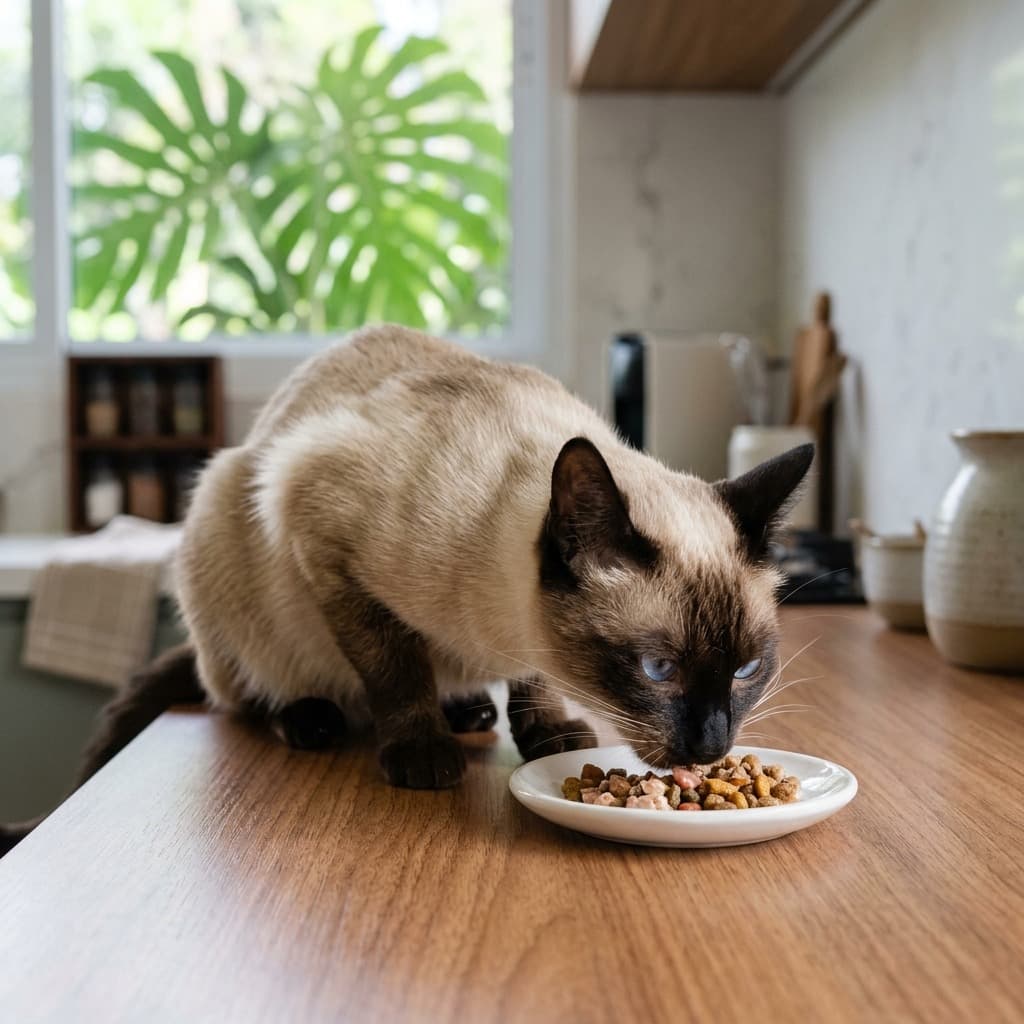
An automatic feeder helps with weight control, but it does not replace choosing the right food: a study published on PMC/NCBI found that 83.2% of cats fed 6 times a day by an automatic feeder reached an ideal body condition score, against 40% of cats fed twice a day by hand. The device solves the when and the how much — it splits portions and reduces begging behavior — but the what is still the owner's decision: a feeder loaded with the wrong high-calorie food still makes the cat gain weight, just in smaller, more frequent portions.
The documented gain did not come from the technology itself but from the splitting: small, frequent meals mimic the cat's natural hunting pattern — a solitary predator that eats several small portions a day, not two large meals the way dogs do.
Does an automatic feeder replace manual portion control?
It replaces the execution, not the decision. An automatic feeder dispenses the amount the owner programmed at the time set — but the right amount in grams still depends on the calories per kilogram declared on the food (kcal/kg) and the cat's target weight, calculated beforehand with a veterinarian or a portion calculator.
Programming a feeder with the wrong amount simply automates the mistake instead of correcting it. The first step is always to calculate the correct daily portion; the feeder only executes that split across the day.
Does an automatic feeder reduce begging behavior?
Yes — the same study showed a drop in behaviors such as standing by the bowl begging, following the owner before a meal, and pawing or scratching for food, compared with the group fed by hand from a fixed bowl. The reduction happens because the cat learns that food arrives at predictable intervals, independent of the owner being present.
That behavioral effect is secondary to the weight gain finding — but it matters in multi-cat homes, where competition over a shared bowl favors the more dominant animal and penalizes the shyer one.
What an automatic feeder solves, and what it does not
| Front | Does the feeder solve it? | Note |
|---|---|---|
| Splitting the portion across several meals | Yes | Study shows 83.2% vs 40% ideal BCS |
| Reducing begging behavior | Yes | Less time waiting at the bowl |
| Separating cats in multi-cat homes | Partly | Microchip-recognition models handle this better than a simple timer |
| Choosing the right food for the profile | No | The nutritional decision remains the owner's |
| Calculating the daily portion in grams | No | Depends on the food's kcal/kg and the cat's target weight |
| Ensuring hydration | No | A feeder is for dry food; a water source is a separate item |
When an automatic feeder is worth it
- Homes with more than one cat, where competition over food favors one animal and leaves another underweight — here, microchip-reading models prevent the wrong cat from eating the other's portion.
- Owners with irregular schedules who currently feed 1-2 large meals and want to split into 4-6 smaller portions without needing to be home.
- Cats on a vet-supervised weight-loss plan, where the daily amount is already calculated and the feeder only has to execute the distribution.
Frequently asked questions
Will an automatic feeder make my cat gain weight if I get the amount wrong?
Yes, exactly as would happen with a manual bowl. The technology automates the distribution, not the correct amount — if the programmed portion is larger than the cat needs, it gains weight in an automated, consistent way, without the owner noticing the daily variation.
Do I need to switch food to use an automatic feeder?
No. The feeder works with any dry food — switching food is an independent decision based on nutritional profile (age, spay/neuter status, health condition), not on the dispensing equipment.
How many meals a day should the feeder be programmed for?
The study compared 2 and 6 daily meals and found no difference in weight-loss speed between the groups — but 6 meals reduced begging behavior more. For healthy cats, 3-4 portions usually balance convenience with the natural hunting pattern.
See the cat food ranking with declared kcal/kg →, or use the cat food comparison tool to place the caloric density of two labels side by side before calculating the portion.
To work out the right portion before programming the feeder, take the nutritional profile quiz.
Picked by score from our overall cat ranking, not by the topic of this article. To get it right for your pet — age, weight, spayed or neutered — take the quiz and get a list made for them. A pet with a diagnosed condition needs a diet prescribed by a veterinarian.



