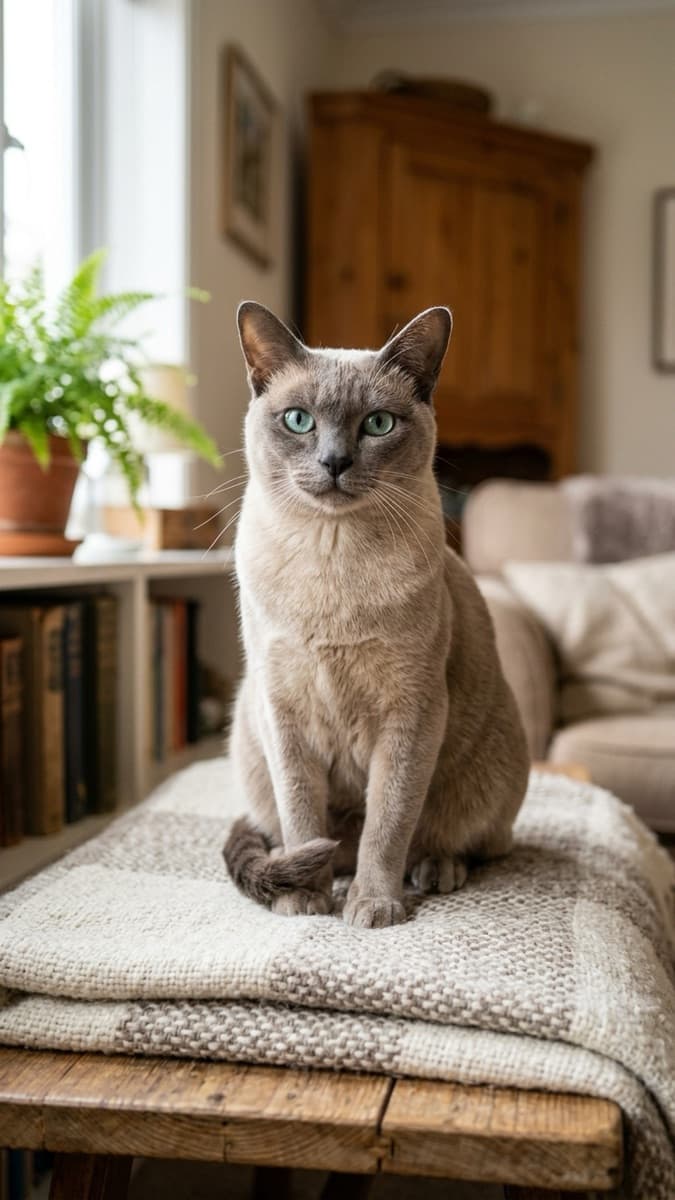
The Tonkinese is a medium-size cat, at 2.5 kg to 5.5 kg as an adult and with high energy. There is no breed-specific documented nutritional predisposition — he is a cross between the Siamese and the Burmese. The food's priority is to follow this active cat's actual energy expenditure, with matching calories and protein.
In the current My Pet Magazine analysis, the best food for the Tonkinese is ACANA Indoor Entrée (ACANA), with a technical score of 87.8/100 (🌟 Superior Quality), calculated with the My Pet Magazine IDNM/IPFI methodology across 50 cat foods reviewed in July 2026. See the full ranking ↓
What to weigh in food for the Tonkinese
With no specific documented health condition, the choice of a Tonkinese's food revolves around the breed's energy level.
High energy. The Tonkinese is the result of crossing the Siamese and the Burmese, and inherits an active temperament from both. AAFCO recommends that the food follow the animal's actual activity level — a formulation designed for a sedentary cat tends to deliver fewer calories than the Tonkinese actually spends day to day.
Variable weight. The breed has a relatively wide weight range for a medium size, from 2.5 kg to 5.5 kg as an adult. The right portion follows each cat's actual weight, calibrated across life, and not a fixed amount defined only by the breed's size category.
Criteria scored against the My Pet Magazine nutritional targets (protein, fat, calcium and caloric density ranges by size — see our methodology).
Breed profile and predispositions
Unlike breeds with a documented nutritional predisposition, the Tonkinese has, in the veterinary literature consulted, no specific health condition consistently associated with diet. What defines the breed nutritionally is temperament: the result of crossing the Siamese and the Burmese, the Tonkinese inherits a high energy level from both.
According to AAFCO — Understanding Pet Food Labels, the feeding instructions on the package are general guidelines that "may need to be adjusted to meet the needs of a specific animal", since individual animals have different activity levels, genetics and environments. For the Tonkinese, that means calibrating the food's caloric density by the cat's actual energy expenditure — which tends to be higher than that of a sedentary medium-size cat — and by individual weight, which ranges from 2.5 kg to 5.5 kg in the breed.
Recommended foods for the Tonkinese
Ranked by IDNM/IPFI technical score across 50 cat foods — no manual product curation.
- 1
ACANA Indoor Entrée · ACANA
87.8/100 - 2
Purina Pro Plan Sensitive Skin & Stomach · Purina Pro Plan
86.5/100 - 3
BLUE Wilderness Adult Indoor · Blue Buffalo
86/100 - 4
Nulo Freestyle Cat & Kitten · Nulo
85.8/100 - 5
Tiki Cat Born Carnivore Indoor Health · Tiki Cat
85.8/100
Frequently asked questions about Tonkinese food
- Does the Tonkinese need a special food?
- There is no breed-specific health condition documented in the veterinary literature that requires a differentiated food. The Tonkinese's point of attention is another: he is an active cat, the result of crossing the Siamese and the Burmese, so the food needs to follow that energy expenditure — not a generic table for a sedentary medium-size cat.
- Why does the Tonkinese need more calories than a more sedate cat?
- Because the breed has high energy, inherited from both the Siamese and the Burmese. AAFCO recommends calibrating the food's caloric density by the cat's actual activity level — an active Tonkinese spends more energy than a sedentary cat of the same weight, and the food needs to reflect that.
- Does the Tonkinese's weight vary a lot between individuals?
- It does — from 2.5 kg to 5.5 kg as an adult, a relatively wide range for a medium-size cat. That is why the right portion follows each cat's actual weight, not a fixed amount defined by breed alone.
- How do I know the right portion for my Tonkinese?
- By weighing the cat and observing his body over time, with attention to his actual activity level — not by age or by the volume of the bowl. It is worth talking to the veterinarian about that individual's ideal weight, considering that the breed tends to be more active than average.
- Is food for active cats different from ordinary food?
- The difference that matters is caloric and protein density matched to the cat's energy expenditure, not a breed-exclusive formula. A Tonkinese does well on a food formulated for cats in general, as long as the amount and the calorie profile follow his actual activity level.
Methodology
The block of recommended foods on this page is ordered by My Pet Magazine's IDNM/IPFI technical methodology, which evaluates the nutritional density and ingredient purity of each product in the active dataset for the Tonkinese's medium-size profile — with no manual curation or brand influence.
The score takes into account how well the food fits the breed profile: caloric and protein density compatible with the high energy level are factors that weigh in the ranking, recalculated whenever the product dataset is updated.
The ranking on this page is a projection of the My Pet Magazine IDNM/IPFI scoring engine over the cat dataset, with no manual product curation. See the full methodology →
Want a recommendation tailored to your Tonkinese?