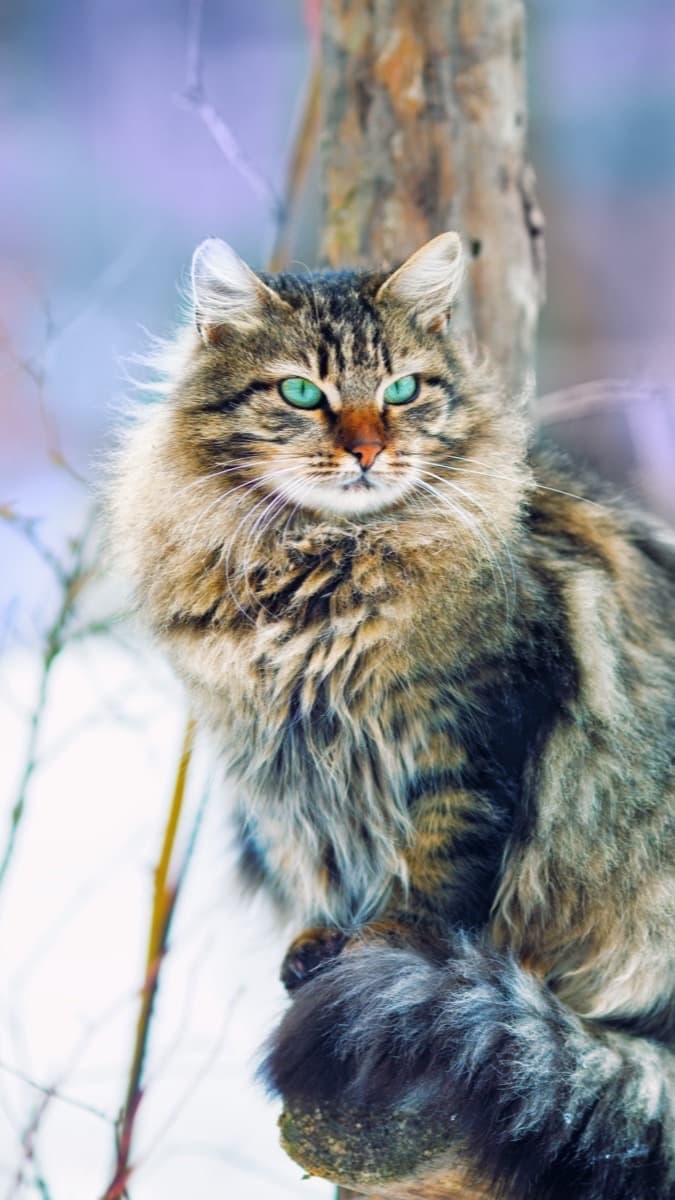
The Siberian is a large cat, from 4.5 kg to 9 kg, with medium energy and a triple, semi-long coat. Frequent grooming of that dense coat favors hairball (trichobezoar) formation, the breed's main nutritional point of attention. Functional fiber in the food helps swallowed hair pass through the intestine instead of accumulating.
In the current My Pet Magazine analysis, the best food for the Siberian is ACANA Indoor Entrée (ACANA), with a technical score of 87.8/100 (🌟 Superior Quality), calculated with the My Pet Magazine IDNM/IPFI methodology across 50 cat foods reviewed in July 2026. See the full ranking ↓
What to weigh in food for the Siberian
Two things weigh in the choice of a Siberian's food: fiber and a portion calibrated by actual weight.
Hairballs under control. The Siberian has a triple coat — a protective outer layer, an intermediate one and a dense undercoat — and grooms himself a great deal to look after it. All that swallowed loose hair can build up in the intestine and form a trichobezoar. Soluble and insoluble fiber in the food help the hair continue on its way through the digestive tract instead of stopping in there. It is the breed's most relevant specific nutritional care point.
Portion by actual weight. The Siberian has a wide adult weight range, from 4.5 kg to 9 kg, and medium energy. There is no fixed portion just because he is considered a large cat — the right adjustment follows the cat's individual weight and actual activity level, calibrated across life, not by the breed category.
Criteria scored against the My Pet Magazine nutritional targets (protein, fat, calcium and caloric density ranges by size — see our methodology).
Breed profile and predispositions
The Siberian has a triple, semi-long, dense coat, which requires frequent grooming to keep the hair in order. According to VCA Animal Hospitals — Trichobezoars in Cats, hair swallowed during that grooming can build up in the gastrointestinal tract and form trichobezoars, a condition that in more accumulated cases can even require veterinary intervention. In practice, that points to a direct nutritional care point: functional fiber in the food, which helps swallowed hair pass through the intestine instead of accumulating.
The breed is also one of the largest domestic cats, with adult weight ranging from 4.5 kg to 9 kg — a wider range than that of a medium-size cat. According to AAFCO — Selecting the Right Pet Food, the food portion should follow each animal's actual weight and activity level, and not a fixed value defined by breed alone — relevant in the Siberian precisely because of the breadth of weight the breed can reach.
Recommended foods for the Siberian
Ranked by IDNM/IPFI technical score across 50 cat foods — no manual product curation.
- 1
ACANA Indoor Entrée · ACANA
87.8/100 - 2
Purina Pro Plan Sensitive Skin & Stomach · Purina Pro Plan
86.5/100 - 3
BLUE Wilderness Adult Indoor · Blue Buffalo
86/100 - 4
Nulo Freestyle Cat & Kitten · Nulo
85.8/100 - 5
Tiki Cat Born Carnivore Indoor Health · Tiki Cat
85.8/100
Frequently asked questions about Siberian food
- Why does the Siberian form hairballs more than a short-haired cat?
- Because he has a triple, semi-long, dense coat, and he grooms himself a great deal to look after it. According to VCA Animal Hospitals, loose hair swallowed during grooming can build up in the intestine and become a hairball (trichobezoar). Fiber in the food helps that hair pass through the digestive tract instead of getting stuck.
- Does fiber in the food really help control hairballs in the Siberian?
- It helps. VCA Animal Hospitals explains that a food with more fiber pushes swallowed hair through the intestine, reducing the risk of build-up. It does not replace regular brushing, but it is a relevant factor when choosing food for a cat with a triple coat like the Siberian.
- Does the Siberian, being a large cat, need more calories than a medium-size cat?
- It needs to be calibrated by the animal's actual weight, not by breed alone. The Siberian ranges from 4.5 kg to 9 kg as an adult, a wide range, and AAFCO recommends adjusting the food to the cat's individual weight and activity level — there is no fixed amount just because he is a large breed.
- Does every Siberian have a coat thick enough to justify concern about hairballs?
- The triple, semi-long coat is characteristic of the breed, present in most individuals, even with some variation in density between cats. That is enough, according to VCA Animal Hospitals, to keep functional fiber as a nutritional care point of attention in the Siberian, regardless of individual coat variation.
- Does dry food help or hinder hairball control in the Siberian?
- What controls hairballs is the fiber composition of the food, not the dry or wet format. A dry food formulated with adequate functional fiber has the same effect of helping hair pass through the intestine as a wet formulation with the same nutritional profile.
Methodology
The block of recommended foods on this page is ordered by My Pet Magazine's IDNM/IPFI technical methodology, which evaluates the nutritional density and ingredient purity of each product in the active dataset for the Siberian's large-size profile — with no manual curation or brand influence.
The score takes into account how well the food fits the breed profile: the presence of functional fiber compatible with hairball control and caloric density adjusted to the large size are factors that weigh in the ranking, recalculated whenever the product dataset is updated.
The ranking on this page is a projection of the My Pet Magazine IDNM/IPFI scoring engine over the cat dataset, with no manual product curation. See the full methodology →
Want a recommendation tailored to your Siberian?