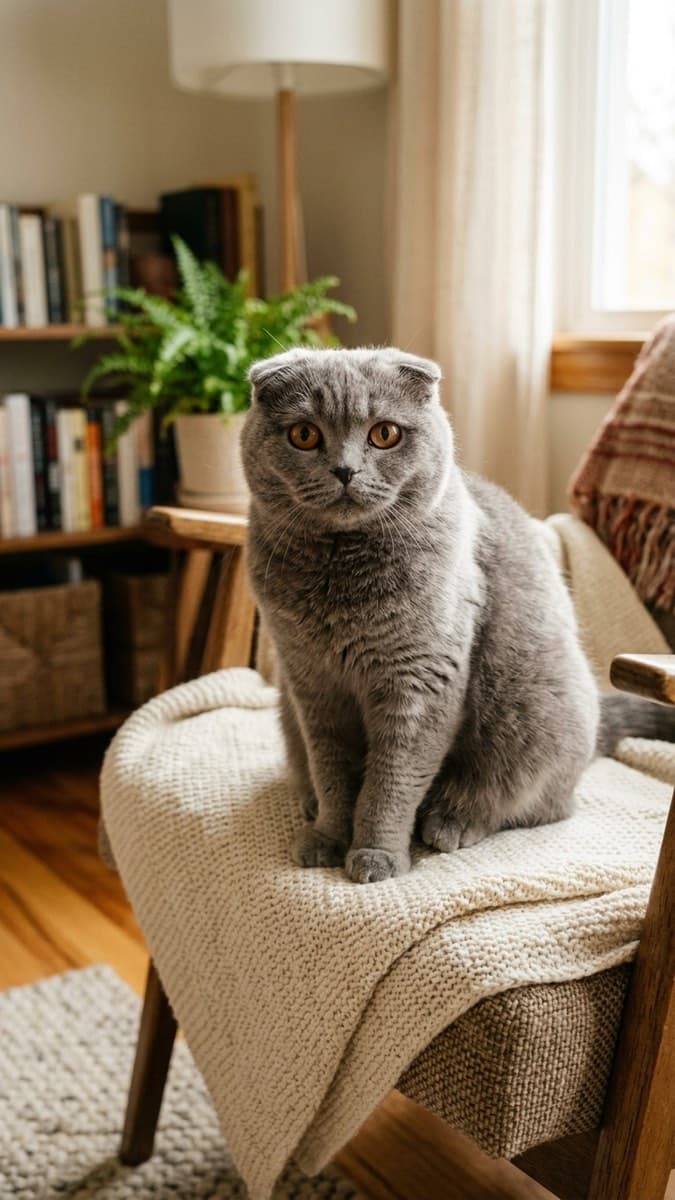
The Scottish Fold weighs between 3 kg and 6 kg, with moderate energy. The breed's folded ear comes from a genetic mutation (TRPV4) that also affects joint cartilage — osteochondrodysplasia documented in a 1999 study. Food does not treat the genetic defect, but weight control reduces joint load, and EPA/DHA with chondroprotectives give extra support.
In the current My Pet Magazine analysis, the best food for the Scottish Fold is ACANA Indoor Entrée (ACANA), with a technical score of 88.9/100 (🌟 Superior Quality), calculated with the My Pet Magazine IDNM/IPFI methodology across 50 cat foods reviewed in July 2026. See the full ranking ↓
What to weigh in food for the Scottish Fold
Two things guide the choice of a Scottish Fold's food: joint support and weight control.
Joints. The genetic mutation that folds the Scottish Fold's ear also compromises cartilage formation in other parts of the body, mainly in the distal limbs and the tail. It is a structural defect, not a problem food causes or resolves. What food can do is provide support: EPA/DHA and chondroprotectives (such as glucosamine and chondroitin) help maintain joint function across the cat's life.
Body weight. Since the cartilage is already more fragile from birth in this breed, every extra kilo becomes added load on joints that have less margin of safety. Keeping the food's caloric density adjusted to the cat's ideal weight — without excess — is the most direct way to reduce that mechanical pressure day to day.
Criteria scored against the My Pet Magazine nutritional targets (protein, fat, calcium and caloric density ranges by size — see our methodology).
Breed profile and predispositions
The Scottish Fold carries a well-documented predisposition, arising from the very feature that gives the breed its name.
A study published in the Australian Veterinary Journal (Malik et al., 1999) — Osteochondrodysplasia in Scottish Fold cats, indexed in PubMed, assessed thirteen Scottish Fold cats and associated the genetic mutation responsible for the folded ear (a variant of the TRPV4 gene) with a defect in cartilage maturation that extends to the joints of the distal limbs and to the tail, causing progressive degenerative joint disease. Food does not treat the mutation — what it does is provide support: weight control reduces the load on more fragile joints, and EPA/DHA with chondroprotectives assist joint function across the cat's life.
Recommended foods for the Scottish Fold
Ranked by IDNM/IPFI technical score across 50 cat foods — no manual product curation.
- 1
ACANA Indoor Entrée · ACANA
88.9/100 - 2
Nulo Freestyle Cat & Kitten · Nulo
86.9/100 - 3
Purina Pro Plan Sensitive Skin & Stomach · Purina Pro Plan
86.5/100 - 4
Tiki Cat Born Carnivore · Tiki Cat
86/100 - 5
BLUE Wilderness Adult Indoor · Blue Buffalo
86/100
Frequently asked questions about Scottish Fold food
- Why does the Scottish Fold have folded ears and what does that have to do with the joints?
- The folded ear comes from a genetic mutation in the TRPV4 gene, which affects cartilage formation throughout the cat's body — not only in the ear. A study published in the Australian Veterinary Journal (Malik et al., 1999) documented that the same mutation compromises the cartilage of the joints of the distal limbs and the tail, causing degenerative joint disease. The folded ear is the visible sign of a problem that goes beyond it.
- Can the Scottish Fold's osteochondrodysplasia be treated or prevented through food?
- No. It is a genetic cartilage defect, and no food changes the cat's genetic structure. What the diet does is provide support: controlling weight reduces the load on joints that are already more fragile from birth, and EPA/DHA with chondroprotectives help maintain joint function — but they do not reverse the underlying defect.
- Does every Scottish Fold develop joint problems?
- The study by Malik et al. (1999) documented the condition in cats that already showed clinical signs — lameness, reluctance to jump, a stiff gait — and also found it through radiographic screening in cats with no apparent symptoms. Severity varies between individuals, but the mutation associated with the folded ear carries that joint risk documented in the veterinary literature.
- Does the Scottish Straight (straight ear) also have that joint risk?
- Not in the same way. The Scottish Straight is a distinct breed, with straight ears, and does not carry the documented joint predisposition that accompanies the Scottish Fold's folded-ear mutation. They are related lines, but with different risk profiles.
- How does weight control help a Scottish Fold with a joint predisposition?
- Every extra kilo is added load on joints that, in the Scottish Fold, already have more fragile cartilage of genetic origin. Keeping the weight within the ideal range — the breed usually weighs between 3 kg and 6 kg — is one of the few variables the owner controls directly to reduce joint discomfort across the cat's life.
Methodology
The block of recommended foods on this page is ordered by My Pet Magazine's IDNM/IPFI technical score, which evaluates the nutritional quality and ingredient purity of every product available for the Scottish Fold's medium-size profile. The order is calculated automatically and updated whenever the catalog changes — no brand pays to appear, and there is no manual product selection.
The ranking on this page is a projection of the My Pet Magazine IDNM/IPFI scoring engine over the cat dataset, with no manual product curation. See the full methodology →
Want a recommendation tailored to your Scottish Fold?