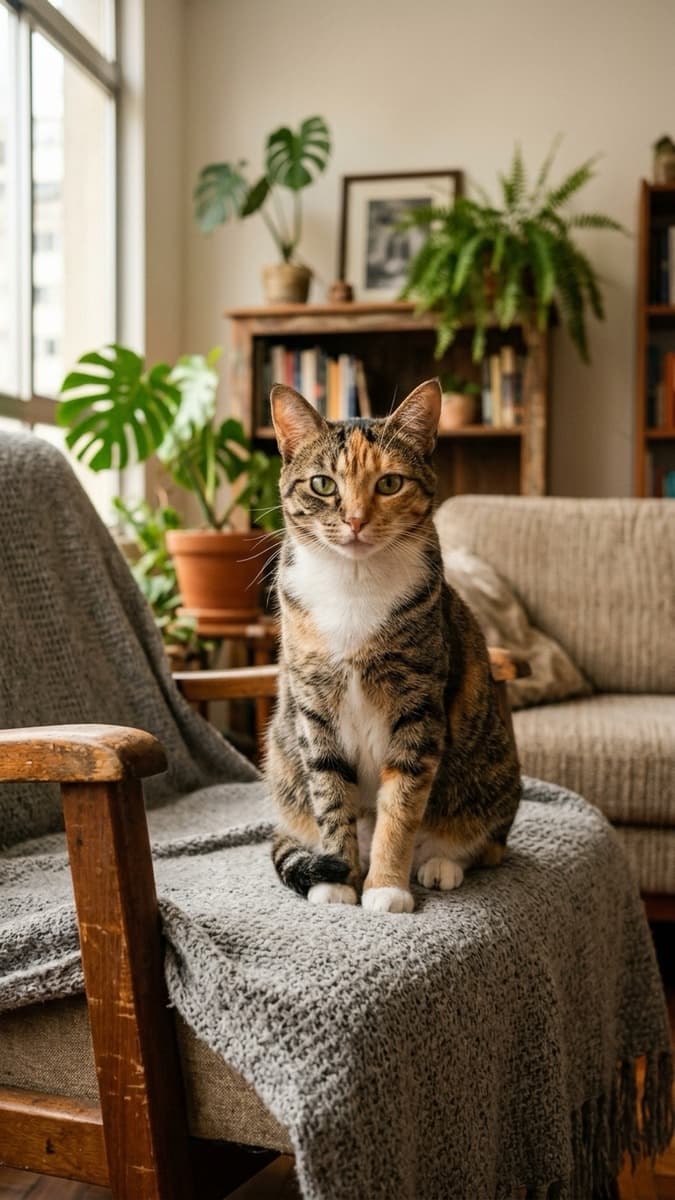
The mixed-breed cat weighs between 3.5 kg and 6 kg and has moderate energy. Two things weigh in the choice of food: he gains weight easily when he lives only indoors, because he moves less, and he has an elevated risk of urinary problems (FLUTD). Controlling calories and getting the cat to drink more water are the priorities.
In the current My Pet Magazine analysis, the best food for the Domestic Shorthair (Mixed Breed) is Purina Pro Plan Weight Management (Purina Pro Plan), with a technical score of 83.4/100 (⭐ High Standard), calculated with the My Pet Magazine IDNM/IPFI methodology across 50 cat foods reviewed in July 2026. See the full ranking ↓
What to weigh in food for the Domestic Shorthair (Mixed Breed)
Weight and a sedentary life. A mixed-breed cat who lives only at home moves less — no hunting, no exploring — and energy expenditure drops. The same amount of food becomes extra weight. A food with fewer calories per portion, with fiber that holds back hunger (such as beet pulp or pea fiber), helps control weight without leaving the cat hungry.
Urinary tract. The mixed-breed cat has an elevated risk of FLUTD, an umbrella name for various problems in the bladder and urethra — stones, inflammation, pain when urinating. Most cases have no clear cause, but drinking little water and concentrated urine increase the risk. Two things help: controlled minerals in the food (magnesium and phosphorus, which form crystals in excess) and encouragement to drink more water — whether with wet food or with water bowls spread around the house.
Food format. What really matters for urinary health is how much water the cat drinks in total, not whether the food is dry or wet. Wet food already comes with water built in. Dry food works too, as long as the cat is encouraged to drink — several water points in the house help.
Criteria scored against the My Pet Magazine nutritional targets (protein, fat, calcium and caloric density ranges by size — see our methodology).
Breed profile and predispositions
The mixed-breed cat tends to gain weight when he lives only indoors, because the sedentary nature of indoor life reduces energy expenditure. According to the AAFCO Cat Food Nutrient Profiles, which define the reference nutritional parameters for cat food, the answer is to reduce the diet's caloric density and add functional fiber, which holds back hunger without cutting the volume of the meal.
Mixed-breed cats also carry an elevated risk of feline lower urinary tract disease (FLUTD), linked to factors such as little water and concentrated urine. According to the Merck Veterinary Manual — Lower Urinary Tract Disease in Cats, the nutritional response is to encourage water intake — through wet food or a formulation that favors greater consumption — and to control the minerals that form crystals in the urine.
Recommended foods for the Domestic Shorthair (Mixed Breed)
Ranked by IDNM/IPFI technical score across 50 cat foods — no manual product curation.
- 1
Purina Pro Plan Weight Management · Purina Pro Plan
83.4/100 - 2
Blue Buffalo Wilderness Kitten · Blue Buffalo
82.7/100 - 3
Purina ONE +Plus Ideal Weight · Purina ONE
82.3/100 - 4
Instinct Original Raw Coated Cat · Instinct
82.1/100 - 5
Hill's Science Diet Perfect Weight Cat · Hill's Science Diet
81.6/100
Frequently asked questions about Domestic Shorthair (Mixed Breed) food
- Why does a mixed-breed cat gain weight easily when he lives only indoors?
- Because he moves less. Life indoors, with no hunting or exploring, reduces energy expenditure — and then the same amount of food becomes extra weight. The answer, according to AAFCO, is a food with fewer calories per portion and fiber that holds back hunger without filling the bowl with extra food.
- What is this FLUTD and does it have anything to do with mixed-breed cats?
- FLUTD is an umbrella name for various problems in a cat's bladder and urethra — stones, inflammation, pain when urinating. According to the Merck Veterinary Manual, most cases have no clear cause, but drinking little water and concentrated urine increase the risk. That applies to any cat, with extra attention for mixed-breed cats.
- Is dry or wet food better for avoiding urinary problems?
- What really matters is how much water the cat drinks in total, not the format of the bowl. Wet food already comes with plenty of water and helps the cat drink more without noticing. Dry food works too, as long as it is formulated to encourage thirst, with water spread across several points in the house.
- Does a mixed-breed cat need different food from a purebred cat?
- Not because of genetics — the mixed-breed cat does not carry a documented line predisposition. But he usually shares two risks common to any cat with the same lifestyle: gaining weight in a closed house and having urinary problems. What governs the choice of food is the cat's profile — weight, activity, environment — not the pedigree.
- Does every mixed-breed cat need strict calorie control?
- Not necessarily. Their energy is considered moderate, and the risk of gaining weight comes from a sedentary life, not from genetics. A mixed-breed cat who moves around and has day-to-day stimulation needs far less strictness in the portion than a sedate cat inside a small apartment.
Methodology
The block of recommended foods on this page is ordered by My Pet Magazine's IDNM/IPFI technical score, which evaluates the nutritional quality and ingredient purity of every product available for the mixed-breed cat's medium-size profile. The order is calculated automatically and updated whenever the catalog changes — no brand pays to appear, and there is no manual product selection.
The ranking on this page is a projection of the My Pet Magazine IDNM/IPFI scoring engine over the cat dataset, with no manual product curation. See the full methodology →
Want a recommendation tailored to your Domestic Shorthair (Mixed Breed)?