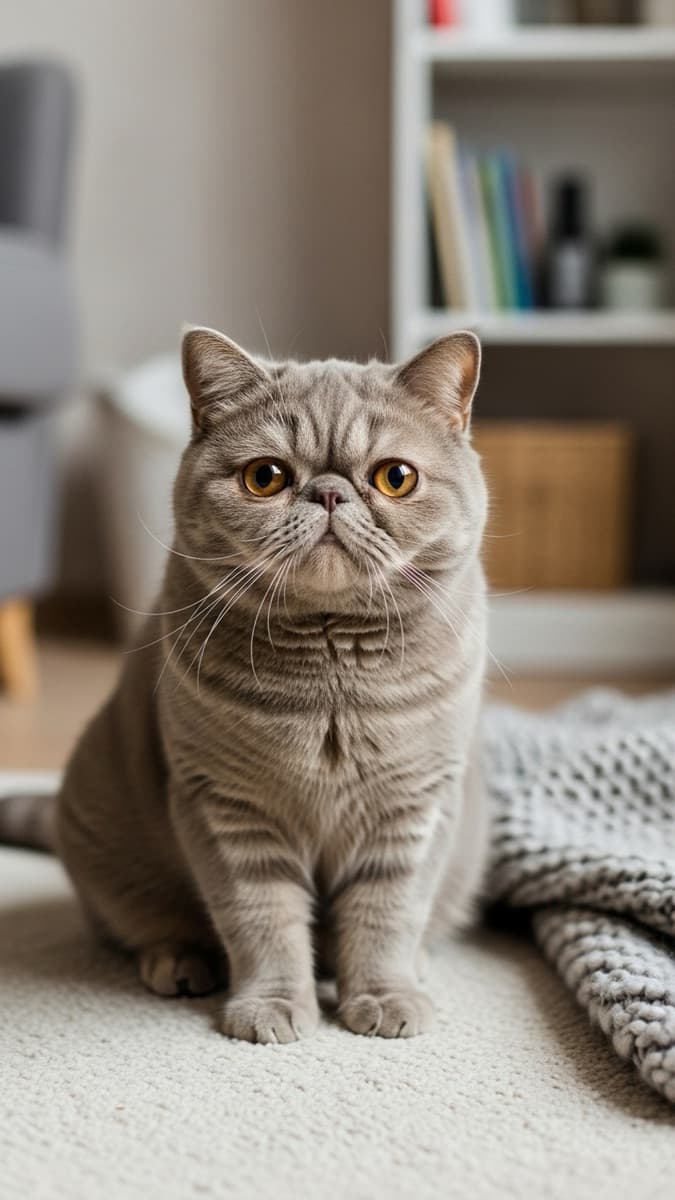
The Exotic Shorthair weighs between 3 kg and 6 kg, is medium in size and low in energy, with a flat face — the same brachycephalic conformation as the Persian. A 2021 study found moderate to severe stenotic nares in 86% of the Persians and Exotics assessed together. The breed also inherits renal risk through genetic kinship with the Persian. Kibble and controlled phosphorus are priorities.
In the current My Pet Magazine analysis, the best food for the Exotic Shorthair is ACANA Indoor Entrée (ACANA), with a technical score of 85.9/100 (🌟 Superior Quality), calculated with the My Pet Magazine IDNM/IPFI methodology across 50 cat foods reviewed in July 2026. See the full ranking ↓
What to weigh in food for the Exotic Shorthair
Two things weigh most in the Exotic's food, and both come from the genetic kinship with the Persian: the shape of the face and the kidney.
Flat face. The Exotic has the same brachycephalic conformation as the Persian — a short, flattened muzzle. According to a study published in the Journal of Feline Medicine and Surgery (Anagrius et al., 2021), 86% of the Persian and Exotic Shorthair cats assessed together showed moderate to severe stenotic nares. Larger kibble, with a geometry designed for that face, makes it easier to pick up the food and reduces the cat's effort in eating.
Kidney. The Exotic is genetically a short-haired version of the Persian — the Cat Fanciers' Association (CFA) today permits only crossing with the Persian for the breed. Through that kinship, the Exotic inherits the same predisposition to polycystic kidney disease (PKD) documented in Persians by the Merck Veterinary Manual — a hereditary mutation that can make the kidneys enlarge through the formation of multiple cysts. Controlled phosphorus in the food works as preventive support for kidney function.
Criteria scored against the My Pet Magazine nutritional targets (protein, fat, calcium and caloric density ranges by size — see our methodology).
Breed profile and predispositions
The Exotic is, genetically, a short-haired Persian. The Cat Fanciers' Association (CFA) — Exotic Breed Article describes how, since 1990, the Exotic's official standard was realigned to be identical to the Persian's, except for the coat description, and how the association has formally recognized that "the Exotic was, in fact, a Persian". Today the only permitted outcross for the breed is with the Persian itself. That genetic proximity explains why the Exotic shares the same documented predispositions as the Persian.
The first is the brachycephalic conformation. A study published in the Journal of Feline Medicine and Surgery (Anagrius et al., 2021) assessed 76 show cats — 64 Persians and 12 Exotics — and found moderate to severe stenotic nares in 86% of the group; the authors analyzed the two breeds together, without separating results by type. In practice, that calls for an adapted kibble shape, which makes it easier for a flat face like the Exotic's to pick up the food.
The second is the predisposition to polycystic kidney disease (PKD), an autosomal dominant inherited condition. The Merck Veterinary Manual — Congenital and Inherited Disorders of the Urinary System of Cats documents the condition in Persian cats and domestic longhair cats, with the kidneys potentially enlarging through the formation of multiple cysts. Since the Exotic is genetically a Persian — and the only outcross permitted by the CFA is precisely with Persians — the same hereditary predisposition extends to the breed. Controlling the phosphorus content of the diet works as preventive support for kidney function.
Recommended foods for the Exotic Shorthair
Ranked by IDNM/IPFI technical score across 50 cat foods — no manual product curation.
- 1
ACANA Indoor Entrée · ACANA
85.9/100 - 2
Purina Pro Plan Sensitive Skin & Stomach · Purina Pro Plan
85/100 - 3
Nulo Freestyle Cat & Kitten · Nulo
84.9/100 - 4
BLUE Wilderness Adult Indoor · Blue Buffalo
84.2/100 - 5
Tiki Cat Born Carnivore Indoor Health · Tiki Cat
84/100
Frequently asked questions about Exotic Shorthair food
- Why does the Exotic Shorthair have the same muzzle problem as the Persian?
- Because, genetically, the Exotic is a short-haired Persian. The Cat Fanciers' Association (CFA) aligned the Exotic's official standard with the Persian's back in 1990, changing only the coat description. A 2021 study in the Journal of Feline Medicine and Surgery found moderate to severe stenotic nares in 86% of the Persians and Exotics assessed together.
- Is the Exotic Shorthair really at risk of polycystic kidney disease?
- The Merck Veterinary Manual documents polycystic kidney disease (PKD) as a hereditary condition in Persian cats and domestic longhair cats. Since the Exotic is genetically a Persian — the CFA today only permits crossing the breed with Persians — the same inherited predisposition extends to it.
- Does food treat or prevent the Exotic Shorthair's polycystic kidney disease?
- No. The cause is genetic and inherited, and no food changes that. What the diet does is provide preventive support: controlling the phosphorus content helps kidney function, especially relevant in a breed with that predisposition documented through kinship with the Persian.
- Does every Exotic Shorthair have stenotic nares?
- Not necessarily to a severe degree. The study by Anagrius et al. (2021) assessed Persians and Exotics together, without separating results by breed, and found the moderate to severe picture in 86% of the group — which still leaves a share with normal or only slightly narrowed nostrils. Even so, adapted kibble shape makes feeding easier for most individuals.
- Why does kibble shape matter so much for the Exotic Shorthair?
- Because the flat face — the brachycephalic conformation documented in the breed — makes it hard to pick up small, round kibble. Larger kibble, with a geometry designed for that face, makes biting easier and reduces the cat's effort in eating, the same care that applies to the Persian.
Methodology
The block of recommended foods on this page is ordered by My Pet Magazine's IDNM/IPFI technical methodology, which evaluates the nutritional density and ingredient purity of each product in the active dataset for the Exotic's medium-size profile — with no manual curation or brand influence.
The score takes into account how well the food fits the breed profile: formulas compatible with preventive kidney support and a kibble shape adapted to the flat face are factors that weigh in the ranking, recalculated whenever the product dataset is updated.
The ranking on this page is a projection of the My Pet Magazine IDNM/IPFI scoring engine over the cat dataset, with no manual product curation. See the full methodology →
Want a recommendation tailored to your Exotic Shorthair?