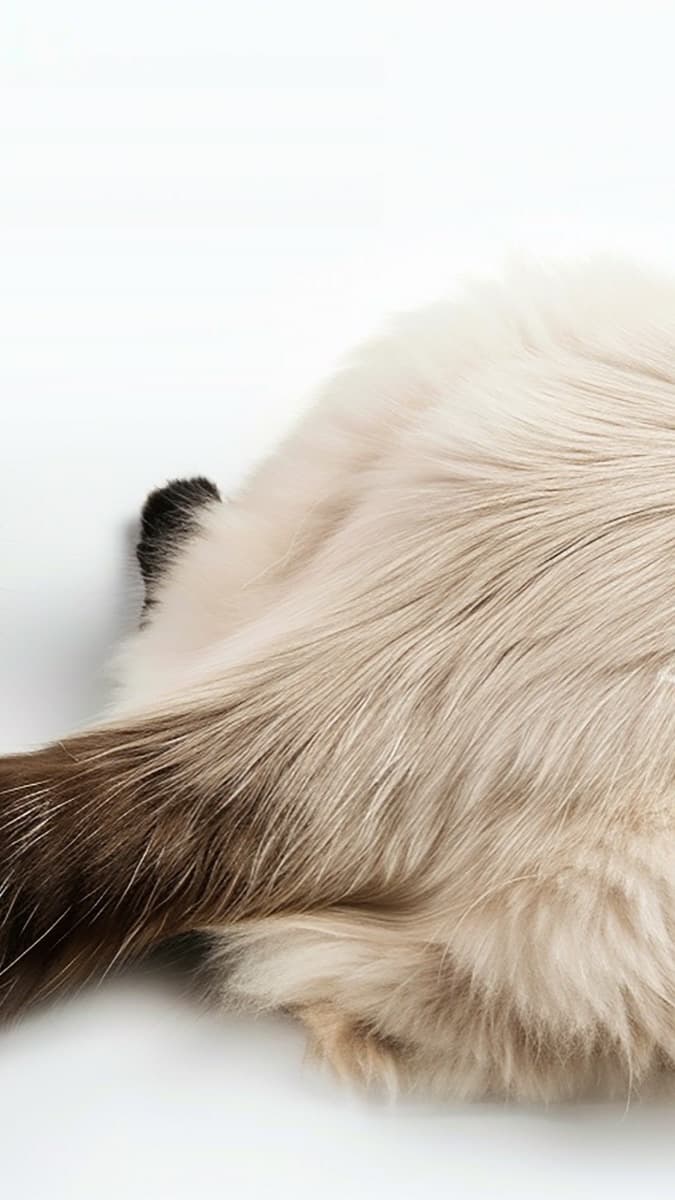
The Balinese weighs between 2.5 kg and 5 kg and has high energy — the semi-long-haired version of the Siamese, lean and athletic. Two things weigh in the food: he forms hairballs easily, even with a silky coat and no dense undercoat, and he has greater energy expenditure than a sedentary cat, typical of the oriental body type.
In the current My Pet Magazine analysis, the best food for the Balinese is Purina Pro Plan Sensitive Skin & Stomach (Purina Pro Plan), with a technical score of 90.5/100 (🌟 Superior Quality), calculated with the My Pet Magazine IDNM/IPFI methodology across 50 cat foods reviewed in July 2026. See the full ranking ↓
What to weigh in food for the Balinese
Two things weigh most in the choice of a Balinese's food: fiber and energy.
Hairballs under control. The Balinese grooms himself like any cat, and the semi-long hair he swallows in that process can build up in the gastrointestinal tract. VCA Animal Hospitals explains that mechanism: soluble and insoluble fiber in the food help push the hair through the intestine instead of letting it accumulate. It is the breed's main specific nutritional care point.
Energy for a lean, active body. The Balinese is of Siamese descent and has the same oriental body type — lean, athletic, with a faster metabolism than that of a sedate house cat. AAFCO recommends that the food follow the animal's actual activity level, not that of a sedentary cat. Protein and caloric density in the right measure sustain that greater energy expenditure.
The two care points do not compete: it is possible to have enough fiber for hairball control without sacrificing the energy the Balinese needs — the right formulation delivers both at the same time.
Criteria scored against the My Pet Magazine nutritional targets (protein, fat, calcium and caloric density ranges by size — see our methodology).
Breed profile and predispositions
The Balinese has a semi-long, silky coat, without the dense undercoat of coarser-haired breeds — but that alone is enough for him to swallow a good deal of hair in daily grooming. According to VCA Animal Hospitals — Trichobezoars in Cats, that swallowed hair can build up in the gastrointestinal tract and form trichobezoars, a condition that sometimes needs veterinary intervention when the build-up obstructs the passage between esophagus, stomach and intestine. In practice, that points to a direct nutritional care point: functional fiber in the food, which helps the hair continue on its way through the intestine instead of accumulating.
The breed is also of the oriental body type — lean, athletic, descended from the Siamese. According to AAFCO — Selecting the Right Pet Food, the food needs to reflect the animal's activity level — a formulation designed for a sedentary cat tends to have fewer calories than the Balinese actually spends.
Recommended foods for the Balinese
Ranked by IDNM/IPFI technical score across 50 cat foods — no manual product curation.
- 1
Purina Pro Plan Sensitive Skin & Stomach · Purina Pro Plan
90.5/100 - 2
Nulo Freestyle Cat & Kitten · Nulo
90.1/100 - 3
Instinct Original Raw Coated Cat · Instinct
89.9/100 - 4
Tiki Cat Born Carnivore · Tiki Cat
89.9/100 - 5
Blue Buffalo Wilderness Kitten · Blue Buffalo
89.6/100
Frequently asked questions about Balinese food
- Why does the Balinese form hairballs even with a finer coat than other long-haired breeds?
- Because the Balinese's coat, though silky and without a dense undercoat, is still long enough to build up during grooming. According to VCA Animal Hospitals, swallowed hair can accumulate in the gastrointestinal tract and form trichobezoars — the mechanism applies to any cat who grooms, regardless of coat density.
- Does fiber in the food help control hairballs in the Balinese?
- It does. VCA Animal Hospitals shows that a food with more fiber pushes swallowed hair through the intestine, reducing the risk of build-up. It does not replace regular brushing, but it is a point in favor when choosing the food.
- Does the Balinese need more protein and calories because he is an oriental-type cat?
- Yes. It is a lean, active breed of Siamese descent, with greater energy expenditure than a sedentary house cat. According to AAFCO, the food needs to follow the animal's actual activity level, and for the Balinese that means protein and caloric density matched to that body type.
- Is every Balinese lean and in need of high-energy food?
- The breed's body type — oriental, lean — is consistent in the standard's description, but each cat's actual energy varies with age, neutering and lifestyle. The reference is to adjust the food to the activity level observed in the animal, not to presume the same calorie expenditure for every individual.
- Does the Balinese need different food from the Siamese because of the longer coat?
- The longer coat changes one specific care point — hairball formation, which calls for functional fiber. Beyond that, the Balinese shares the same lean, active body type as the Siamese, so the food's energy basis remains similar between the two breeds.
Methodology
The block of recommended foods on this page is ordered by My Pet Magazine's IDNM/IPFI technical methodology, which evaluates the nutritional density and ingredient purity of each product in the active dataset for the Balinese's medium-size profile — with no manual curation or brand influence.
The score takes into account how well the food fits the breed's parameters: the presence of functional fiber compatible with hairball control and protein/caloric density adjusted to the high energy level are factors that weigh in the ranking, recalculated whenever the product dataset is updated.
The ranking on this page is a projection of the My Pet Magazine IDNM/IPFI scoring engine over the cat dataset, with no manual product curation. See the full methodology →
Want a recommendation tailored to your Balinese?